Belgian UFO Wave: The Silent Triangle 2,000 People Reported
Thousands watched a silent triangle glide over Belgium in 1989-90. F-16 radar locked onto it 3 times. The famous photo was a hoax — so what chased those jets?
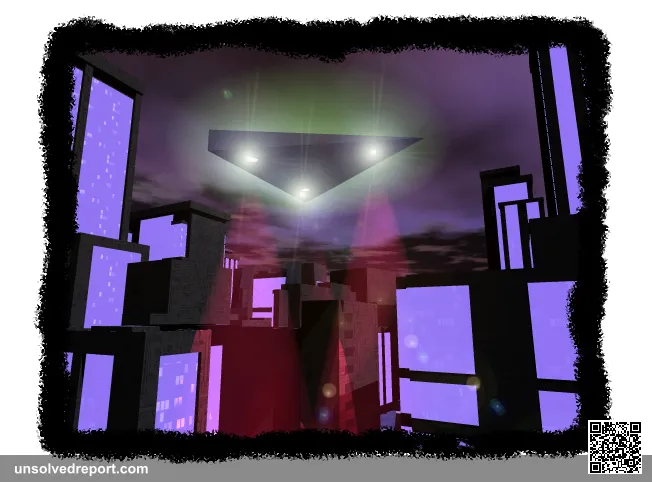
Two cops on a hillside road. A cold November night in 1989, just outside the Belgian town of Eupen. Above them hangs something the size of a building, dead silent, shaped like a triangle. A bright spotlight burns at each of its three corners. A red light pulses in the middle. No engine. No roar. Nothing.
Back at the station, the dispatcher who took their call tried to laugh it off: "It made no noise. We joked about it and said it might be Santa Claus trying to land" (The Week).
The joke didn't last. Over the next five months, thousands of ordinary people, police officers, and even fighter pilots would line up behind those two cops, all swearing they saw the same impossible thing. Belgium still can't fully explain it.
How It Started
It began on the evening of November 29, 1989, near Eupen in eastern Belgium. The two gendarmes who phoned it in were named Heinrich Nicoll and Hubert von Montigny. And they weren't alone, not even close. That same night, by some counts, at least 30 separate groups and three police patrols reported a triangular craft in the same few hours (The Week).
That was just the door swinging open. From late November 1989 all the way through April 1990, the calls kept coming. And here's the eerie part: people kept describing the exact same thing. A large, slow, perfectly silent triangle. White lights at all three corners. The Belgian UFO study group SOBEPS ended up collecting roughly 2,000 written witness statements before the wave was over (The Week).
These weren't a handful of bored teenagers daring each other to lie. Cops. Soldiers. Engineers. Every kind of person you can imagine, all pointing at the same patch of sky.
The Night the Jets Went Up
Now for the big one. March 30–31, 1990.
Ground radar stations caught an unidentified target. Around 11 p.m., the Belgian Air Force scrambled two F-16 fighter jets out of Beauvechain Air Base to go take a look (Wikipedia), the same kind of military scramble that would later play out over Washington in the 1952 radar panic over the capital. For the next hour, the pilots tried nine separate times to close in on it. Three times, their onboard radar actually locked on for a few seconds, and the numbers it spat back were insane: changes in speed and altitude no normal aircraft could survive (Wikipedia).
Sounds like a slam dunk, right? Here's the catch the dramatic retellings love to leave out: the pilots never actually saw a thing with their own eyes. Radar locks, yes. Eyeballs on a craft, no — a gap that echoes Japan Airlines Flight 1628, another radar-backed case the authorities never fully explained.
The man who fronted the whole case was Colonel Wilfried De Brouwer, later a Major General, then the air force's chief of operations. At a packed press conference at the Ministry of Defence on July 11, 1990, he put the F-16 radar images up for the public and picked his words like a man walking on glass: "We cannot explain the nature of the craft, but we are certain it was not a figment of imagination" (OpenMinds.tv).
He'd already chased down the obvious boring answer, too. Figuring it might be a secret American stealth test, he went straight to the U.S. Embassy and asked. The answer: no USAF stealth aircraft were flying in the area at the time (The Week). At least these pilots landed safely — back in 1948, an Air Force pilot chasing a UFO over Kentucky never made it home.
So if it wasn't ours, and it wasn't theirs... whose was it?
The Photo Everybody Knew
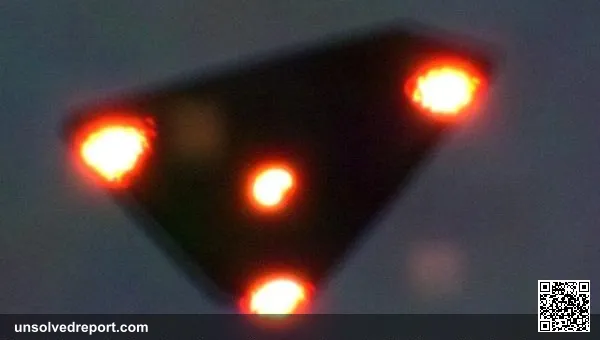
For decades, one picture WAS the Belgian wave. The "Petit-Rechain photograph": a crisp shot of a dark triangle, three glowing corner lights, a soft glow at the center. Taken in April 1990. It ran everywhere.
Then, in 2011, a man named Patrick Maréchal walked into the light and said: I made it up. He built the "craft" out of a panel of painted polystyrene foam with some lights stuck on. In his own words: "We made the model with polystyrene, we painted it, and then we started sticking things to it, then we suspended it in the air... then we took the photo" (The Week; Bad UFOs).
Case closed. Foam and lights. Go home.
Except... not so fast.
Where It Gets Slippery
The hoax confession feels like the end of the story. It isn't. It only kills one photo. It doesn't touch the other 2,000 reports. And believe it or not, even that one photo refuses to stay dead.
Start with the F-16 radar. After picking the data apart, investigators decided those wild radar locks were most likely a known atmospheric trick called Bragg scattering, and that several of the "impossible" returns were actually the two jets accidentally locking onto each other (Wikipedia). Clean debunk, you'd think.
But De Brouwer himself wasn't buying that it explained everything. He pointed out that on at least one occasion, a ground radar and an F-16 radar seemed to pick up the same contact at the same moment, which "weakens the theory that all radar contacts were caused by electromagnetic interference" (OpenMinds.tv). Two different machines, two different places, same blip. That's harder to wave away.
Now back to the photo, because it gets weirder. Maréchal later claimed his 2011 confession was itself staged, saying he'd been paid to call the image a hoax, and that he reportedly couldn't cleanly recreate the picture using the method he'd described (The Week). So now we've got a confessed fake whose confessor then half-took it back. Wonderful.
Strip away the hoaxes, the radar glitches, the honest mistakes. Is there anything left at the bottom? The people who actually swam through all 2,000 reports thought so. SOBEPS investigator Patrick Ferryn said there remained "a residue, which we simply can't explain" (The Week).
What that residue was, more than 35 years later, nobody has proven.
So What Was It?
A secret military aircraft (unproven). The neatest answer: people saw a classified flying-wing or stealth prototype, the silent triangle matching the rough shape of something like a B-2. Tidy. The problem is the United States flatly denied flying any such thing over Belgium, and in 1990 no known aircraft could hover in dead silence or pull the moves some witnesses swore they saw (The Week). A good guess. Not a proven one.
Eyes playing tricks, fed by the headlines (speculation). Skeptics say that once the newspapers printed the first triangle stories, regular lights, planes, and stars all started looking like the same craft, while the jaw-dropping radar numbers came from instrument errors like Bragg scattering (Wikipedia). But notice: De Brouwer flatly rejected the "mass hysteria" label, insisting the witnesses "were sincere and honest" (The Week). A real wave can still be full of honest mistakes. Both things can be true.
Aliens, or something we have no name for (unproven, fringe). The headline version: a genuine alien craft, or an unidentified anomalous phenomenon (UAP). Let's be blunt, because this one matters. There is zero physical proof of extraterrestrial visitors. None. And the single most famous piece of "evidence" the wave ever produced, the Petit-Rechain photo, was confessed as foam and lights. The alien idea rests entirely on eyewitness accounts and that unexplained data residue. No recovered object. No metal in a hangar. It stays firmly in the land of maybe.
The Belgian triangle got photographed, got chased by fighter jets, got half explained away, and STILL nobody can fully say what it was. But here's the thing that should keep you up tonight: this wasn't the only time an entire country looked up and swore it saw the same impossible shape sliding silently overhead, the way hundreds of students and teachers did over an Australian school in 1966. Why do these silent black triangles keep turning up, decade after decade, thousands of miles apart, like the sky is showing the same trick to different audiences?
Sources & Further Reading
- Belgian UFO wave — Wikipedia
- "30 years later, we still don't know what really happened during the Belgian UFO wave" — The Week
- "Belgium's Flying Triangle Wave" — OpenMinds.tv
- "'Classic' UFO Photo from Belgian Wave — the Hoaxer Confesses" — Bad UFOs (Robert Sheaffer)
Betty and Barney Hill: 65 Years On, Still 2 Hours Nobody Can Explain
2 hours missing, a torn dress still in a UNH archive, a star map to Zeta Reticuli later disowned by its own author. What the 1961 Hill case actually proves.
Cash-Landrum Incident 1980: The UFO That Left Real Burns
A Texas grandmother, her friend, and a 7-year-old boy said a fiery UFO surrounded by 23 helicopters made them sick. Decades later, no one has explained why.
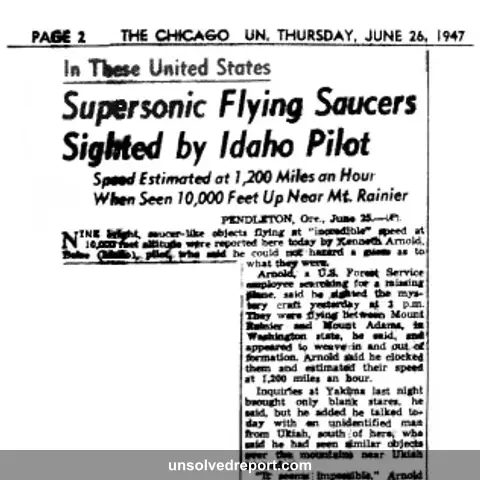
Kenneth Arnold 1947: The Sighting That Named Flying Saucers by Mistake
Pilot Kenneth Arnold clocked nine objects at 1,700 mph over the Cascades — then a reporter's mishearing coined 'flying saucer.' What did he actually see?