Fast Radio Bursts: The Flash With 3 Days of the Sun's Power
A fast radio burst crams 3 days of the Sun's energy into one millisecond, then vanishes. We've caught thousands. So what in the universe is firing them?
Right now, while you read this sentence, a flash of radio waves is hitting the Earth. It will be gone in a few thousandths of a second. In that blink, somewhere out in the dark, a single object just unleashed as much energy as the Sun pours out over three full days. This happens several thousand times a day. We have caught thousands of these flashes. And we still cannot fully say what makes them. That is not a figure of speech — it is the genuine, unsolved puzzle astronomers call the fast radio bursts mystery.
What We Actually Know
Start with the flash itself. A fast radio burst (FRB) is a pulse of radio waves that comes and goes in anything from a sliver of a millisecond to a few seconds — and it is fired off by some high-energy process that, in the flat words of the published literature, is "not yet understood" (Science, 2022). The numbers are almost absurd. In one millisecond, the average FRB throws out as much energy as the Sun radiates in about three days. Yet after that signal has crawled across billions of light-years to reach us, it lands here fainter than a mobile phone calling home from the Moon (Wikipedia overview, citing Petroff, Hessels & Lorimer).
Here's the strange part about how we even found the first one. It wasn't caught live. It was dug out of an archive. The first FRB — designated FRB 010724 and now famous as the "Lorimer Burst" — actually hit the Parkes radio telescope in Australia on July 24, 2001. Then it just sat there, unnoticed, for six years. It surfaced in 2007 only because Duncan Lorimer of West Virginia University handed his student David Narkevic the tedious job of combing through old data (Science, 2022). What they found looked, at a glance, as bright as a nearby pulsar — but the math put it roughly a million times farther away. That mismatch meant one thing: a brand-new kind of cosmic object nobody had ever seen.
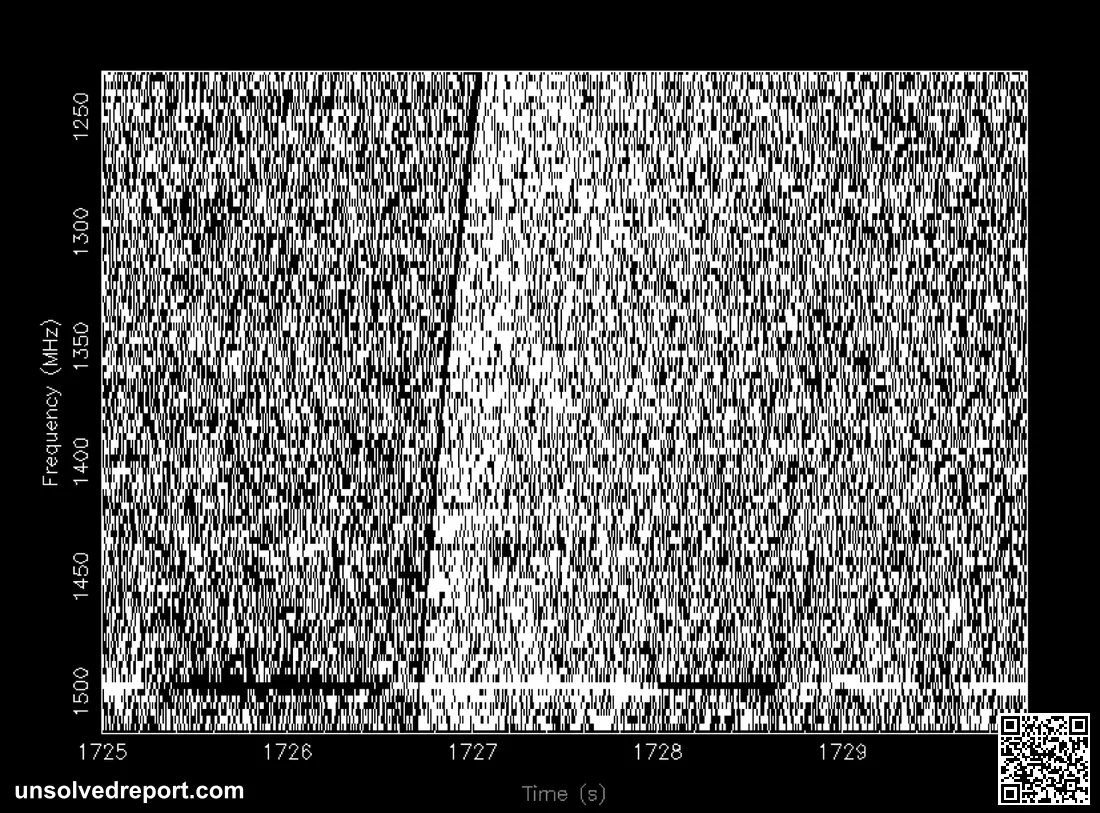
So how do we measure a distance like that from a flash that's already gone? The burst leaves a fingerprint. As it races toward us, its higher-frequency waves pull slightly ahead of its lower-frequency waves, because the thin haze of free electrons in space drags on the longer wavelengths. More electrons in the way, bigger the lag. That lag is called the dispersion measure, and it works like a cosmic odometer, reading off the ionized gas stacked up between us and the source (Wikipedia overview).
For years FRBs were rare curiosities. Then the Canadian CHIME telescope turned the trickle into a flood. Its very first catalog logged 536 bursts in a single year (MIT News, 2021). Its second catalog, covering 2018 to 2023, lists a staggering 4,539 bursts from 3,641 unique sources — including 981 bursts from 83 confirmed repeaters (Second CHIME/FRB Catalog, ApJS). Read that last bit again, because it hides the whole drama of the field: most FRBs flash once and vanish forever, never to be heard from again. A stubborn minority come back.
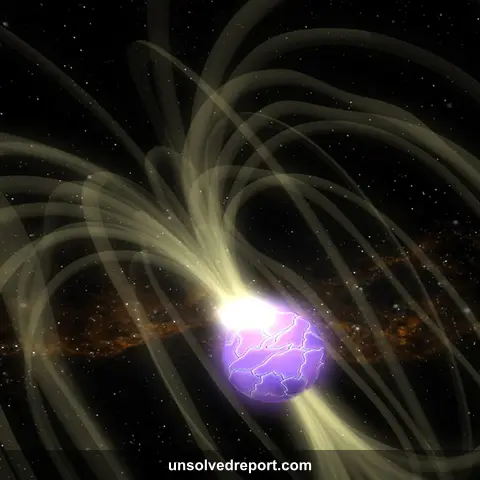
Two discoveries finally cracked the door open. The first arrived in April 2020, when CHIME and the STARE2 instrument caught a bright millisecond burst — FRB 200428 — and this time they could point straight at the culprit: SGR 1935+2154, a magnetar, an ultra-magnetized neutron star sitting inside our own Milky Way, about 30,000 light-years from here. It was the first FRB ever traced back to a known object (Nature, 2020; Nature Astronomy, 2021). Suddenly we had at least one engine with a name.
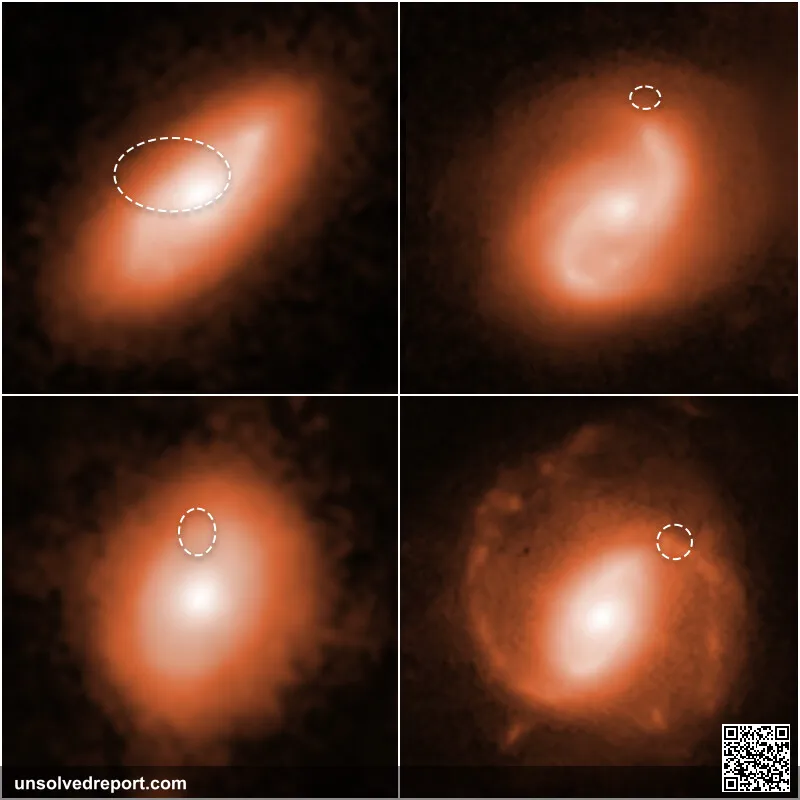
The second discovery flipped the script in a different way: FRBs turned out to be useful. By matching the dispersion measures of pinned-down bursts to the distances of their home galaxies, astronomers used the so-called Macquart relation to run a direct census of ordinary matter — and accounted for roughly 83% of the universe's expected baryons, helping crack the long-standing "missing baryon" problem by catching the gas spread thin in the void between galaxies (IOPscience, ApJL 2022). The current distance champion, FRB 20220610A, was spotted by Australia's ASKAP array on June 10, 2022. Its light had been traveling for about 8 billion years, and it seems to come from a small knot of merging galaxies (UC Santa Cruz News, 2023). We are now using these flashes to weigh the cosmos. We still can't say what lights them.
The Question Nobody Can Answer
So here's the catch, and it's a sharp one. We know magnetars can make FRBs. We do not know that all FRBs come from magnetars — and a handful of findings keep stubbornly refusing to fall in line.
Take the first one: some repeaters keep a schedule. The repeater FRB 20180916B fires its bursts in a window that comes back around every 16.35 days, while FRB 121102 shows a tentative cycle of about 157 days (Nature, 2020; MNRAS, 2020). A clock that clean smells like an orbit, or a slow, ponderous spin — the same rotating timekeeping that makes it so strange when a pulsar's clock skips a beat — not the sort of thing a single, freshly born magnetar hands you on its own.
Then there's the matter of where one of them lives. The repeating source FRB 20200120E was traced to a globular cluster in the nearby galaxy M81 — and globular clusters are ancient places, packed with old, long-burning stars whose dead cores test just how much mass a neutron star can carry before it breaks. That's a real problem for the favorite story, which says FRB-making magnetars are young objects, born only recently in core-collapse supernovae (Nature, 2022). An old neighborhood is the last place you'd expect to find a newborn.
And the field keeps throwing curveballs. In March 2026, researchers unveiled FRB 20250316A — nicknamed "RBFLOAT," for radio brightest flash of all time — and pinned it to the outskirts of the galaxy NGC 4141, a mere 130 million light-years away. It did not repeat. The lead researcher said it "opens the door to reconsidering more 'explosive' origins for at least some of them" (ScienceDaily, 2026). This one is very fresh, and how we read it could well change as other scientists pick it apart.
Which leaves the real question, and it isn't "what is one FRB?" It's bigger: are fast radio bursts one phenomenon with one engine — or a whole family of different cosmic events that just happen to look identical when they hit our radio dishes? As of mid-2026, nobody can answer that. The case is wide open.
The Suspects (All Still Unproven)
Everything below is speculation — working hypotheses scientists are still testing, not settled answers. Read it that way.
Magnetars, the front-runner
The leading idea casts magnetars as the engine: crackling, quaking, ultra-magnetic stars that hurl out FRBs, either in violent flares ripping off the surface or in shock waves slamming into the gas around them. That Milky Way detection is the strongest card on the table (Nature, 2020). The argument that won't die is whether magnetars can also account for the rare, blinding, one-and-done bursts — or just the repeaters.
Pairs, collisions, and catastrophes
Those metronome-steady repeaters practically beg for a model where a neutron star circles a partner — another neutron star, a white dwarf, a hefty star — so the rhythm is really an orbit ticking by. Mergers and collapses of compact objects get floated for the non-repeaters too (arXiv preprint, 2020 — labeled preprint). And that globular-cluster source hints at a magnetar born the weird way — maybe a white dwarf caving in on itself, or two stellar corpses fusing (Nature, 2022).
The genuinely strange ideas
Out at the speculative edge, the literature floats "blitzars" (a spinning neutron star collapsing into a black hole), cosmic strings, and clumps of decaying dark matter (Wikipedia overview). These stay firmly in minority-report territory.
And, yes — what about aliens?
Let's just say it out loud and move on: the scientists who found and study FRBs do not lean toward an artificial origin, and no evidence points there. Unlike the decades-long hunt for one anomalous transmission in the SETI archives, FRBs arrive by the thousands — the sheer count, scattered all across the sky, plus the natural energy signatures, all fit ordinary astrophysics. We raise it only to set it down.
And that's exactly why these flashes are so hard to look away from. We've measured FRBs precisely enough to weigh the universe's hidden gas — and we still can't fully explain what fires them. That gap, between what we can use and what we can understand, is the whole mystery. It is very much still open, somewhere out there in the dark, flashing several thousand times a day while we keep watching and wondering what's on the other end.
Sources & Further Reading
- E. Petroff et al., "The discovery and scientific potential of fast radio bursts," Science (2022): https://www.science.org/doi/10.1126/science.abj3043
- "Fast radio burst" overview, Wikipedia (citing peer-reviewed reviews): https://en.wikipedia.org/wiki/Fast_radio_burst
- CHIME/FRB Collaboration, "A bright millisecond-duration radio burst from a Galactic magnetar," Nature (2020): https://www.nature.com/articles/s41586-020-2872-x
- "The Second CHIME/FRB Catalog of Fast Radio Bursts," ApJS: https://iopscience.iop.org/article/10.3847/1538-4365/ae3828
- "Periodic activity from a fast radio burst source," Nature (2020): https://www.nature.com/articles/s41586-020-2398-2
- "A repeating fast radio burst source in a globular cluster," Nature (2022): https://www.nature.com/articles/s41586-021-04354-w
- "Finding the Missing Baryons... with Localized Fast Radio Bursts," ApJL: https://iopscience.iop.org/article/10.3847/2041-8213/aca145
- "Record-breaking fast radio burst is most distant ever detected," UC Santa Cruz News (2023): https://news.ucsc.edu/2023/10/distant-radio-burst/
- "Source of the brightest fast radio burst ever (FRB 20250316A)," ScienceDaily (2026): https://www.sciencedaily.com/releases/2026/03/260315004348.htm
SGR 0501+4516: The Roaming Magnetar With No Birthplace
Hubble tracked SGR 0501+4516 for a decade and its birthplace vanished — no supernova shell, no star cluster, nothing. So where was it actually born?
JuMBOs: 40 Pairs of Rogue Planets Science Can't Explain
JWST found 40 pairs of Jupiter-mass objects drifting through Orion with no star, no clear origin, and no explanation. So what are the JuMBOs really?
WD 1145+017: The Disintegrating Planet Nobody Has Ever Seen
WD 1145+017: a dead star shredding a planet in real time, yet no one has ever actually seen the thing being destroyed. Here's why that's still a mystery.