Final Parsec Problem: Black Holes Stuck Forever—Or Are They?
The final parsec problem says merging black holes should freeze forever, one parsec short of collision. So why does the universe hum like they don't?
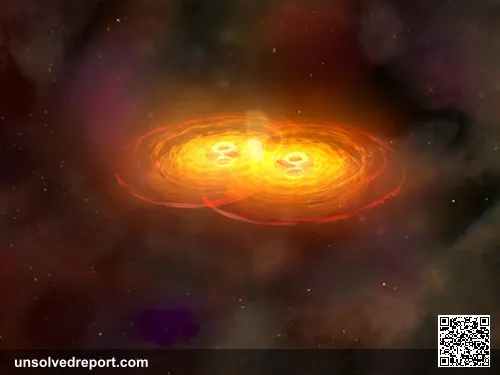
Two monsters are circling each other in the dark. Each one is a supermassive black hole, millions or billions of times heavier than the Sun, buried in the heart of a galaxy that was born when two other galaxies smashed together. Our best theories say they should keep spiraling inward until they slam together and ring spacetime like a struck bell. Do the math carefully, though, and the dance just... stops. The two giants freeze about one parsec apart—roughly 3.26 light-years—still impossibly far from the finish line. That's the "final parsec problem," and it's one of the strangest puzzles in astrophysics. The sky is littered with evidence that these mergers happen. Our cleanest models insist the last step is impossible.
What we actually know
Let's begin with the solid ground. When two galaxies merge, their central black holes start sinking toward the middle of the new combined galaxy, dragged down by something called dynamical friction. Picture each black hole plowing through a sea of stars and dark matter like a ship through water—it pushes that material around, and the drag bleeds away its orbital energy. This works beautifully right up until the two black holes lock into a gravitationally bound binary, the moment their combined mass outweighs all the stars trapped inside their orbit. For black holes heavier than a million Suns, that happens when they're about 1 to 10 parsecs apart (Milosavljević & Merritt, The Final Parsec Problem, AIP Conf. Proc. 686, 201, 2003).
Then the engine stalls. Below that scale, dynamical friction runs out of grip, and the binary has to find another way to keep tightening. Its only tool: picking off stars one at a time. When a single star wanders too close, the pair flings it away like a stone from a slingshot—and every fling steals a sip of the black holes' orbital energy and angular momentum, drawing them a little closer. Here's the catch. The trick only works on stars whose orbits carry them right into the binary's danger zone, a population astronomers call the "loss cone." In a perfectly round, idealized galaxy, those stars get ejected and nothing refills their ranks fast enough. The loss cone empties out. The slingshot starves. And the binary grinds to a halt at about a parsec (Milosavljević & Merritt, 2003).
The name comes from Miloš Milosavljević and David Merritt, who coined it in the early 2000s after running numerical N-body simulations of black hole binaries inside gas-free, perfectly spherical galactic cores (Milosavljević & Merritt, 2003). The label is brutally literal: the natural stalling distance for such a binary is right around one parsec.
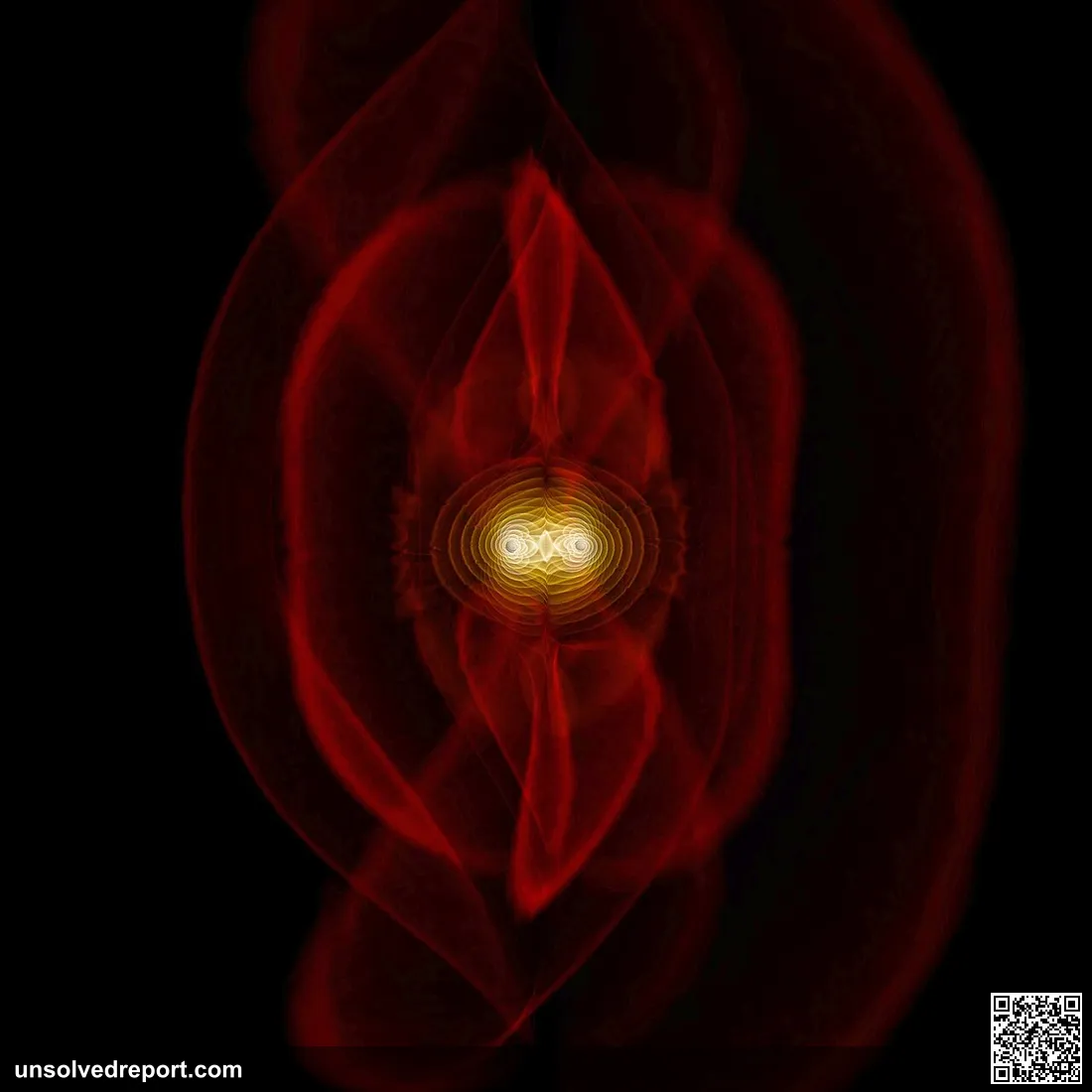
So why does a stall this far apart spell doom? Because gravitational waves—those ripples in spacetime Einstein predicted—only become a serious engine of the inspiral once the black holes are crammed vastly closer than a parsec. Fail to cross that final stretch, and the binary never reaches the zone where gravitational waves can take over and slam the door. The two black holes would just keep orbiting—possibly for longer than the universe has existed.
And here's where the puzzle turns. In the summer of 2023, four separate teams watching the sky—the NANOGrav, European, Chinese, and Parkes pulsar timing arrays—reported a faint, galaxy-wide "hum" of gravitational waves rolling through space at nanohertz frequencies, with waves that take years to decades to rise and fall (Berkeley News, June 28, 2023). The best explanation? The blended chorus of hundreds of thousands of supermassive black hole binaries scattered across the cosmos. NANOGrav's Luke Kelley called the signal "fully consistent" with exactly that idea—while adding the honest caveat that "we're still not 100% sure that it's produced by supermassive black holes" (Berkeley News, 2023).
The question nobody can answer yet
So sit with the contradiction. If that hum really is the sound of black hole binaries, then a huge share of them did manage the impossible—shrinking all the way from galaxy-merger distances down to the cramped subparsec orbits where gravitational waves rule (Berkeley News, 2023). And the signal is, if anything, a hair louder than many models guessed. Nature is plainly getting these black holes across the final parsec. So the real mystery was never whether it happens. It's how—which physical mechanism, or which mix of them, does the heavy lifting, and how fast. The clean spherical models that produce the stall are almost certainly too tidy to be true. Real galaxies are lumpy, lopsided, chaotic things. The whole game now is pinning down which piece of that mess rescues the merger—and the leading suspects each predict a noticeably different gravitational-wave sky.
The leading suspects
None of these answers involve exotica. They're mainstream astrophysics. (Well-supported.) Real galactic cores aren't perfectly round. Make a galaxy even slightly triaxial—stretched along three different axes, the way merger leftovers tend to be—and stars can settle onto so-called box or chaotic "centrophilic" orbits that keep swinging them back near the center, over and over. Those orbits constantly top up the loss cone and keep the slingshot fed. Several simulation studies argue that with realistic lopsidedness the binary never genuinely stalls at all; one team drove the point home by titling its paper "the final parsec problem is not a problem" (Vasiliev, Antonini & Merritt, MNRAS, 2014/2015).
(Well-supported, in gas-rich galaxies.) Some mergers are drowning in gas. When that happens, inflowing material can settle into a circumbinary accretion disk—a swirling ring wrapped around both black holes. Friction and torques from that gas tug on the binary, drain its orbital energy, and herd it inward, no starlight required (Cuadra et al. and related work, MNRASL, 2011).
(Newer, and more speculative.) And then there's the wild card. A 2024 study in Physical Review Letters makes the case that dark matter itself could finish the job. The authors argue that a dense spike of self-interacting dark matter wrapped around the binary keeps dynamical friction going long after the stars give out; its "isothermal core" works like a reservoir, soaking up the orbital energy the black holes shed and ferrying them across that final parsec (Alonso-Álvarez, Cline & Dewar, Phys. Rev. Lett. 133, 021401, 2024). The twist: ordinary collisionless cold dark matter wouldn't work—it dumps in so much energy that the spike tears itself apart. Treat this one as a promising minority idea, not a verdict. It still has to be weighed against its rivals.
The honest takeaway? The final parsec problem is probably a problem of idealized geometry, not missing physics. Drop the fantasy of a flawlessly smooth, spherical galaxy, and several believable rescues step out of the shadows. Which one nature actually reaches for—triaxial stars, gas, dark matter, or all three depending on the galaxy—is exactly the question the swelling pulsar-timing datasets may soon answer. The universe is humming. We're only just learning to read the tune.
Sources & further reading
- Milosavljević, M. & Merritt, D., "The Final Parsec Problem," AIP Conf. Proc. 686, 201–210 (2003) — https://ui.adsabs.harvard.edu/abs/2003AIPC..686..201M/abstract
- Berkeley News, "After 15 years, pulsar timing yields evidence of cosmic gravitational wave background" (June 28, 2023) — https://news.berkeley.edu/2023/06/28/after-15-years-pulsar-timing-yields-evidence-of-cosmic-gravitational-wave-background/
- Vasiliev, E., Antonini, F. & Merritt, D., "Collisionless loss-cone refilling: there is no final parsec problem," MNRAS (2014/2015) — https://academic.oup.com/mnras/article/464/2/2301/2404637
- Cuadra et al., "The final parsec problem: aligning a binary with an external accretion disc," MNRAS Letters 417, L66 (2011) — https://academic.oup.com/mnrasl/article/417/1/L66/1038829
- Alonso-Álvarez, G., Cline, J. M. & Dewar, C., "Self-Interacting Dark Matter Solves the Final Parsec Problem of Supermassive Black Hole Mergers," Phys. Rev. Lett. 133, 021401 (2024) — https://link.aps.org/doi/10.1103/PhysRevLett.133.021401
- Phys.org, "New study uses self-interacting dark matter to solve the final parsec problem" (July 2024) — https://phys.org/news/2024-07-interacting-dark-parsec-problem.html

Pulsar Glitch Mystery: The Clock Nobody Can Explain
Pulsar glitch mystery: the universe's steadiest clocks suddenly speed up, no warning. One glitch was caught live — so why can no one predict the next?
CMB Cold Spot: The Patch of Sky Colder Than Physics Allows
One patch of the Big Bang's afterglow is colder than it has any right to be. A giant void sits right there — but it can't explain the whole gap. So what does?
Bootes Void: 330 Million Light-Years of Almost Nothing
The Bootes Void holds ~60 galaxies where 2,000 should be. DESI's finished 3D map is now testing whether a void this size fits the standard model.