CMB Cold Spot: The Patch of Sky Colder Than Physics Allows
One patch of the Big Bang's afterglow is colder than it has any right to be. A giant void sits right there — but it can't explain the whole gap. So what does?
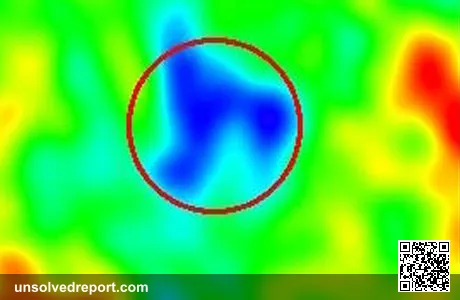
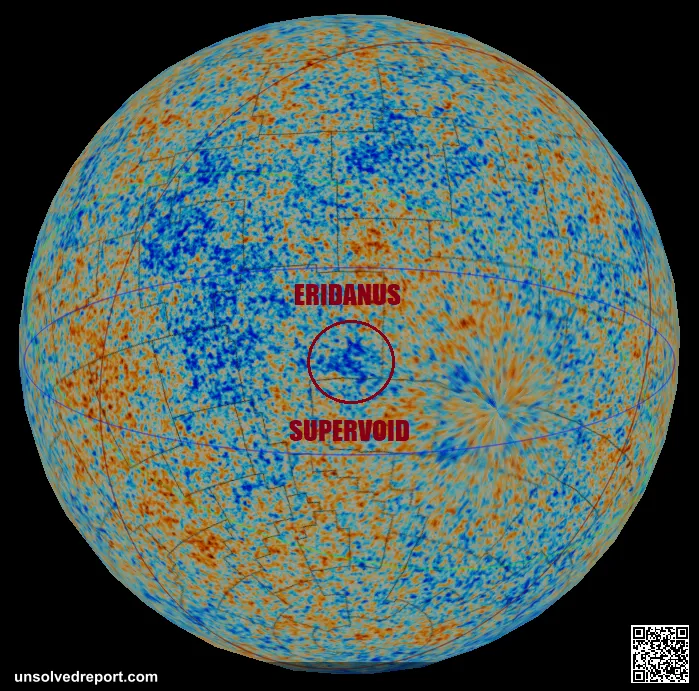
Look up, in any direction at all, and the oldest light in the universe is shining back at you. You can't see it with your eyes, but it's there: a faint glow that broke free when the cosmos was just 380,000 years old. It blankets the entire sky, and it is almost perfectly smooth, the same temperature everywhere to within a hundred-thousandth of a degree. Almost. Off in the direction of the constellation Eridanus, there's a patch that breaks the pattern. It's colder than it has any statistical right to be, and it's huge. Cosmologists have been arguing about it for twenty years. They call it the Cold Spot.
The oldest light there is
To see why the Cold Spot matters, you first have to picture the canvas it's painted on. The cosmic microwave background (CMB) is the leftover heat of the young universe, back when everything was hot, dense, and packed together. As the cosmos expanded and cooled, it suddenly turned transparent, and the light set free in that instant has been racing across space ever since, its waves stretched by the expansion until they slid down into the microwave band.
That light is unbelievably even. But not perfectly. Ripple through it and you find the faintest temperature fluctuations, hotter and colder spots that differ by mere millionths of a degree. Don't let the smallness fool you. Those ripples are the seeds of everything that came later: galaxies, clusters, the vast cosmic web. The way they're distributed is one of the strongest confirmations we have of the standard cosmological model. NASA's WMAP and ESA's Planck satellites mapped them across the whole sky with breathtaking precision.
Here's the thing about those ripples: they're supposed to be random in a very particular way. Spots of all sizes and temperatures, scattered with no favorite spots, like static on an old TV tuned to nowhere. The Cold Spot is fascinating precisely because it looks like a crack in that randomness.
The patch that shouldn't be there
Researchers first caught the Cold Spot in WMAP data in the mid-2000s. Then Planck, an entirely different telescope with sharper eyes, looked at the same patch of sky and saw it too. So this isn't a smudge on one camera lens. It's real. And it has three features that make people sit up:
- Size: it's a giant, sprawling across roughly 5 to 10 degrees of sky, far bigger than the ordinary ripples.
- Temperature: at its heart, it runs about 70 microkelvin below the average CMB temperature. A small number, sure, but for a feature this big, a startling one.
- The halo: strangest of all, the cold core is ringed by a comparatively warm halo. That pairing is odd.
Any one small cold spot? Nothing to write home about. The puzzle is the combination: this large and this cold together. A feature like that almost never shows up when you simulate a standard, random CMB sky. Exactly how rare it is depends on precisely how you define it and how you go looking for it, and that, as you'll see, is where the real fight begins.
The honest catch before we get carried away
Before anyone reaches for something exotic, there's a trap to walk around first, and it has a name: the "look-elsewhere effect," or a posteriori statistics. Picture scanning an entire sky packed with random fluctuations, then triumphantly pointing at the single weirdest thing you found. Of course it looks improbable in isolation. You searched everywhere and cherry-picked the outlier.
This matters enormously for the Cold Spot. Some analyses argue that once you properly account for the fact that the Cold Spot was found by combing the whole sky, its significance shrinks, and it drops from glaring contradiction to mild curiosity. Other analyses, using specific filtering techniques, insist it stays genuinely unlikely. So the very first open question isn't what causes the Cold Spot. It's how strange is it really? And here, reasonable cosmologists flatly disagree.
The leading suspect: a colossal hole in space
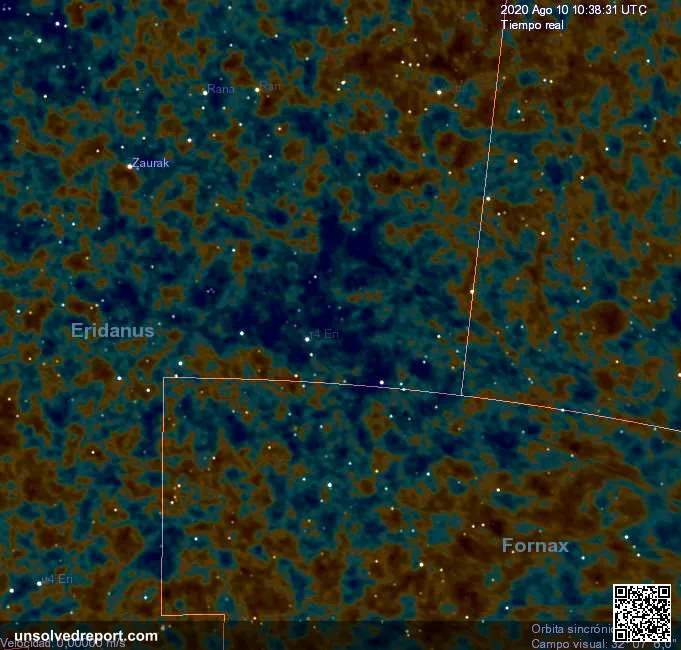
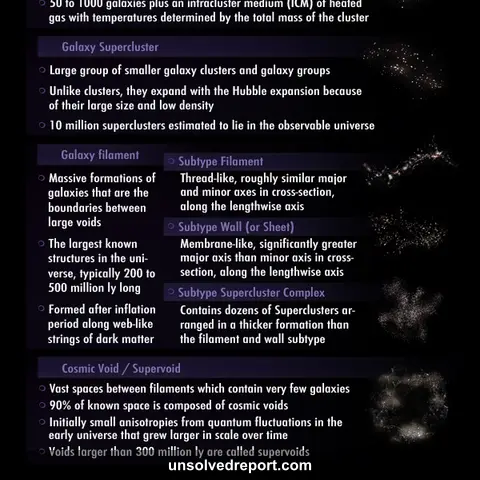
The most-discussed natural explanation points to something sitting between us and the CMB, right in the Cold Spot's direction: a giant under-dense region of space. And surveys really have spotted one there. It's sometimes called the Eridanus supervoid, a stretch maybe a billion or more light-years across where galaxies are noticeably scarcer than usual, not unlike the vast, near-empty Bootes void found elsewhere in the sky. An enormous, half-empty hole in the cosmos.
How does a hole make a cold spot? Through something called the integrated Sachs-Wolfe effect. In plain terms, follow a single photon of ancient CMB light on its journey:
- It falls into the void, a region of weaker gravity, and picks up a little energy as it drops in.
- It should hand all that energy back as it climbs out the far side. Even trade.
- But the universe is expanding, and that expansion is speeding up thanks to dark energy, so the void's gravitational well quietly flattens out while the photon is still inside.
- The photon climbs out of a shallower well than the one it fell into. It leaves with slightly less energy than it arrived with, and that patch of sky looks a touch colder.
It's an elegant idea, and the supervoid is genuinely there. But here's the honest punchline. Detailed studies, including work drawing on the Dark Energy Survey, have concluded that the supervoid, on its own, just isn't big enough or empty enough to carve out the full depth of the Cold Spot under standard physics. The most-cited estimates say a void that size could explain maybe a fifth of the anomaly. So the supervoid is a contributor. It is probably not the whole story.
So what's actually going on?
With the supervoid explanation falling short, cosmologists are left holding a few live possibilities, and it's only fair to admit none of them is fully nailed down.
- It's a rare but genuine fluke. Even in the standard model, extreme features pop up now and then. The Cold Spot might simply be a rare cold patch that happens, by sheer coincidence, to line up roughly behind a real supervoid. Pair that with the look-elsewhere caveat and many cosmologists call this the most likely answer.
- The void's cooling punch is stronger than the textbooks predict. If voids chill the CMB more than expected, that would whisper of something interesting about dark energy or gravity on the largest scales. But this is speculation, not an established result.
- Something far stranger. Over the years, bolder hypotheses have surfaced, including the eye-popping notion that the Cold Spot is a bruise left behind when our universe collided with another "bubble" universe in some multiverse.
That last one needs a warning label slapped right across it. The cosmic-collision idea is highly speculative, has no direct evidence behind it, and sits far outside mainstream consensus. It's the kind of claim that makes for irresistible headlines while resting on assumptions nobody can currently test. Treat it as a fringe hypothesis, not a leading explanation. The serious scientific debate is between "rare statistical fluke" and "under-dense region plus possibly enhanced ISW." It is not between colliding universes.
The Cold Spot has company
The Cold Spot may be the famous one, but it isn't the only oddity lurking in the large-scale CMB. It belongs to a small, peculiar family that researchers call the "CMB anomalies." There's a hemispherical power asymmetry, where the ripples look slightly stronger on one half of the sky than the other. And there's an eerie apparent alignment among some of the very largest features, nicknamed the "axis of evil." Like the Cold Spot, both turned up in WMAP data and refused to vanish when Planck took a fresh look.
Worth keeping the heads cool here, though. Each anomaly, taken alone, is only mildly improbable, and every one of them faces that same look-elsewhere catch: with a whole sky to scour and several different statistical tests to throw at it, stumbling onto a few odd-looking features is partly expected even in a perfectly ordinary universe. So cosmologists argue. Do these anomalies, together, hint at something beyond the standard model? Or are they just the kind of chance quirks any random sky tosses up? The honest current verdict: none of them, the Cold Spot included, rises to the level of overturning Lambda-CDM. But they're being watched closely as the data sharpen.
What sharper maps could settle
A lot of the progress here comes down to mapping the foreground more completely, charting what actually sits along that line of sight. If the Cold Spot is mostly the handiwork of intervening under-dense regions and the integrated Sachs-Wolfe effect, then ever-deeper galaxy surveys aimed that way should pin down precisely how much cooling those voids can muster. The Dark Energy Survey work on the Eridanus region was one step down that road. The next steps are bigger: surveys from the Vera C. Rubin Observatory and the Euclid space telescope will chart the three-dimensional spread of matter along that sightline in far richer detail.
And then we'll know which way it breaks. If those maps reveal that the under-dense structure can fully account for the Cold Spot under standard physics, the anomaly quietly dissolves back into ordinary cosmology. But if a stubborn gap stays open between what the voids can do and how cold the spot truly is, that gap turns into a much sharper question. Either way, the answer arrives through better measurement, not louder speculation. Which is exactly how an anomaly is supposed to be handled.
What we know versus what we don't
Established:
- The Cold Spot is a real feature of the CMB, seen consistently in both WMAP and Planck data.
- It's unusually cold and unusually large compared with the typical ripples.
- A genuine, enormous under-dense region (a supervoid) really does sit roughly in that direction.
Open:
- How statistically anomalous the Cold Spot truly is, once the look-elsewhere effect is accounted for.
- Whether the supervoid plus standard physics can explain it, or whether it's mostly a coincidental rare fluctuation.
- Whether any non-standard physics is involved (unresolved, and not required by current evidence).
Why this is a triumph, not a UFO
The Cold Spot is a beautiful little case study in how science handles a mystery responsibly. It's real. It's been measured by independent instruments. And yes, it's mildly puzzling. But "mildly puzzling" is a long way from "unexplained by known physics," and a much longer way still from evidence of anything exotic. The most probable answers are gloriously mundane: a partial nudge from a real cosmic void, plus the plain fact that random skies cough up rare features from time to time.
That's the honest, evidence-first picture. The Cold Spot lives right at the frontier, the place where our maps of the infant universe have finally grown precise enough to notice tiny oddities, much like the precision mismatch behind the Hubble tension, and where careful scientists argue, calmly and rigorously, over whether an oddity is a clue to new physics or just the universe being a little lumpy in the way statistics allows. Both possibilities are thrilling. Neither one needs anything beyond patient cosmology. The next time someone tells you the sky is hiding a secret, you'll know the right first question to ask: how strange is it, really?
Sources & further reading
- Wikipedia - CMB cold spot - https://en.wikipedia.org/wiki/CMB_cold_spot
- Wikipedia - Cosmic microwave background - https://en.wikipedia.org/wiki/Cosmic_microwave_background
- ESA - Planck mission - https://www.esa.int/Science_Exploration/Space_Science/Planck
- NASA - WMAP mission - https://wmap.gsfc.nasa.gov/
- Kovacs et al. 2022, DES view of the Eridanus supervoid and the CMB Cold Spot, MNRAS - https://academic.oup.com/mnras/article/510/1/216/6468992
- Wikipedia - Sachs-Wolfe effect (integrated Sachs-Wolfe) - https://en.wikipedia.org/wiki/Sachs%E2%80%93Wolfe_effect
Bootes Void: 330 Million Light-Years of Almost Nothing
The Bootes Void holds ~60 galaxies where 2,000 should be. DESI's finished 3D map is now testing whether a void this size fits the standard model.
PSR B1257+12: The Pulsar Planets Mystery Nobody Can Explain
PSR B1257+12: the first exoplanets ever confirmed orbit a corpse star, not a sun. So how did they survive the blast that made it? Nobody fully knows.
Nanohertz Gravitational Wave Background: The Hum Nobody Can Name
In 2023, dead stars across the sky drifted out of step together in a pattern no noise can fake. What's making them do it? Scientists still aren't sure.