Nanohertz Gravitational Wave Background: The Hum Nobody Can Name
In 2023, dead stars across the sky drifted out of step together in a pattern no noise can fake. What's making them do it? Scientists still aren't sure.
Out in the Milky Way, a dead star the size of a city is spinning — one of the strange, ultra-dense corpses that also pushes the limits of how much mass matter can hold before it breaks. Hundreds of times every second it whips around, flinging a beam of radio waves past Earth like a lighthouse gone berserk — and it keeps time better than the clock on your wall, better than almost any clock humans have ever built.
Now scatter dozens of these spinning corpses across the sky. Each one ticking. Each one steady.
And then, one day, they all start drifting out of step. Not randomly. Together. In a pattern that wraps the whole sky.
In June 2023, astronomers stood up and said: yes, we see this. And the thing nudging all those clocks at once seems to be a low, slow hum of gravitational waves filling the entire universe. This is one of the most carefully checked discoveries in modern astrophysics — and at its heart sits a question nobody can answer yet.
What We Actually Know
June 28, 2023. Five separate teams of astronomers, on different continents, all pulled back the curtain on the same day — and they were all pointing at the same thing: the first evidence of a background of nanohertz gravitational waves. The teams were the North American Nanohertz Observatory for Gravitational Waves (NANOGrav), the European Pulsar Timing Array, the Indian Pulsar Timing Array, the Parkes Pulsar Timing Array in Australia, and the Chinese Pulsar Timing Array (Caltech/LIGO Lab).
Here's how they did it, and it's clever. Those spinning dead stars are millisecond pulsars — neutron stars whirling so fast and so evenly that their pulses arrive like clockwork, rivaling the finest clocks ever made, the same precision timing that made it possible to spot planets orbiting a dead star decades earlier. When a gravitational wave rolls through, it stretches and squeezes the space between Earth and a pulsar. The pulse shows up a few billionths of a second early, or late. Tiny. Almost nothing. Even without any gravitational wave in the picture, pulsars aren't always perfectly steady clocks — they're occasionally caught in sudden glitches that skip a beat, a wrinkle the teams had to account for in the data.
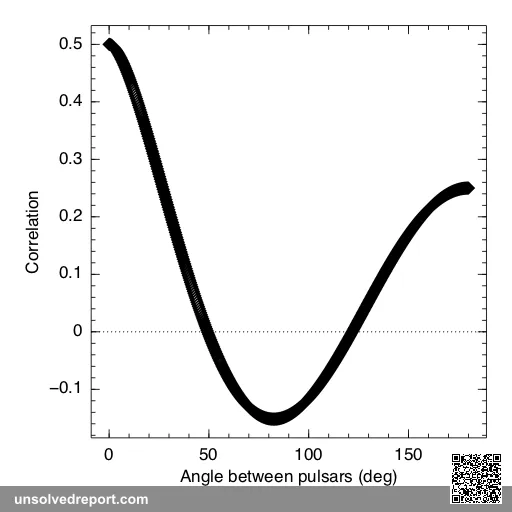
One pulsar alone can't prove a thing — a single clock running funny could mean anything. But a real background of waves leaves a signature you can't fake: a precise correlation between pairs of pulsars, set by the angle between them in the sky.
That correlation is the whole ballgame. It's called the Hellings–Downs curve, worked out back in 1983, and it spells out the exact quadrupolar pattern a sea of gravitational waves should carve into the data (Wikipedia: Hellings–Downs curve). Scientists call it the "smoking gun" — the "fingerprint" — because plain old noise simply doesn't behave this way. NANOGrav built its key plot from 2,211 pulsar-pair combinations drawn from 67 individual pulsars. And the data fell right along the predicted curve.
The NANOGrav 15-year data set was the richest of the five, watching roughly 67 to 68 millisecond pulsars for fifteen straight years (NANOGrav). When the result landed in The Astrophysical Journal Letters, the numbers were jaw-dropping. A gravitational-wave background beat the boring "it's just random pulsar noise" explanation by a Bayes factor north of 10^14 — that's a hundred trillion to one — with a frequentist significance of roughly 3.5 to 4 sigma (p-values around 5×10^-5 to 1.9×10^-4) (IOPscience / ApJL 951:L8).
They even measured how loud the hum is. Assuming the kind of spectrum you'd expect from giant black holes spiraling together, the strain amplitude comes out near 2.4×10^-15 at a reference frequency of one cycle per year (ApJL 951:L8). And remember — these are nanohertz waves. A single wave can take years, even decades, to rise and fall once. That's why catching them took more than a decade of patient, unblinking watching.
This is a wholly different beast from LIGO. LIGO and Virgo hunt high-frequency waves — in the hertz-to-kilohertz range — from stellar-mass black holes and neutron stars that whip around each other in a fraction of a second. Pulsar timing arrays peer about a billion times lower, into a realm where a single orbit takes many years to complete (Caltech/LIGO Lab).
The Part Nobody Can Answer Yet
Here's where the science gets honest with you. The teams never claimed to know what makes the hum. They were even careful about the word "detection." A 3.5-to-4-sigma result is strong — genuinely strong — but it hasn't crossed the 5-sigma line that physicists treat as the gold standard for "yes, this is real, case closed." The Hellings–Downs pattern is rising into view. It just needs more time to lock in.
But the bigger mystery is deeper than that. What's singing?
The volume and the pitch of the hum match what astrophysicists expect from a vast crowd of supermassive black hole binaries — pairs of monster black holes, somewhere between roughly 100 million and 10 billion times the mass of our Sun, slowly winding toward each other in the hearts of galaxies that smashed together ages ago (NANOGrav). If that's right, the background is the blended roar of countless such couples, echoing across the whole history of the cosmos — assuming those pairs can actually finish the job, since theorists have long puzzled over why the final stretch of a black hole merger seems to stall out rather than complete.
But that's not the only suspect. As the researchers themselves admit, they can't yet say for sure whether the signal comes from supermassive black hole binaries, from cosmic inflation, from cosmic strings, or from some mix of all three (Caltech/LIGO Lab). NANOGrav says it flat out: "the source population is still in question, and alternative cosmological hypotheses have been explored" (NANOGrav). So the open question has two halves — pin the signal down at higher confidence, and figure out which cosmic thing (or things) is doing the humming.
The Suspects
What follows are real, science-backed guesses still under investigation — not settled answers.
The front-runner: dying-galaxy black holes. The favorite explanation is a swarm of supermassive black hole pairs locked in slow death spirals. It's the source astronomers expected, and the measured pitch fits it best. Status: leading candidate, not confirmed. Nail this down and the hum becomes a brand-new instrument — a way to watch how galaxies and their central monsters grow and collide.
The wild card: leftovers from the beginning of time. A stranger possibility is that part of the hum carries echoes from the universe's very first moments — gravitational waves born during cosmic inflation, or flung off by cosmic strings, those hypothetical hair-thin cracks in spacetime that some theories say formed as the young cosmos cooled. Status: speculative, not ruled out. If even a sliver of the hum turned out to be cosmological, it would let us peer at physics no particle accelerator on Earth could ever reach.
Or maybe both. Researchers also flag a very real chance that the background is a blend — part black holes, part early-universe relics — which would turn separating the threads into a years-long puzzle. Status: plausible, under study.
So how does this get solved? Not with bolder guesses. With more pulsars, longer stretches of watching, and pooled data. The teams are merging their observations through the International Pulsar Timing Array to sharpen the correlation curve and tighten the spectrum (NANOGrav). Every extra year of ticking pushes the confidence higher and brings the fine details into focus.
Sit with this for a second. The cosmos appears to be ringing — softly, endlessly — at notes so low their wavelengths stretch across the galaxy. And we figured it out by doing one strange, patient thing: listening, for fifteen years, to the ticking of dead stars. The hum is real enough to take seriously. What's singing it to us is, for now, a gorgeously open mystery — and the next fifteen years of ticking may be the ones that finally tell us its name.
Sources & further reading
- NANOGrav, "Evidence for a Gravitational-Wave Background" — https://nanograv.org/15yr/Summary/Background
- Caltech / LIGO Lab, "LIGO Congratulates Pulsar Timing Array Teams" (June 28, 2023) — https://www.ligo.caltech.edu/news/ligo20230628
- The Astrophysical Journal Letters 951:L8, "The NANOGrav 15 yr Data Set: Evidence for a Gravitational-wave Background" — https://iopscience.iop.org/article/10.3847/2041-8213/acdac6
- Wikipedia (overview), "Hellings–Downs curve" — https://en.wikipedia.org/wiki/Hellings-Downs_curve
- Max Planck Institute for Gravitational Physics, "Pulsar Timing Arrays" — https://www.aei.mpg.de/ptas
511 keV Positron Annihilation: The Galaxy's Antimatter Fountain Nobody Can Explain
The Milky Way's core glows with antimatter dying by the trillion-trillion every second, at exactly 511 keV. Fifty years of data and still no source. Here's why.

NGC 1052-DF2: The Galaxy With No Dark Matter Nobody Can Explain
NGC 1052-DF2 shouldn't exist—a galaxy with almost no dark matter, then a second one turned up nearby. So what's really missing? Here's what the data says.
Dark Energy: The Invisible Force Ripping Space Apart
Dark energy makes up 70% of the universe and is tearing it apart faster every second — but nobody actually knows what it is. So what's really behind it?