Kuelap: The Peruvian Fortress Built Into a Mass Grave
Kuelap's 60-foot wall hides 100+ human burials — and bodies left unburied where they fell. Was it a fortress, a tomb, or something no one has named yet?
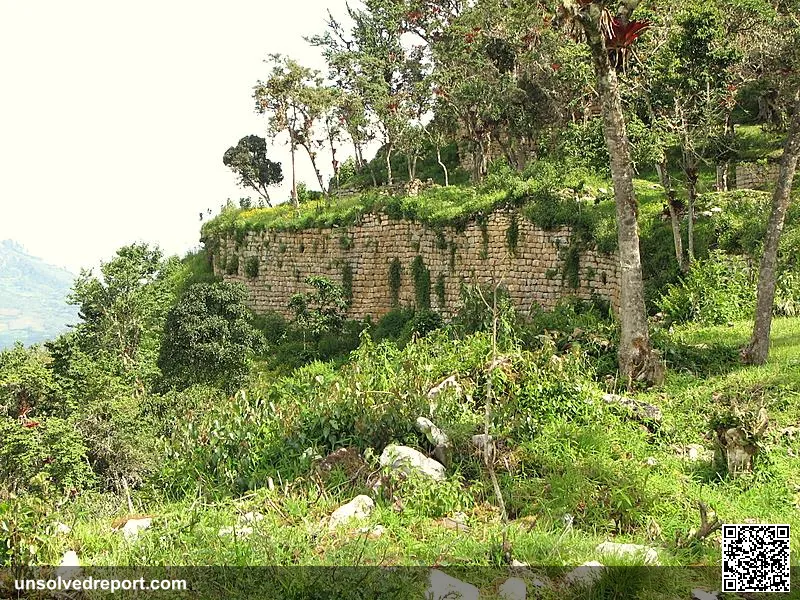
The clouds come up the valley most mornings and swallow it whole. Then they thin out — and there it is. A wall of pale stone, almost 60 feet tall, riding the spine of a limestone ridge high above a Peruvian river. Behind that wall sits a stone city older than Machu Picchu, built by people the Inca called the warriors of the clouds.
Here's the strange part. We actually know a lot about this place. We know who built it, roughly when, and how they buried their dead. And yet two questions still won't go away — two questions that have archaeologists genuinely arguing to this day. What was this colossal wall really for? And what happened on the morning everything ended?
What we actually know
Start with the setting, because it does half the work. Kuelap perches on a ridge above the Utcubamba River in the Amazonas region of northern Peru, roughly 10,000 feet up in thin mountain air. The builders were the Chachapoya, a cloud-forest culture that thrived on the eastern Andean slopes from about 800 to 1470 CE — long before the Inca ever showed up (Popular Archaeology). And that nickname, "warriors of the clouds"? It isn't about some legendary battle. "Chachapoya" traces back to Quechua roots meaning roughly "cloud forest" or "people of the clouds" — it's a name for where they lived, up in the fog, not for anything they did with a spear (Popular Archaeology).
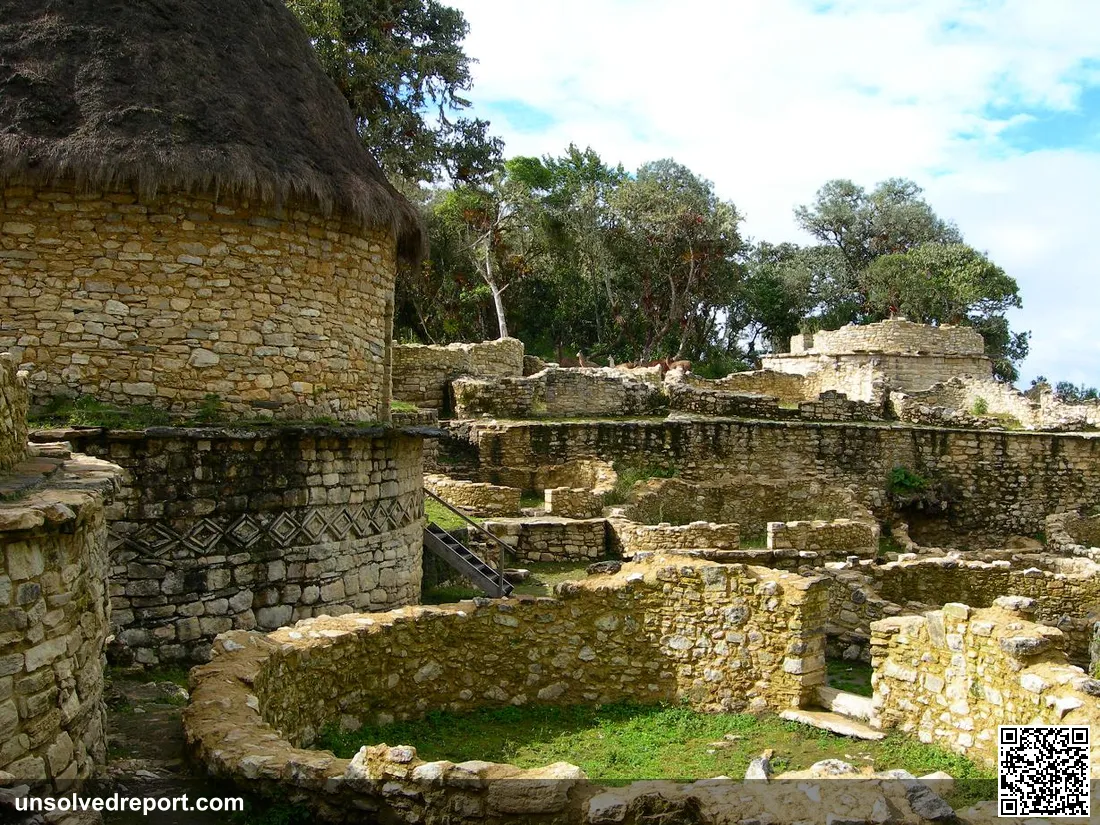
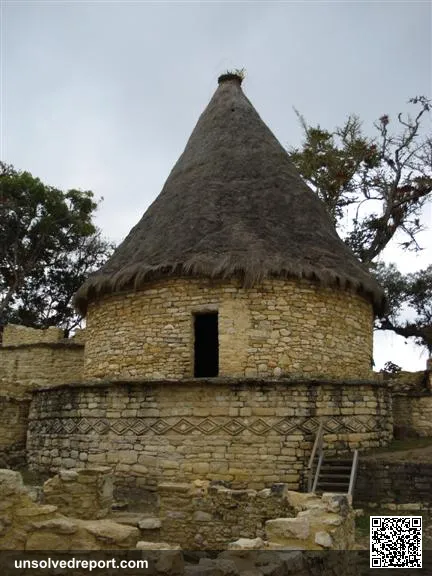
Now stand at the base of the wall. It's enormous — fitted limestone in the same tradition of monumental Andean masonry as the 100-ton stones of Sacsayhuamán, climbing in places to about 19 or 20 meters — 60 to 70 feet of stacked stone. Step inside and you're in a town: surveys have counted somewhere between 400 and 550 structures, most of them the round houses that are a Chachapoya signature (HeritageDaily). To get in at all, you funnel through narrow entryways that pinch down until only one person can squeeze through at a time — a detail the archaeologist Alfredo Narváez mapped out in close detail (Popular Archaeology).
The dates are where it gets quietly amazing. People seem to have first settled here around the sixth century CE — but the great wave of monumental building came centuries later, somewhere between roughly 900 and 1100 CE (HeritageDaily). So the wall you'd be standing under wasn't thrown up in one heroic push. It's the work of generations — grandparents and grandchildren hauling stone up the same ridge, decade after decade.
Then the Inca came. Colonial chronicles — including a secondhand account preserved by Inca Garcilaso de la Vega — describe the ruler Tupac Inca Yupanqui, the same expanding empire later linked to the legend of Atahualpa's vanished gold, pushing into Chachapoya country in the mid-to-late 1400s, conquering the region around 1475 after fierce resistance and later revolts that the Inca crushed with forced resettlement (Wikipedia: Chachapoya culture). Then came the Spanish in the 1530s, and the floor fell out. Disease, conquest, relocation — by some estimates the population dropped around 90 percent over roughly two centuries (Popular Archaeology). Kuelap slipped out of memory entirely, much like the ruins beneath Lake Titicaca waited for their own rediscovery. It stayed lost until 1843, when a judge from the nearby city of Chachapoyas named Juan Crisóstomo Nieto stumbled onto the ruins and formally reported them (HeritageDaily).
One last fact belongs here, and it's a modern twist. A cable car opened in 2017 and sent visitor numbers soaring. Then in 2022, after heavy rains, parts of the perimeter wall collapsed — triggering a long closure, repairs, and a multi-year conservation program (Peru Reports). Sit with that for a second. A wall that shrugged off a thousand years of weather is now something we're scrambling to save.
The question nobody can close
For a long time, Kuelap had one easy word stamped on it: fortress. And honestly, you can see why. The towering wall. The single-file gates. And a stash of an estimated 2,500 sling stones piled in the lookout tower they call the Atalaya — basically a quiver of ammunition, ready to fly (Popular Archaeology). Every bit of it screams defense.
Then the diggers got to work, and the tidy story fell apart. The honest answer today? Archaeologists still don't fully agree on what Kuelap mainly was — or how it ended.
Take that mighty wall. It isn't just a rampart. Narváez found more than a hundred burials tucked inside the great wall itself, and came to a startling conclusion: "in reality the outer wall is a cemetery," part of a wider Chachapoya habit of laying their dead to rest in high, protected places (Popular Archaeology). So you're not just looking at a barrier. You may be looking at a tomb the size of a city block. Other researchers point at the dense clusters of storage buildings and read the whole site as much as a food-storage and administrative hub — a hedge against crop failure in a brutally unpredictable mountain climate — as a stronghold (Popular Archaeology). Fortress. Necropolis. Granary. Home of the elite. Ceremonial center. The evidence keeps pointing at all of it — a place that layered jobs and changed across the centuries, not a building with one label. Which of those roles mattered most is still up for debate.
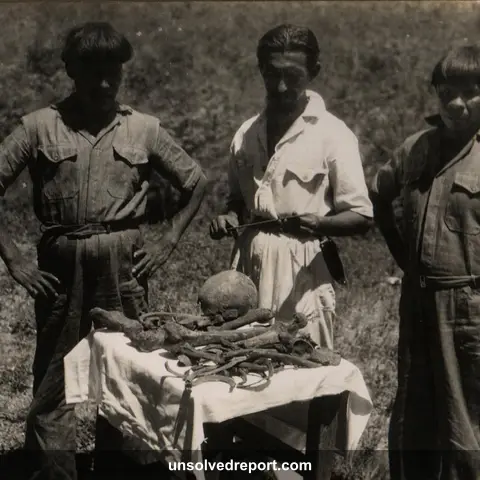
The ending is darker, and murkier. Big clumps of burnt roofing thatch say the place went up in flames at the close — but was that fire an attack, or a deliberate ritual sendoff for a town already emptied? Nobody's sure (Popular Archaeology). And then there's the detail that's hard to read without a chill. Bioarchaeological work led by J. Marla Toyne turned up unburied human remains with perimortem cranial trauma — penetrating head wounds, on people left lying where they fell inside their own houses (ResearchGate). That's not the signature of a town packing up and walking away. That looks like a targeted, late attack. Who did it, and exactly when — before, during, or after the Inca and Spanish upheavals — nobody has nailed down.
The theories — and where they break
Everything below goes past what the evidence can currently prove. These are interpretations, and that's exactly how to take them.
Reading one: it was a stronghold (the mainstream view). The wall, the pinch-point gates, the heap of sling stones — all of it suggests Kuelap was built, at least partly, with a fight in mind. Maybe, some have speculated, against pressure from the expanding Chimú or rival groups, and later inherited by the Inca. On this reading, those unburied trauma victims are the grim proof that the defenses finally failed. Plausible. But the bodies in the wall and the rows of storerooms make it clear defense was never the whole story.
Reading two: it was a ritual-and-storage center (also mainstream). Here the giant wall is less a bulwark and more a statement — a monumental container for the community's dead, its grain, and its leaders. The "fortress" feeling, on this view, is partly something we projected onto a building that quietly did a dozen jobs at once. Also plausible. But it struggles to explain the killing blows at the end.
Reading three: a mysterious "white-skinned race" (speculation — and the evidence says no). Because the chronicler Pedro Cieza de León described the Chachapoya as unusually fair, popular writing has spun whole theories of lost European or other foreign origins. It's a great campfire story. It's also folklore, not fact. A peer-reviewed genetic study published in PLoS One in 2020 analyzed 246 individuals and found their ancestry overwhelmingly Native American — the major Indigenous haplogroups — with European input that fits post-contact mixing, plus a sharp male-specific population bottleneck dated to the conquest era (PMC / PLoS One, 2020). The Chachapoya were Indigenous Americans, full stop. A little variation in how people looked needs no exotic backstory.
So what actually lingers? Not the question of who built Kuelap — we know that. The Chachapoya did. What lingers are the quieter, more human questions a great ruin always leaves behind. Why pour generations of labor into this ridge? What did it feel like to live and die behind that wall? And what final morning left bodies lying unburied in the round houses of the cloud forest, waiting centuries for someone to find them? Those questions are still wide open. And cloud forests, it turns out, are very good at keeping their secrets — just ask the jungle that swallowed Percy Fawcett while he was hunting for a lost city of his own.
Sources & further reading
- Popular Archaeology, "Warriors of the Clouds: Kuelap, a Chachapoya Citadel" — https://popular-archaeology.com/article/warriors-of-the-clouds-kuelap-a-chachapoya-citadel/
- HeritageDaily, "Kuelap - The Walled City in the Clouds" (2020) — https://www.heritagedaily.com/2020/05/kuelap-the-walled-city-in-the-clouds/129348
- Wikipedia, "Chachapoya culture" — https://en.wikipedia.org/wiki/Chachapoyas_culture
- Guevara, Sajantila et al., "Genetic assessment reveals no population substructure...in the Chachapoyas from northeast Peru," PLoS One, 2020 (PMC) — https://pmc.ncbi.nlm.nih.gov/articles/PMC7774974/
- Toyne, "Reconsidering the Notion of Fortaleza Kuelap" (bioarchaeology / perimortem trauma) — https://www.researchgate.net/publication/272089097_Reconsidering_the_Notion_of_Fortaleza_Kuelap
- Peru Reports, "Peru's Kuelap archaeological site reopens following 2022 wall collapse" — https://perureports.com/perus-kuelap-archaeological-site-reopens-following-2022-wall-collapse/10213/
- UNESCO World Heritage Centre Tentative List, Chachapoyas sites of the Utcubamba Valley — https://whc.unesco.org/en/tentativelists/6411/
Mary Celeste: 10 People Vanished, the Ship Never Sank
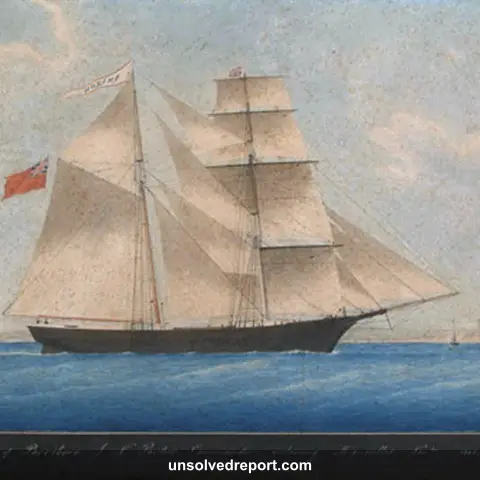
1872: the Mary Celeste found adrift, fully stocked, all 10 aboard gone without a trace. Mutiny and piracy don't fit the evidence. So what does?

Uranus's Axial Tilt: The 98-Degree Mystery Nobody Can Explain
Uranus spins on its side at a 98-degree tilt, and scientists still cannot agree on what flipped it. Why did the collision leave its moons untouched?
Percy Fawcett Disappearance: The Explorer the Jungle Swallowed
In 1925 Percy Fawcett disappeared into the Amazon chasing a lost city — and nearly 100 people who went looking for him vanished too. Why?