Uranus's Axial Tilt: The 98-Degree Mystery Nobody Can Explain
Uranus spins on its side at a 98-degree tilt, and scientists still cannot agree on what flipped it. Why did the collision leave its moons untouched?
Every planet leans a little as it spins. Earth tips about 23.4 degrees, and that gentle lean is the whole reason we get summer and winter. Mars leans about the same. Then there's Uranus. It doesn't lean. It lies flat on its side and rolls around the Sun like a ball someone shoved across a table. Its north pole and south pole take turns staring almost straight into the sunlight. Something tipped this entire planet over, and here's the part that should make you sit up: scientists have good guesses, real ones, backed by hard math, and they still cannot agree on which one is right.
What We Know for Sure
Start with the number, because the number alone is jaw-dropping. NASA pins Uranus at an axial tilt of 97.77 degrees, calling it "the only planet whose equator is nearly at a right angle to its orbit" (NASA Science, Uranus Facts). Read that again. The planet's equator is basically perpendicular to where it should be. And because the tilt tips past 90 degrees, Uranus spins backward compared to most of its neighbors. Only one other planet does that. (It's Venus.) One full spin takes about 17 hours. One full loop around the Sun takes roughly 84 Earth years.
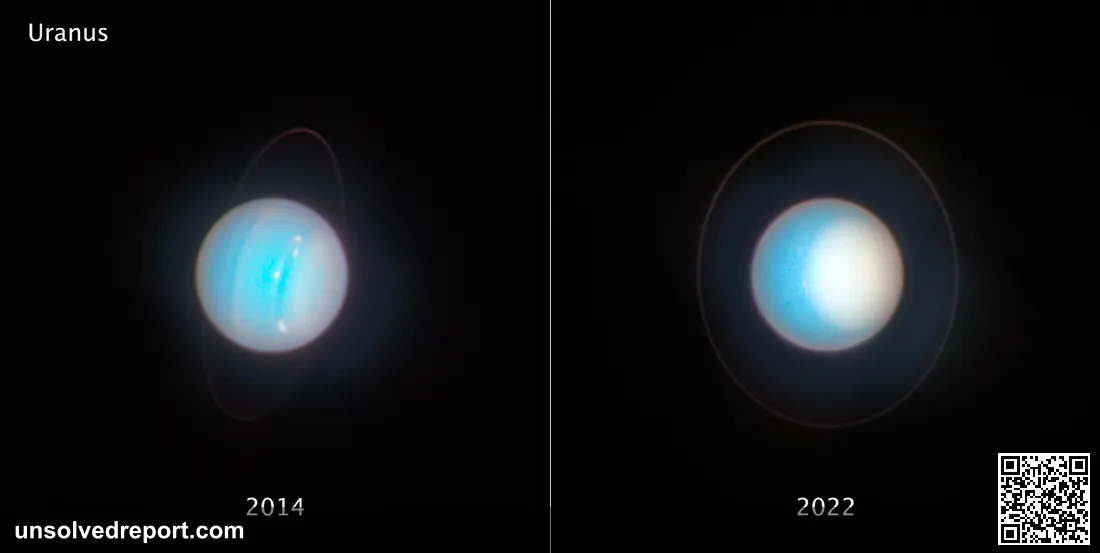
Now picture what that does to the seasons. They are the most savage in the solar system. As NASA puts it, "for nearly a quarter of each Uranian year, the Sun shines directly over each pole, plunging the other half of the planet into a 21-year-long, dark winter" (NASA Science). Twenty-one years of unbroken sunlight on one pole. Then twenty-one years of solid night. Imagine being born into that darkness and reaching your twenties before the first dawn.
Here's the clue that quietly makes this whole thing so hard to solve. Uranus's big moons and its rings don't orbit the way you'd expect after a disaster. They circle the planet's tilted equator in a neat, calm, orderly ring, all tipped over together as one tidy family. So whatever knocked Uranus sideways didn't just shove the planet. It shoved the planet AND somehow left its moons and rings parked in perfect formation. Hold onto that. It's the knot at the center of the mystery.
One more thing, and it's a strange one. Uranus is freezing. Its upper atmosphere drops to about minus 216 degrees Celsius (minus 357 degrees Fahrenheit), making it the coldest planetary atmosphere in the entire solar system, even though Neptune sits farther from the Sun (Durham University study coverage, Phys.org). A planet closer to the warmth, somehow colder than the one beyond it. File that away too.
The Question Nobody Can Answer Yet
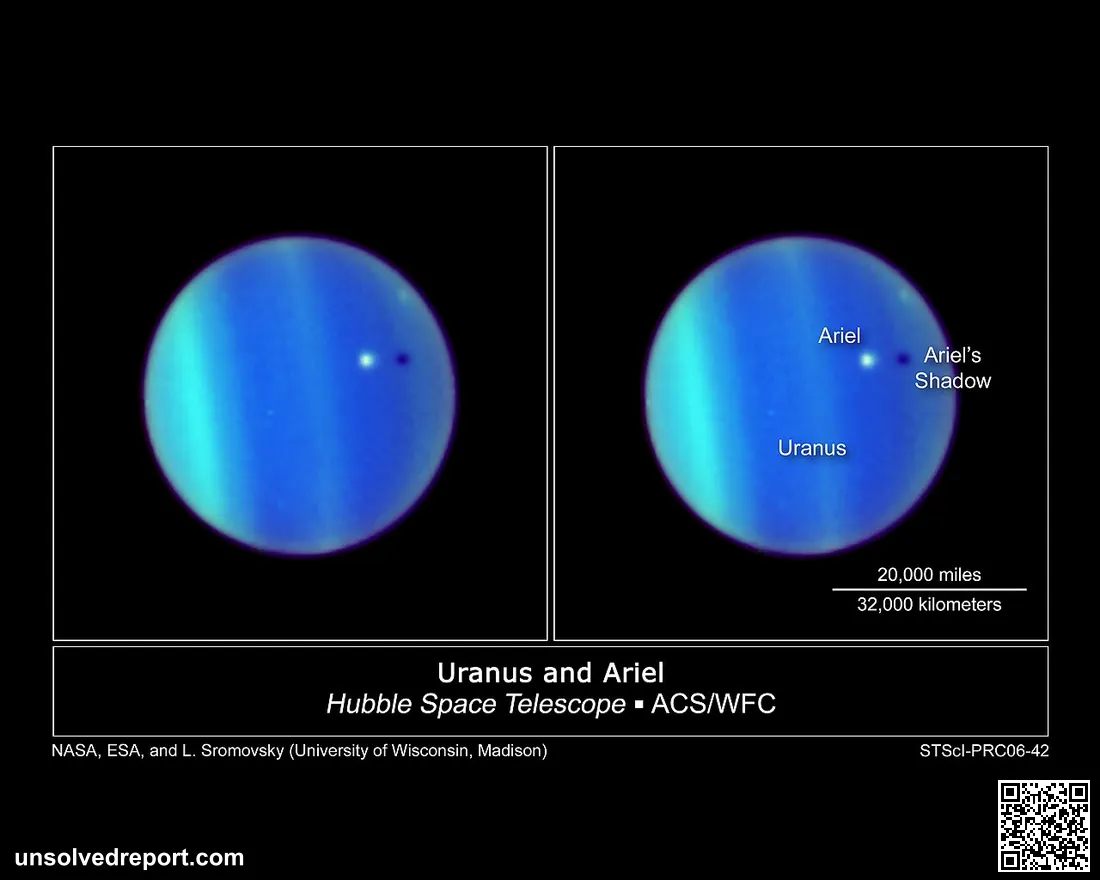
So what tipped it? Here's the frustrating truth: no spacecraft has ever orbited Uranus. Not one. Voyager 2 swept past in a single flyby back in 1986 and kept going. Everything we've learned since has come from telescopes and computer models. We are detectives at a crime scene that's four billion years cold, reading the only clues left behind: the tilt, the tidy moons, the rings, the strange cold interior, and the speed of its spin.
And the obvious answer breaks the moment you test it. The intuitive story is a single massive crash that knocked the planet over. But a hit that violent should have flung the moons everywhere, scrambled them, wrecked their formation. Instead they orbit in calm, regular circles around the tilted equator. How do you get a catastrophic, planet-flipping blow AND a peaceful, perfectly aligned moon system out of the same event? That contradiction is exactly why the smartest people in the field still haven't settled this.
The Leading Suspects
The giant smash (the front-runner). NASA blames the tilt on "a collision with an Earth-sized object long ago" (NASA Science). The deepest look at this idea came in 2018, when a team led by Jacob Kegerreis at Durham University ran high-resolution simulations and published them in The Astrophysical Journal. Their picture: a young protoplanet of rock and ice, roughly twice the mass of Earth, slammed into Uranus about four billion years ago. Hard enough to tip the whole planet over, but a glancing hit, so Uranus kept most of its atmosphere (Phys.org). And watch how the loose clues snap together: the simulations suggest debris from the crash may have formed a thin shell that trapped the planet's heat inside, which would explain why it's so cold. Some of the blasted-out rock and ice may have clumped into the inner moons. Kegerreis put it bluntly, saying the work confirms "that the most likely outcome was that the young Uranus was involved in a cataclysmic collision with an object twice the mass of Earth." Some researchers prefer a twist: not one giant blow, but several smaller ones. A string of impacts would give the moon-forming disk time to settle back into line with the planet's new equator, which fits those orderly orbits better than a single knockout punch.
The slow wobble (an alternative, and still speculative). Not everyone buys that a crash is the best fit. Astronomers Zeeve Rogoszinski and Douglas Hamilton at the University of Maryland argue Uranus could have tipped slowly, with no giant collision at all, if the young planet was wrapped in a massive disk or ring of material. That disk could have set the planet's spin axis wobbling like a dying top, until the wobble locked in step with the slow drift of Uranus's orbit, a feedback loop they call a secular spin-orbit resonance that can gradually pump the tilt higher over enormous stretches of time (ScienceAlert). Their points are sharp: Uranus's moons look a lot like Jupiter's in their sizes and spacing, and they still hold plenty of ice, ice that a roasting mega-impact might have boiled clean away. These are open arguments, not the final word, and the wobble idea has long had trouble cranking a tilt past 90 degrees on its own.
The vanished moon (newer, and speculative). Then there's a 2022 study by Melaine Saillenfest and colleagues in Astronomy & Astrophysics that offers a third path, and an eerie one: a moon that no longer exists. In this version, an ancient satellite slowly crept outward over a billion years, dragging Uranus's spin axis into a resonance that tipped the planet, and then, once the tilt pushed past about 80 degrees, the moon itself went unstable and plunged into Uranus, erasing the evidence (Astronomy & Astrophysics, Saillenfest et al. 2022). The authors say they could reproduce Uranus-like tilts with high probability, though the scenario tends to need a fairly large lost moon to pull it off.
For now the giant smash is still the textbook answer. But the other ideas aren't going away, precisely because the crash story leaves threads dangling. The real way to break the tie is to finally go there. Planetary scientists keep naming a Uranus orbiter as a top priority, and the data it could send back about the planet's interior, its magnetic field, and its moons may at last reveal why the strangest planet in the solar system ended up lying down on the job. Until that ship arrives, Uranus keeps rolling on its side, holding its secret, four billion years and counting.
Sources & Further Reading
- NASA Science, "Uranus: Facts" — https://science.nasa.gov/uranus/facts/
- Phys.org, "'Cataclysmic' collision shaped Uranus' evolution" (Durham University / Kegerreis et al., The Astrophysical Journal, 2018) — https://phys.org/news/2018-07-cataclysmic-collision-uranus-evolution.html
- Kegerreis et al., "Consequences of Giant Impacts on Early Uranus..." The Astrophysical Journal (2018) — https://iopscience.iop.org/article/10.3847/1538-4357/aac725
- ScienceAlert, "There's Another Way Uranus Could Have Ended Up Tipped on Its Side" (Rogoszinski & Hamilton) — https://www.sciencealert.com/there-s-another-way-uranus-could-have-ended-up-tipped-on-its-side
- Saillenfest et al., "Tilting Uranus via the migration of an ancient satellite," Astronomy & Astrophysics (2022) — https://www.aanda.org/articles/aa/abs/2022/12/aa43953-22/aa43953-22.html
- Space.com, "Planet Uranus Got Sideways Tilt From Multiple Impacts" — https://www.space.com/13231-planet-uranus-knocked-sideways-impacts.html

Percy Fawcett Disappearance: The Explorer the Jungle Swallowed
In 1925 Percy Fawcett disappeared into the Amazon chasing a lost city — and nearly 100 people who went looking for him vanished too. Why?

Naga Fireballs: The Glowing Orbs That Rise From a River
Every October, silent red orbs climb out of the Mekong River and vanish. Decades of science still can't agree on what they are. Here's the real mystery.
Patiala Necklace Mystery: 2,930 Diamonds, Almost None Found
Cartier built the Patiala Necklace with 2,930 diamonds in 1928. By 1948 it vanished from a locked treasury — so where did nearly 3,000 stones go?