Oak Island Money Pit: The 200-Year Mystery Nobody Can Solve
200 years, millions of dollars, six deaths — and still no treasure. So what's really down the Oak Island Money Pit? The evidence points somewhere stranger.
A hole deeper than a ten-story building is tall. Two hundred years of shovels, then steam engines, then drilling rigs, then millions of dollars. And the honest answer to the only question that matters — what did they find down there? — is still, basically, nothing.
Welcome to Oak Island.
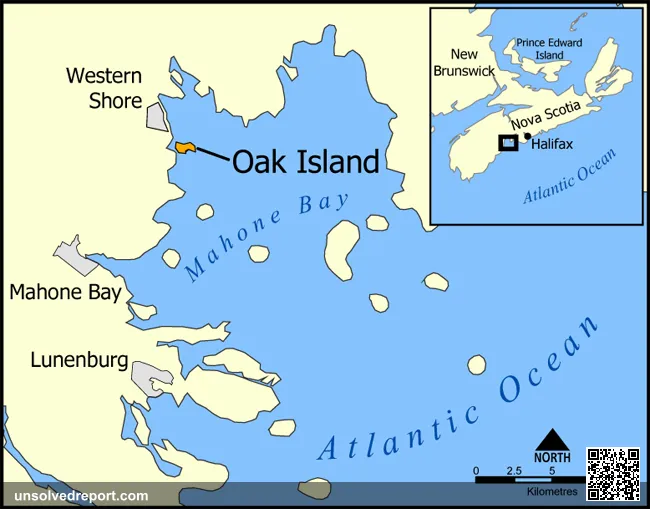
It's a small, forested speck off the coast of Nova Scotia, and for more than two centuries people have shown up here chasing one stubborn rumor: that something valuable is buried in a pit the locals call the Money Pit. They have flooded the shaft. Drained it. Cored it. Mapped it. Died in it. And the treasure has never once appeared.
Here's the strange part. That is the story. Oak Island isn't a tale about treasure found — it's a tale about treasure that refuses to show up, and may never have existed at all. So let's separate the three things that get tangled together every time someone tells this: what the records actually say, where those records run out, and where the legends take over.
What We Can Actually Document
Start with the solid ground — and brace yourself, because even the "solid" ground here has a crack running through it.
A dent in the dirt under a tree (1795)
Summer, 1795. A young man named Daniel McGinnis spots something odd on the eastern end of Oak Island: a shallow, saucer-shaped dip in the soil, the kind of sag the ground makes when something underneath it has settled. He grabs two friends, John Smith and Anthony Vaughan, and they start digging.
A couple of feet down, the diggers say, their shovels hit flagstones. Below that, loose fill — soil that had clearly been moved before. They kept going, deeper and deeper, until they finally gave up at around 30 feet (Heritage Daily; Wikipedia).
Now the part most retellings quietly skip. Nobody wrote any of this down at the time. The earliest detailed published accounts of the 1795 dig show up in the Liverpool Transcript (October 1862) and the Halifax British Colonist (1864) — roughly 70 years after it supposedly happened (Wikipedia). Seventy years is a long time for a good story to grow. So the foundation of the whole legend is documented — but documented late, secondhand, after decades of retelling. Keep that crack in mind as the platforms and tunnels and trapdoors start piling up.
Companies, deep shafts, and a stone that ate its own symbols (1800s)
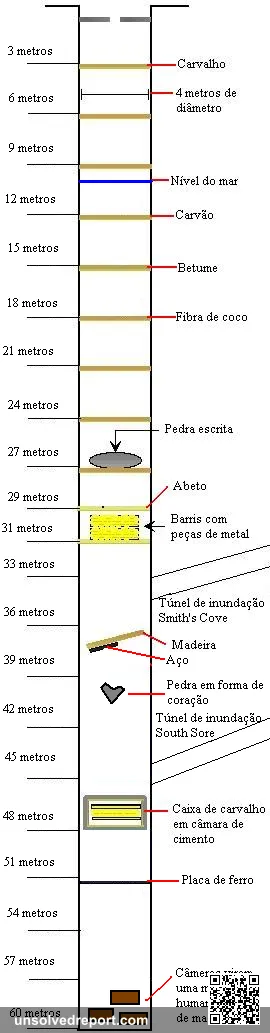
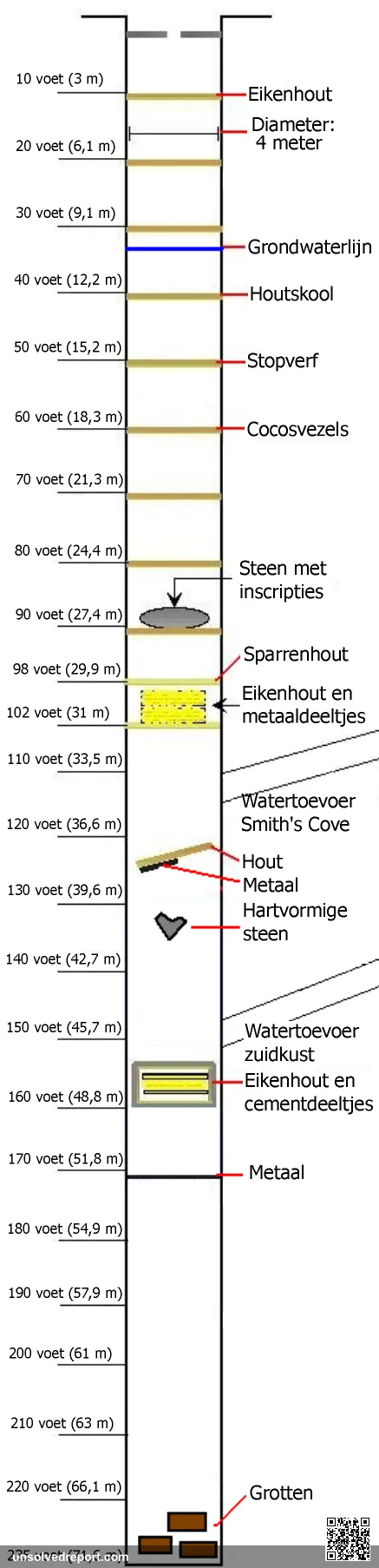
By the 19th century, the loners were gone and the companies moved in. The Truro Company, formed in 1849, drove a drill into the old shaft and reported its auger biting through a spruce platform around 98 feet down, then into layers that supposedly held loose metal "in pieces" (Wikipedia).
Then there's the stone. Early diggers described pulling up a slab "cut square, two feet long and about a foot thick," carved with strange characters, said to have come from around the 90-foot level. A coded message guarding buried treasure — it's the perfect detail, the kind of unsolved code that turns up again in the Beale Ciphers. Too perfect, maybe. When Captain Henry Bowdoin's 1911 expedition got hold of a stone claimed to be that very artifact, observers looked it over and described a plain, fine-grained, basalt-type rock with no symbols on it at all. The mysterious carvings had simply... vanished (Wikipedia). That's Oak Island in a nutshell: the closer you look at the evidence, the more it dissolves in your hands.
A future president, a TV crew, and the lab results
This pit has pulled in some astonishing names. In 1909, the Old Gold Salvage group launched an expedition — and one of the men chasing treasure on that muddy island was a young Franklin D. Roosevelt, decades before he ran the United States (Wikipedia).
Fast forward. In 2006, brothers Rick and Marty Lagina bought a major stake in Oak Island Tours, and since 2014 their hunt has played out on the History channel series The Curse of Oak Island (Wikipedia). And here, finally, modern digging turned up something that genuinely makes you sit up: coconut fibre, pulled from Smith's Cove, radiocarbon-dated to roughly 1260–1400 AD, with nearby swamp wood landing in the same medieval window (Oak Island Treasure archive; ArcheoThoughts).
Coconuts do not grow in Nova Scotia. They don't grow anywhere near it. So how did coconut fibre end up buried on a freezing North Atlantic island, dated to the Middle Ages? That's a real, honest, unanswered question — though, as you'll see, "unanswered" doesn't have to mean "supernatural."
A loss that wasn't a legend
Not everything here is romance. Some of it is just grief.
On August 17, 1965, treasure hunter Robert Restall, his teenage son, and two other men — Karl Graeser and Cyril Hiltz — went down a shaft at Smith's Cove and never came back up. They were overcome by what was identified as toxic gas (Wikipedia). Historians generally count six accidental deaths across the island's long search. No drama is needed for that line, and none is wanted. Deep, waterlogged, gas-filled shafts are genuinely dangerous, and the men who died in them deserve to be remembered plainly.
The Mystery: Why Nobody Can Reach the Bottom
Here's the single most famous thing about the Money Pit, the detail that has kept the legend alive for generations: it fights back. Dig deep enough, the accounts say, and the sea pours in — faster, always faster, than any pump can throw it out. The shaft fills, the diggers retreat, the treasure stays sealed.
Nineteenth-century searchers reached a chilling conclusion. This couldn't be an accident. Someone, they decided, had built a hidden flood tunnel — an engineered booby trap, designed to drown anyone who got too close and protect whatever lay below. A trap, centuries old, still working.
It's a spine-tingling idea. It's also, and this matters, a guess. No one has ever actually seen this tunnel. As the skeptical site Critical Enquiry points out, nobody has ever found a man-made flood tunnel under Oak Island — its existence was assumed back in the 1800s purely from the way the water behaved, not from anyone laying eyes on a built passage (Critical Enquiry). That little gap — between "the water acts weird" and "therefore an ancient genius built a death trap" — is the exact spot where the whole mystery lives.
The Theories and the Legends
Over the years, people have hung every kind of explanation on this pit, from the reasonable to the gloriously bonkers. None of what follows is proven. These are the theories, and we're flagging them as theories.
Who hid the treasure?
- Pirate gold — often pinned on Captain Kidd, buried before the law caught up with him, in the same tradition as Blackbeard's own missing hoard.
- A French war chest — a military or naval stash hidden during the colonial fights for North America.
- The "deposited records" theories — Freemason artifacts, Knights Templar relics, even the original Shakespeare manuscripts, smuggled across the ocean and sunk in a Nova Scotia hole.
Fantastic stuff for a fire and a flashlight under the chin. What every one of these stories is missing, though, is the same thing: any recovered treasure, and any document from the time tying a specific group to this specific island.
The skeptics' buzzkill (and it's a good one)
Now the deflating possibility — the one backed by the most actual evidence. What if there's no treasure, and never was? What if the Money Pit is just a natural sinkhole?
Oak Island sits on top of water-filled anhydrite and limestone, the kind of soft, soluble rock that hollows out into cavities and caves in. A retired geologist told CBC that features like these "are not man-made... they take sometimes thousands to even millions of years to form" (CBC News). And the famous flooding? When the Woods Hole Oceanographic Institution studied it in 1995, they pinned the inrush on a natural tug-of-war between the island's freshwater lens and the pressure of the tides — no ancient tunnel required (Wikipedia). Even those eerie "platforms" the early diggers swore they hit? Skeptics say layers of debris settling inside a natural cavity can look unnervingly like the floors of a man-made vault — a sinkhole doing a very convincing impression of a buried treasure shaft (HowStuffWorks).
The curse
And then there's the line that hangs over the whole thing like fog: "seven must die before the treasure is found." Six deaths have been counted so far. So the legend whispers that the prize will stay locked away until the seventh person goes into the ground (Looper). Where did this saying come from? Genuinely nobody knows. It's best read as folklore — a story people tell about the island, not a prophecy the island is keeping.
So What's the Real Mystery Here?
After 200 years, the deepest puzzle of Oak Island might not be what's buried there. It might be why we can't stop digging.
Lay it all out. The record gives us a discovery written down 70 years too late, some genuinely strange medieval-dated coconut fibre, a stone that lost its carvings the moment someone examined it, and water that floods like clockwork. The legends give us pirates, Templars, and a body count waiting for one more. And the science calmly offers the least thrilling answer of all: a hole that nature, not pirates, spent thousands of years carving out of soft rock.
That's the real treasure of Oak Island — that tug-of-war between wonder and evidence, neither side ever quite winning. It costs nothing to dig into. And unlike the Money Pit itself, it never runs dry.
Hungry for more vanished fortunes? Explore our roundup of history's greatest lost treasures still waiting to be found.
Sources & Further Reading
- Oak Island mystery — Wikipedia
- The history of the Oak Island Money Pit — Heritage Daily
- Money pit or sinkhole? Retired geologist digs up Oak Island's history — CBC News
- Claims of a flood tunnel under Oak Island — Critical Enquiry
- What the Skeptics Say about Oak Island — HowStuffWorks
- Coconut fibre — Oak Island Treasure archive
- Just how surprising is the coconut fiber? — ArcheoThoughts
- The "Seven Must Die" Myth Explained — Looper
Kruger Millions: The Lost Gold Nobody Can Fully Account For
A republic loaded its gold onto a train and fled the British army. The treasure was real — but a quarter-million ounces still won't add up. Here's why.
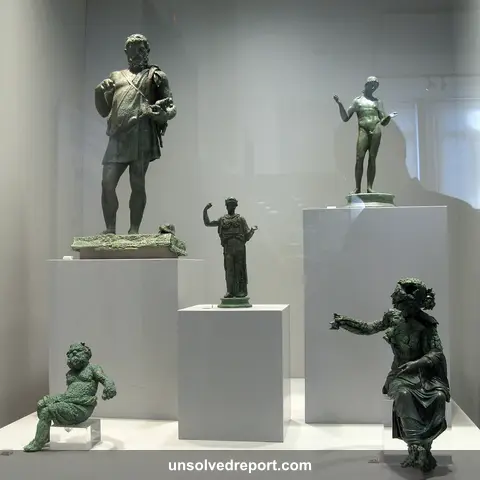
Antikythera Wreck: 9 Bronze Statues Still Buried Below
Antikythera wreck: a diver surfaced screaming about corpses on the seabed. It was bronze masterpieces — and up to 9 statues are still buried down there. Which ones?

Lake Toplitz: The Nazi Treasure Lake That's Half True
A diver died searching Lake Toplitz. Nazi forgeries really did surface from its depths. But the gold everyone whispers about? Still unaccounted for.