Knights Templar Treasure: The Gold That Vanished Overnight
In 1307 France raided the richest order in Europe and the vault came up empty. Was the Knights Templar treasure hidden, or did it never exist at all?
The Holy Grail. The Ark of the Covenant. A bottomless pit on a Canadian island. A vault under a Scottish chapel. A secret banking dynasty that supposedly faked its own death and rules the world from the shadows. All of it has been pinned, at one time or another, to the same group of medieval warrior monks. Of all the famous lost treasures still missing, none has spawned more books, documentaries, and feverish theories than the missing hoard of the Knights Templar. It makes for irresistible television.
It also buries a real mystery under a mountain of glitter. Here is the actual question, and it is a good one: in 1307, the French crown set out to destroy one of the richest institutions in all of medieval Europe overnight. So where did the money go? The honest answer, the one the documents support, is stranger and more revealing than any buried chest - and a whole lot less magical.
Who these monks really were
They called themselves the Poor Fellow-Soldiers of Christ and of the Temple of Solomon. "Poor" did not stay accurate for long. Founded around 1119 in the wake of the First Crusade, their original job was simple and dangerous: keep Christian pilgrims alive on the long, bandit-haunted roads to the Holy Land. Two centuries later they were something nobody had quite seen before.
Picture this. You are a noble in England, and you need to send money to a son fighting in Jerusalem. Hand cash to a courier on those roads and you might as well throw it in a ditch. So instead you walk into a Templar house, deposit your funds, and walk out with a credit note. Your son redeems it on the other side of the known world. That is banking - centuries early, run by monks in armor. The order spread out across Christendom, swallowing up land, fortified strongholds, and hard cash as it went. In France, the Paris Temple basically functioned as the king's own treasury, holding and managing crown money.
So hold onto this, because everything turns on it. The Templars were genuinely, staggeringly rich. But their wealth was financial and territorial - notes, loans, estates, fortresses, spread across an entire continent. That is a very different thing from a single chest of gold sitting in the dark, waiting for someone to dig it up.
The king who couldn't pay his bills
Every treasure legend needs a villain, and this one is real. His name was Philip IV of France, and they called him Philip the Fair - for his looks, certainly not his conduct. Philip had one chronic, grinding problem: he was always broke. He had already expelled France's Jews and its Lombard bankers and pocketed everything they owned. He had debased the coinage. And he owed the Templars a fortune he had no real way of paying back.
Now look at his situation through his eyes. Here sits an order that is rich, disciplined, militarily trained, and - this is the part that stung - not answerable to him at all. The Templars answered to the Pope. A rival power, sitting on a pile of money, holding his debt. You can almost hear the gears turning.
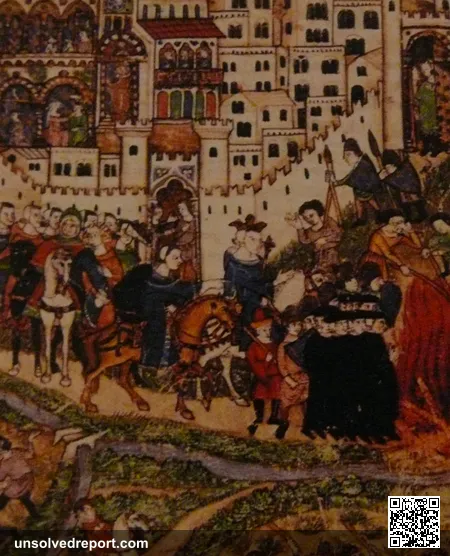
Then came the move. On Friday, October 13, 1307, in a single coordinated strike across the whole of France, Philip's agents kicked in the doors and arrested the Templars all at once. The charges were grotesque and almost certainly invented from scratch: heresy, blasphemy, idol worship, spitting on the cross, obscene secret rituals. Under torture, or the raw terror of it, many of the knights confessed - including the Grand Master himself, Jacques de Molay. Most of them would take it all back later. The date, the coordinated raid, the charges - it is all firmly documented. And so is the real reason behind it: a king drowning in debt, lunging at the one creditor he could not control.
The vault that came up short
And here is the detail that launched a thousand treasure hunts.
When Philip's men finally cracked open the Paris Temple - the order's great financial nerve center, the place where the gold should have been piled to the rafters - the cash they found was reportedly far less than the crown had counted on. The mountain of treasure the king was banking on simply was not there.
That single fact is the seed of the entire legend. So let us be careful with it, because it is genuinely slippery. Maybe the Templars saw it coming - Philip's intentions had been building for a while - and quietly moved or hid some of their liquid wealth before the doors caved in. That is possible. But here is the unglamorous flip side: maybe the expectation was just inflated. Maybe most of the order's wealth was locked up in land and outstanding loans, not stacked as coins in a cellar. And a working treasury that doubled as the royal bank would not necessarily be sitting on a giant cash surplus on any given Tuesday anyway.
So a vault that came up lighter than hoped is not proof that someone spirited a hoard away in the night. It fits a secret escape - sure. But it fits just as neatly with the wealth never having existed in the shape the legend demands.
Follow the money - all of it
This is where the romance runs straight into a wall of paperwork. And honestly? The paperwork is the better story.
The Templars were not wiped out the morning after the arrests. Their fate dragged out over years. Then, at the Council of Vienne in 1312, Pope Clement V formally dissolved the order by decree. And here is the crucial part everyone forgets: the Pope did not let the treasure vanish into thin air. He ordered Templar property handed over, largely, to the Knights Hospitaller - the Templars' great rivals.
On paper. In reality, much of it never completed the trip. The handover was fought over, dragged out, and left half-finished. Secular rulers - Philip first in line - skimmed enormous sums off the top: "compensation" for the cost of the trials, seized movable goods, assets that simply never left royal hands in the first place. The Hospitallers got legal title to a vast stretch of land and then had to claw, for years, to actually get their hands on it. As a parting gift, they inherited the order's debts too.
So follow the trail and you do not hit a continent-sized hole that only a secret hoard can fill. The famous Templar fortune has a destination, even if it is a messy one: absorbed by the Hospitallers in name, quietly stripped by the crowns of France and other kingdoms in fact. The money was largely accounted for. Not dramatically. Bureaucratically. Which is somehow the most medieval ending of all.
Fire on the island
The human ending is grim, and it is recorded in unsettling detail.
March 1314. After years rotting in prison, Jacques de Molay - the last Grand Master - was led onto a small island in the Seine, in the heart of Paris, and burned alive at the stake. Beside him died Geoffroi de Charney. In their final moments both men did something stunning: they publicly took back their forced confessions and declared the order innocent before the watching crowd. That defiance is documented. What is not - what is pure legend - is the story that crept in afterward: that de Molay screamed a curse from the flames, summoning both king and pope to answer before God within the year. Eerie footnote: both men did die within that year.
With de Molay gone, the order was finished. But here is the twist that quietly demolishes half the conspiracy theories - the surviving knights were not hunted into oblivion. Most were pensioned off, folded into other orders, or simply set free to walk away. Remember that. It matters for everything that comes next.
The legends, weighed one by one
Into the vacuum left by that lighter-than-expected vault rushed an extraordinary flood of speculation. It deserves a straight answer, not a shrug. So let us put each legend on the scale.
- The ghost fleet of La Rochelle. The story goes that on the eve of the arrests, a Templar fleet slipped silently out of the port of La Rochelle, holds heavy with treasure, and sailed off the edge of history, never seen again. Thrilling. The trouble is the contemporary record shows almost nothing to back a specific treasure fleet - it is largely a much later reconstruction. The Templars did own ships, and individual vessels surely dodged the dragnet. But a coordinated treasure armada vanishing over the horizon? That is romance, not record.
- Scotland and Rosslyn Chapel. Modern Templar lore loves this one: fugitive knights flee to Scotland, turn the tide for Robert the Bruce at Bannockburn in 1314, and stash their treasure beneath Rosslyn Chapel. Rosslyn is real, and it is breathtaking - an intricately carved chapel raised by the Sinclair family. The snag is the calendar. It was built in the 15th century, well over a hundred years after the order was crushed. The Templar-Rosslyn connection is a late invention, dreamed up by 20th-century authors and fiction, not a medieval fact.
- Oak Island, Nova Scotia. Then there is the idea that the Templars hauled their fortune across the Atlantic and sank it into the legendary Money Pit on Oak Island. It rests on exactly zero documentary evidence of any Templar presence anywhere in the Americas. People have spent centuries and small fortunes digging there. They have pulled up no Templar treasure and not a single Templar artifact.
- Portugal and the Order of Christ. Now this one is different - it has a real beating heart of truth. In Portugal, the Templars were not destroyed at all. With royal backing, they were quietly reborn as the Order of Christ, which inherited the Templar estates and later helped power the great age of exploration. That is genuine history. But notice what it actually is: an institution changing its name and surviving, not a band of monks burying a chest in the dark.
Fact, hunch, and fairy tale
So let us lay the cards face up, three piles, no blur between them.
What the documents prove: The Templars were a fabulously wealthy banking and military order. Philip IV, deep in debt to them, arrested them on October 13, 1307, on fabricated heresy charges. The Paris treasury yielded less than expected. The order was suppressed at the Council of Vienne in 1312, with its assets ordered transferred to the Hospitallers. Jacques de Molay burned in 1314. And in Portugal, the order lived on as the Order of Christ.
What we can reasonably infer: Most of the wealth was swallowed by the Hospitallers in title and by greedy crowns in practice. Any treasure hidden before the arrests was likely modest - a clever stash, not a continent-spanning fortune.
Pure fairy tale: The ghost fleet of La Rochelle, the vault under Rosslyn Chapel, the Oak Island hoard, the Grail and the Ark, and the immortal secret brotherhood guarding it all. Later inventions, every one, with nothing in the medieval record to hold them up.
Strip it all back, and the true story of the Templar gold turns out to be a tale of medieval banking, royal greed, and the slow grinding machinery of confiscation. You do not need a buried hoard to explain where the money went. The documents already did that. What is left is a smaller, sharper, human-sized mystery - and far more believable for it.
And maybe that is the real lesson the Templars left behind: the most seductive treasures are the ones that never existed, because a story you can never disprove is a story that never has to end. Which raises a quieter, more uncomfortable question for the next legend you fall in love with - what else have we been digging for, in a place where nothing was ever buried?
Sources & further reading
- Deseret News - This Week in History: The Knights Templar Are Arrested - https://www.deseret.com/2013/10/16/20527642/this-week-in-history-the-knights-templar-are-arrested/
- History Hit - How the Knights Templar Were Eventually Crushed - https://www.historyhit.com/how-the-knights-templar-were-eventually-crushed/
- Wikipedia - Trials of the Knights Templar - https://en.wikipedia.org/wiki/Trials_of_the_Knights_Templar
- Wikipedia - Jacques de Molay - https://en.wikipedia.org/wiki/Jacques_de_Molay
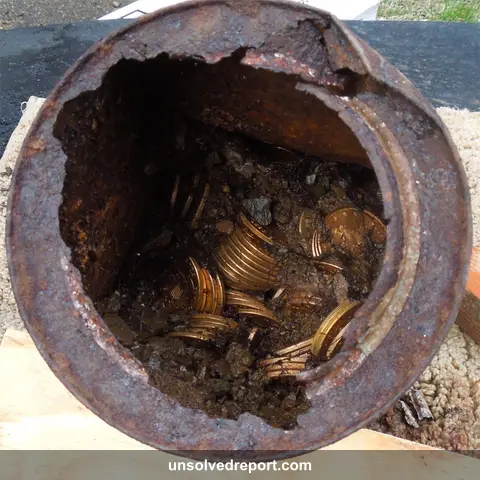
Saddle Ridge Hoard: $10M in Buried Gold Nobody Can Explain
The Saddle Ridge Hoard: $10M in gold coins dug up under a California tree in 2013. We know everything about it — except who buried it, and why.
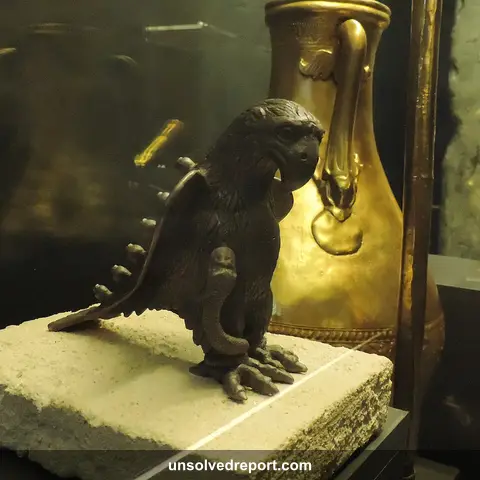
Pereshchepina Treasure: 800 Objects, One Unproven Royal Grave
75kg of gold and silver, 800+ objects, one boy's stubbed toe in 1912 — is the Pereshchepina Treasure really Khan Kubrat's grave? The evidence still splits historians.
São João Shipwreck 1552: The Treasure No One Has Ever Found
One of the richest ships to ever sail from India broke apart on a wild African coast in 1552. Her treasure vanished. Nobody has ever found it — why?