Oualata, Mauritania: The Ksour Mystery No One Can Date
Oualata's painted walls are repainted by hand every year, erasing the evidence — so how old is this Mauritania ksour really? Even UNESCO won't say.
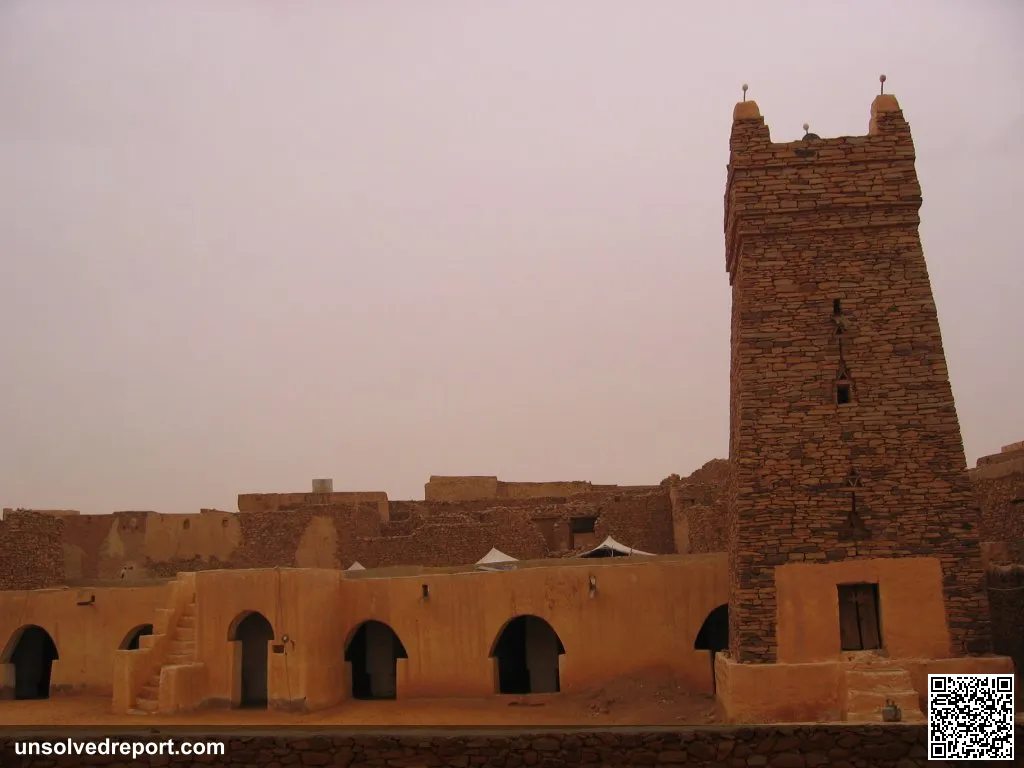
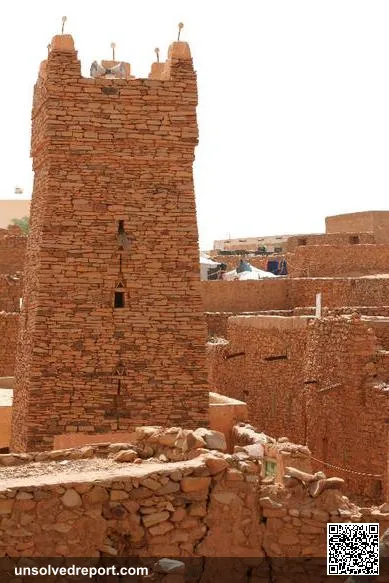
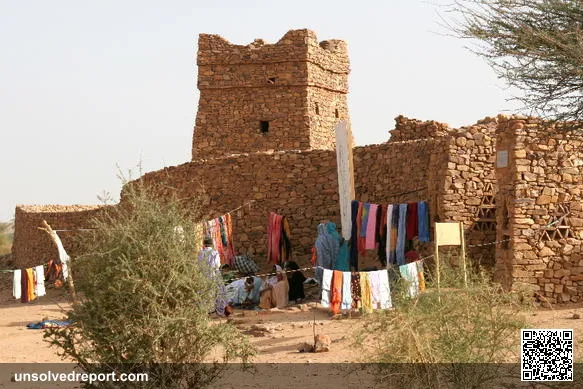
Walk to the far eastern edge of Mauritania, to the line where the green Sahel gives up and the real desert begins. There, a small reddish town grips a rocky ledge like it's holding on for dear life. From a distance the houses are just the color of the sand. Then you get close. And the walls come alive — white and ochre swirls, lattices, triangles, curling around every doorway like lace pressed into mud by hand. This is Oualata. Once it was a glittering end-of-the-line for camel caravans loaded with gold. Today the dunes creep up to its doorsteps, and inside the houses, centuries-old books are slowly turning to dust. It's gorgeous. It's dying. And it holds a question that even the experts can't answer.
What We Actually Know
Start with the things we're sure of. Oualata is one of four desert towns that together make up a single UNESCO World Heritage Site — the Ancient Ksour of Ouadane, Chinguetti, Tichitt and Oualata, added to the list in 1996 under cultural criteria (iii), (iv), and (v), with the reference number 750 (UNESCO World Heritage Centre). A "ksar" (say it "ksar"; the plural is "ksour") is a fortified Saharan settlement. UNESCO calls these four some of the finest surviving examples anywhere of the medieval caravan towns and the nomad culture that kept them alive (UNESCO; African World Heritage Sites).
Now picture the town at its peak. Around the start of the thirteenth century, Oualata took over from the older trading post of Aoudaghost to become the main southern gateway of the trans-Saharan trade — the last stop on a route that ran south from Sijilmasa through the salt mines of Taghaza (Wikipedia: Oualata). Through this one town poured the great riches of the medieval Sahara: gold, salt, ivory — and enslaved people too — all loaded onto camels bound for the markets of North Africa, the same gold-hungry trade network that let Mansa Musa beggar Egypt's economy on his famous pilgrimage. The historian Raymond Mauny figured the medieval town held somewhere between 2,000 and 3,000 people (Wikipedia: Oualata).
All that money bought something unexpected: books. Oualata grew into a center of Islamic learning, and to this day its family libraries still guard manuscripts on Quranic science, law, astronomy, and poetry. One of them — the Taleb Boubacar (or Ben Baty) family library — holds 223 manuscripts, the oldest reaching back to the fourteenth century, a hoard of unread pages as tantalizing in its own way as the Voynich manuscript. In the 1990s, Spanish funding built a library to house more than 2,000 restored and digitized works (phys.org / AFP). "We inherited this library from our ancestors, founders of the town," the imam and library manager Mohamed Ben Baty told AFP (phys.org / AFP).
Then the slow fall began. From the fourteenth century on, Timbuktu kept growing while Oualata kept shrinking, until Timbuktu had stolen its job as the great southern caravan stop. The Mali Empire lost its grip on the town in 1433. The Mossi sacked it around 1480. And by 1509–1510, when the traveler Leo Africanus passed through, he wrote it off as "a small kingdom, and of mediocre condition" (Wikipedia: Oualata).
But the walls — the walls are the thing everyone comes for. Underneath, the buildings are sandstone, coated in "banco," a reddish mud plaster. Then the local women take over, painting geometric patterns in white, red, and indigo using pigments straight from the earth and the plants around them — henna, indigo, plant extracts (Wikipedia: Oualata; UNESCO gallery). Even the doors get the treatment: carved from acacia wood "and adorned with traditional motifs painted by local women" (phys.org / AFP). The skill passes from mother to daughter — watched, copied, learned by eye — and the patterns get repainted after every rainy season.
And here's the part that should worry you. Roughly 80% of Mauritania is being eaten by the spreading desert (phys.org / AFP). By the 1980s, the sand had buried the town's mosque so deeply that, as one preservation worker remembered it, "people were praying on top of the mosque" (phys.org / AFP). Today only about a third of the buildings are still lived in; the rest empty out as people leave to find work. The 2023 census counted 4,782 people in the town (Wikipedia: Oualata; phys.org / AFP). "Oualata is covered in sand everywhere," foundation member Sidi Mohamed Lemine Sidiya told AFP. "Our biggest problem is desertification" (phys.org / AFP).
The Question Nobody Can Answer
So here's the real puzzle, the one that won't go away: how old is Oualata, actually — and where did those painted walls come from?
Those two questions are knotted together, and pulling on one tugs the other. The town's documented golden age is medieval. UNESCO and historians date the four ksour to a founding "around the 11th century," when they sprang up as caravan rest stops (African World Heritage Sites). But Oualata's deepest layers may go much, much further down. The site was first settled by farming-and-herding peoples close kin to the Soninke, and some accounts call its stone settlements "among the oldest" anywhere on the African continent — a claim that echoes the nearby prehistoric cities of Dhar Tichitt, older than the Islamic trade town that made it famous (Wikipedia: Oualata). In other words, the busy caravan city might just be the latest chapter of a story that's been running for far longer — a story still buried, never fully dug up.
And the painted tradition only deepens the fog. The motifs are obviously old. But exactly where they came from? No one wrote it down. Are they an Islamic-era flourish? A Soninke inheritance from the deep Sahelian past? Or a blend forged by the Berber, Arab, Soninke, and Songhai peoples who all crossed paths at this desert junction? Here's the strange part: the art lives on perishable mud, gets redone by hand every single year, and was never written down, never signed. There's no archive to check. The walls keep erasing and remaking themselves — which means the true age of the tradition is, in a very real way, impossible to read from the walls alone.
The Best Guesses
Theory 1 — The roots run deep. One reading of the archaeology says Oualata's stone-building culture belongs to a very old, much wider Saharan settlement tradition — the same one that raised the prehistoric stone villages at nearby Tichitt — with the painted geometry handed down from native Soninke artistic practice. It's a believable idea, and it fits the "oldest stone settlements" picture. But to be clear, this is an interpretation, not a result that's been pinned down by excavation.
Theory 2 — A medieval melting pot. A rival reading says the decoration we see today took shape during the Islamic caravan years, mixing motifs that traveled in along the trade routes into something only Oualata makes. This one squares neatly with the town's known role as a crossroads of cultures from the 12th to 16th centuries.
The stories the town tells about itself. Then there's the local oral tradition, which ties certain patterns to named designs and household meanings — the triangular "broken calabash," for one — and treats the painting as protective and identity-bearing, not just pretty. These meanings are real and alive in the community. But they're passed down by word of mouth, so read them as living cultural memory rather than verified history — folklore, not the record book.
One thing, though, is not up for debate: the clock is ticking. With only a third of the houses still lived in and the dunes pressing closer every year, this question may not stay open much longer. If the answer ever comes, it'll have to be pulled out of the sand — before the sand finishes burying it for good. The next desert town over has its own buried secret — ask the vanished goldsmiths of Lohron. But that's a story for another day.
Sources & Further Reading
- UNESCO World Heritage Centre — Ancient Ksour of Ouadane, Chinguetti, Tichitt and Oualata and photo gallery
- African World Heritage Sites — Ancient Ksour of Mauritania
- Wikipedia — Oualata
- phys.org / Agence France-Presse — Ancient town and its manuscripts face ravages of the Sahara
Hinterkaifeck: The Killer Who Stayed for Dinner
Six people slaughtered on a Bavarian farm in 1922 — then someone fed the cows, lit the stove, and stayed for days. Who, and why, still has no answer.
Easter Island Moai Walking Mystery: The Legend Science Mocked
Elders swore the moai walked to their platforms. Scientists dismissed it as myth — until 18 people, 3 ropes, and a 4-ton replica proved something startling.
Taos Hum: The Sound Only 2% Can Hear—Machines Found Nothing
Only 2% of people near Taos, New Mexico can hear a strange low drone nobody else can — and government scientists never found where it comes from. Why?