Mansa Musa: The King Who Broke Egypt With Gold
In 1324 one king gave away so much gold that Cairo's economy crashed for over a decade. So where did the richest man in history's fortune actually go? Nobody's sure.
A king walks into Cairo and starts giving gold away. Not selling it. Giving it. To officials, to merchants, to strangers in the street. He hands out so much, so fast, that the price of gold itself falls through the floor — and stays down for more than ten years.
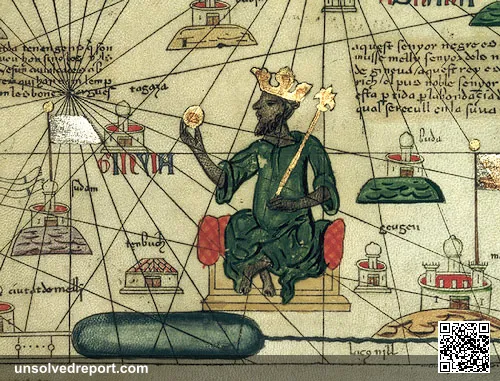
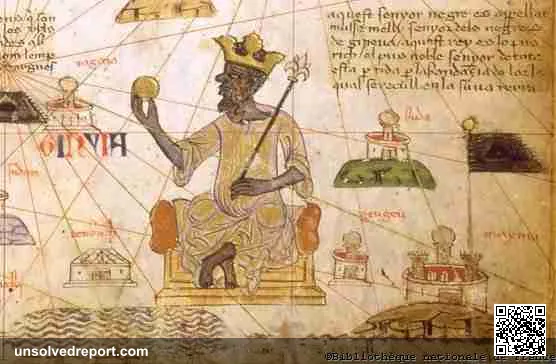
That king was Mansa Musa, emperor of Mali, and in 1324 he crossed the Sahara on his way to Mecca trailing a fortune behind him. The story has been retold for seven hundred years. But here's the part nobody likes to mention. Mali sat on top of one of the richest gold supplies the world had ever seen, and Musa scattered a treasure across two continents — yet we don't actually know where most of it went. Or even how much there was. So let's follow the gold.
What we know for sure
Start with the man. Mansa Musa ruled Mali from roughly 1312 to about 1337, and he is remembered as the empire's greatest leader (Britannica; EBSCO Research Starters). His wealth came straight out of the ground — gold panned from the river fields of Bambuk and Bure, near the upper Niger and Senegal, with the Akan goldfields of what is now Ghana folded in as Mali expanded (World History Encyclopedia), part of the same West African gold trade that built fortunes across the region. Picture thousands of independent miners hunched over shallow pits, each one coughing up just a few grams at a time. A cut of every find flowed up to the imperial treasury. And under Musa, exporting gold became, in effect, a royal monopoly (EBSCO).
Now the journey. Musa was a devout Muslim, and in 1324–1325 he set out on the hajj with what Arabic chroniclers describe as a city on the move. The numbers that survive are staggering, and they all trace back to later Arab writers: around 60,000 people, 500 enslaved attendants each carrying a gold staff weighing about six pounds, and 100 camels each hauling roughly 300 pounds of gold dust (Britannica). Read those figures the way historians do — not as a careful inventory, but as the wide-eyed impressions of people watching the spectacle pass by.
Here's where it gets unusually well documented. About a dozen years after the visit, the Egyptian scholar al-Umari went to Cairo and talked to people who still remembered it. By his account, Musa "left no court emir nor holder of a royal office without the gift of a load of gold," and the Malians "exchanged gold until they depressed its value in Egypt and caused its price to fall" (World History Commons). He even gave a number. The mithqal, a gold coin that used to trade above 25 dirhams, afterward never climbed past 22. "This has been the state of affairs for about twelve years until this day," al-Umari wrote, "by reason of the large amount of gold which they brought into Egypt" (World History Commons). Modern summaries put the drop at roughly 20 to 25 percent (World History Encyclopedia). One man's generosity reached into the pocket of every gold trader in Egypt.
Why did that matter so far beyond Cairo? Because West African gold was the lifeblood of the whole Mediterranean. It moved north by caravan, and at the medieval peak roughly two-thirds of all the gold circulating around the Mediterranean had started in West Africa — the same continent that also produced the golden rhinoceros of Mapungubwe further south — ending up in the mints of Castile, Genoa, Florence, and Venice from the late 1200s onward (World History Encyclopedia). And what came back the other way? Salt. Mined at Saharan sites like Taghaza, salt was so prized in the gold-rich, salt-starved interior that pound for pound it could nearly match gold in value. Read that again: salt, worth almost its weight in gold.
One piece of all this you can still touch today. When Musa came home, he brought the Andalusi architect Abu Ishaq al-Sahili with him, and around 1327 the Djinguereber Mosque rose at Timbuktu — built of mud brick, during his reign. UNESCO inscribed it as part of Timbuktu's World Heritage listing in 1988, and it is still a working mosque and place of learning (UNESCO/World History Encyclopedia; Wikipedia: Djinguereber Mosque). Seven centuries on, the gold may be gone — but the mosque it paid for still stands.
The question nobody can answer
So here's the strange part. For all the breathless detail, we genuinely do not know how much gold Musa carried, how much he gave away, or where the bulk of it finally landed. There is no ledger. No receipt. The famous numbers come from chroniclers writing years later, working from secondhand stories — and you know how a good story grows in the telling. Those headlines that crown Musa "the richest person in history"? They're modern estimates stacked on top of medieval impressions, and serious historians warn that no figure can really be checked.
The gold's fate is just as murky. Some of it clearly poured into Cairo's markets and crushed the price, exactly as al-Umari recorded. Some was reportedly bought back. The rest? It vanished into a sprawling, undocumented machine of caravans, mints, mosques, and merchants stretching across the Sahara and the sea — the same continent-spanning pattern that turned gold into stone at Great Zimbabwe far to the south. And here's the cruel twist: gold can be melted and reused forever, so no coin, no ingot, can be traced back to a single source. So no — Musa's gold is not sitting in a hidden cave waiting for a treasure hunter. It dissolved into the medieval world economy and was melted down and recoined again and again. The real mystery isn't where the treasure is buried. It's how much there ever was, and how completely it reshaped markets that left almost no trace behind.
Theories and interpretations
The buyback (well supported). Plenty of popular and secondary accounts say that on the road home, once Musa realized the chaos he'd left behind, he borrowed gold back from Cairo's money-lenders at steep interest — helping prices recover. It's plausible, and it gets repeated everywhere. But be honest about the evidence: it's less firmly pinned down in the surviving primary excerpts than the price crash itself. Treat it as likely, not proven.
A real shock — but a local one (mainstream economics). The calmest reading is that Musa's spending triggered a genuine, regionally serious gold inflation in Egypt that lasted about twelve years — exactly what al-Umari described — without "collapsing" anyone's economy. Some sources gently push back on the louder claim that the "gold standard nearly collapsed," pointing out that it was medieval writers, not modern economists, who made that call (EBSCO).
The "lost hoard" (treat with skepticism). The romantic idea that Musa's gold lies hidden somewhere is treasure-hunting legend, not history. No reputable source describes a missing cache. The gold was spent, gifted, and recirculated — which is the whole reason it can't be found in one place.
Strip away the doubt and one thing stands rock solid: a 14th-century African emperor's act of religious generosity rippled through Mediterranean markets hard enough that we're still talking about it seven hundred years later. The dazzling numbers may be inflated. But the dent in Egypt's gold price was real — and so is the mosque still standing at Timbuktu, waiting for anyone who wants to go look.
Sources & further reading
- Britannica — Musa I of Mali: https://www.britannica.com/biography/Musa-I-of-Mali
- EBSCO Research Starters — Mansa Musa (biography): https://www.ebsco.com/research-starters/biography/mansa-musa
- World History Commons — Al-Umari's Account of Mansa Musa's Visit to Cairo (primary source): https://worldhistorycommons.org/al-umaris-account-mansa-musas-visit-cairo
- World History Encyclopedia — The Gold Trade of Ancient & Medieval West Africa: https://www.worldhistory.org/article/1383/the-gold-trade-of-ancient--medieval-west-africa/
- The Metropolitan Museum of Art — The Trans-Saharan Gold Trade (7th–14th Century): https://www.metmuseum.org/essays/the-trans-saharan-gold-trade-7th-14th-century
- World History Encyclopedia — Djinguereber Mosque, Timbuktu (UNESCO listing): https://www.worldhistory.org/image/10126/djinguereber-mosque-timbuktu/
- Wikipedia — Djinguereber Mosque (construction date, al-Sahili, UNESCO 1988): https://en.wikipedia.org/wiki/Djinguereber_Mosque
Padmanabhaswamy Temple Vault B: The $22B Door Nobody Dares Open
Padmanabhaswamy Temple Vault B has stayed sealed since the 1880s, right next to $22 billion in gold. Officials could open it. They won't. Here's why.
Oak Island Money Pit: The 200-Year Mystery Nobody Can Solve
200 years, millions of dollars, six deaths — and still no treasure. So what's really down the Oak Island Money Pit? The evidence points somewhere stranger.
Kruger Millions: The Lost Gold Nobody Can Fully Account For
A republic loaded its gold onto a train and fled the British army. The treasure was real — but a quarter-million ounces still won't add up. Here's why.