Golden Sun Bird Mystery: The Vanished City China Can't Explain
A 20-gram gold disc dug up by accident in 2001 may be the only clue to where an entire Bronze Age civilization went. So where did Sanxingdui's people actually go?
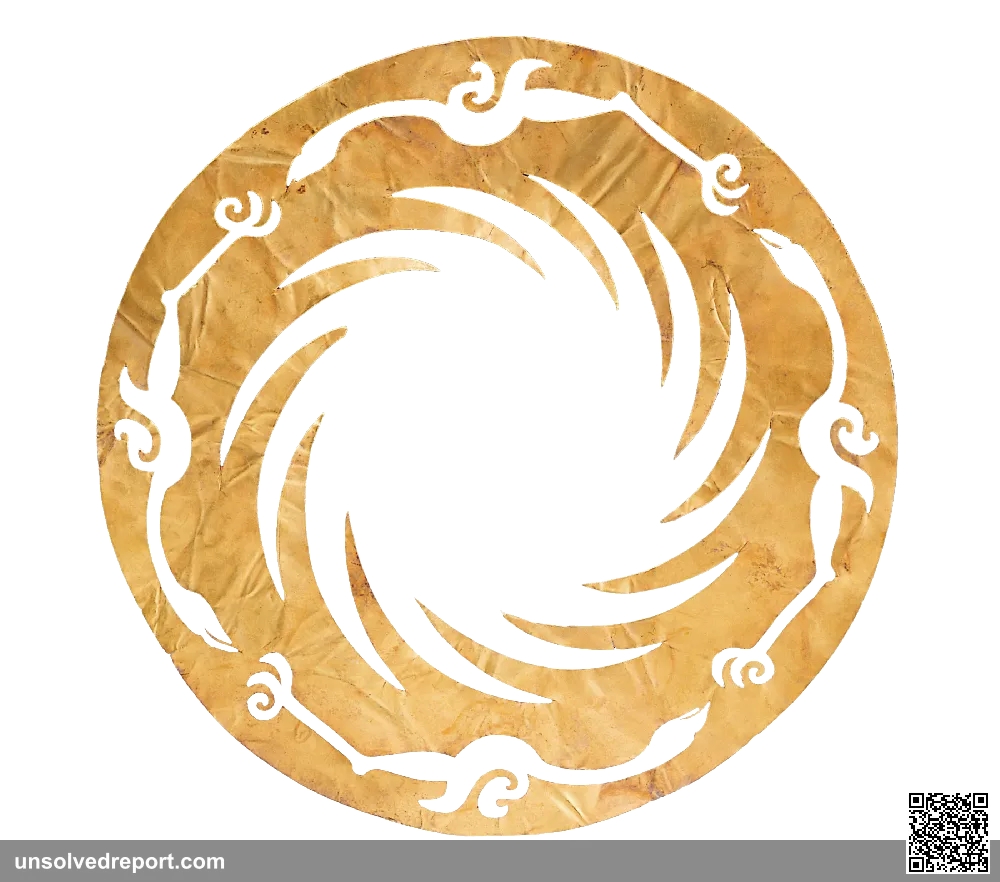
A construction crew in Chengdu, in China's Sichuan Province, was just turning over ordinary dirt in 2001 when their tools hit something that shouldn't have been there. It was gold. Not a coin, not a lump, but a thin disc of pure foil so delicate it could shiver in a single breath. On it: four birds, frozen mid-flight, chasing each other in a ring around a blazing sun.
Today that little disc, the Golden Sun Bird, is one of the most famous images in all of China. But its calm beauty is hiding something. The people who made it seem to have inherited the soul of a far greater city, a city that was suddenly emptied out and walked away from, only about 30 miles away. So here's the question that won't let go: where did the people of Sanxingdui actually go? And did they carry their fire-bright sun gods with them?
What We Know For Sure
Start with the gold itself. It turned up at the Jinsha site, dug up entirely by accident on February 8, 2001, when crews were working the Chengdu Plain (Wikipedia, Jinsha site). Hold it in your hand and you'd barely feel it. The ornament spans about 12.5 centimeters, is roughly 0.02 centimeters thick, weighs around 20 grams, and is made of nearly pure gold, about 94.2 percent (Wikipedia, Golden Sun Bird). Four birds wheel in the same direction around a central sun, its points stabbing outward like flames. It dates to the region's late Bronze Age. People loved it so much that in 2011 the city of Chengdu made the motif part of its official imagery, and it became the logo of the Jinsha Site Museum (Wikipedia, Golden Sun Bird).
Jinsha wasn't built overnight. It thrived during the late Shang dynasty and Western Zhou periods, tied to what's called the Shi'erqiao culture (roughly 1200–800 BCE), and then the settlement seems to have quietly faded sometime between about 500 and 200 BCE (Wikipedia, Jinsha site). What it left behind is staggering: dozens of gold artifacts, hundreds of bronze and jade pieces, and thousands of pottery vessels (Wikipedia, Jinsha site).
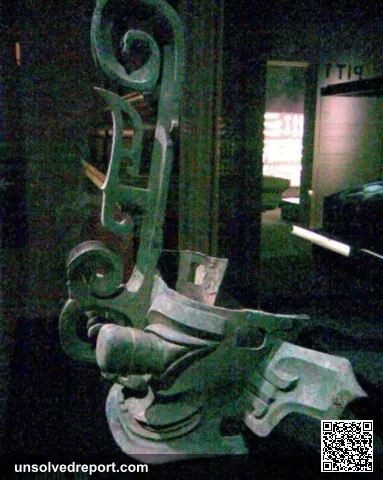
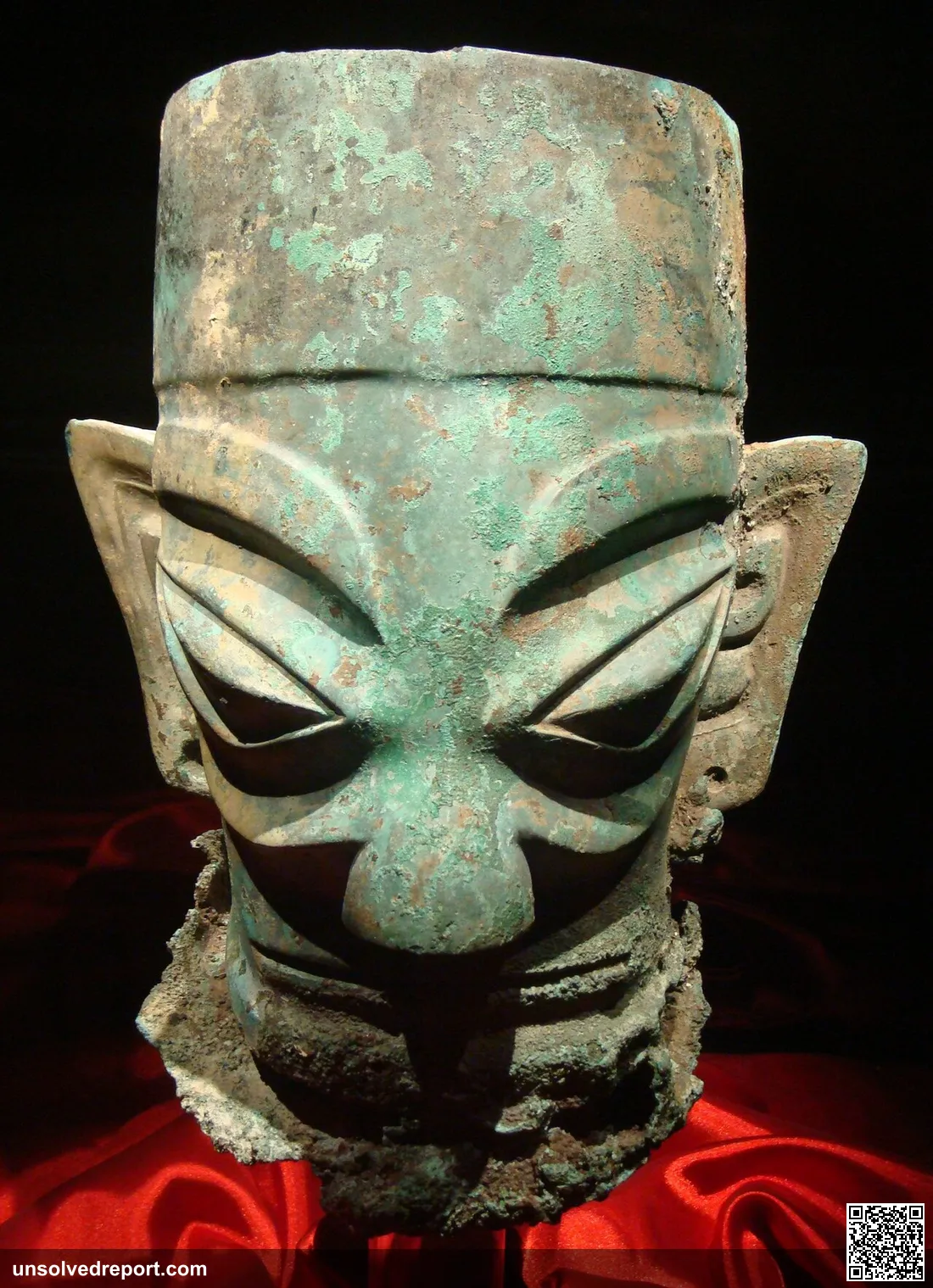
Now meet the older city. Sanxingdui, near Guanghan, sits about 40 kilometers (roughly 30 miles) from Jinsha, and it is famous for something genuinely unnerving: pits stuffed with treasure that someone smashed to pieces and buried on purpose. Between 2020 and 2022, archaeologists opened six newly found pits and pulled out around 13,000 artifacts, including 1,238 bronze items, 543 gold artifacts, and 565 jade objects, plus jaw-dropping finds like giant bronze masks, a bronze sacrificial altar, and a bronze box with a tortoise-shaped lid (Smithsonian Magazine). Radiocarbon dating put several of the pits, the largest among them, somewhere between roughly 1200 and 1010 BCE, overlapping the late Shang dynasty up north (CGTN).
Here's where it gets strange. Two facts make Sanxingdui one of 15 ancient mysteries archaeologists still can't explain. First, there are no written records and no human remains directly tied to the Sanxingdui culture that survive today, so these people never get to tell us a single thing about themselves (Smithsonian Magazine), a silence as total as the undeciphered Indus script left behind by another Bronze Age culture that never explained itself. Second, Sanxingdui's glory ends and Jinsha's begins in a way that looks less like coincidence and more like a handoff. Many scholars think Jinsha rose up as a new center right after Sanxingdui declined, and the two sites share deep artistic and ritual fingerprints (Wikipedia, Jinsha site). The Golden Sun Bird is the loudest clue of all: that flaming solar circle echoes the very sun-worship carved into Sanxingdui's bronze sacred trees and figures.
The Question Nobody Can Close
Let's say it plainly. We can see Sanxingdui's huge walled city was abandoned, the kind of sudden emptying-out that echoes Cahokia's own mysterious decline in North America or the Classic Maya collapse centuries later. We can see a near-twin culture flare up nearby at Jinsha soon after. What nobody has been able to prove is the thread connecting them: exactly why Sanxingdui ended, whether its people physically packed up and moved to Jinsha, and how a society that left behind no readable writing managed to pass on something this specific, the circling birds, the radiant sun, across that gap.
The missing texts and missing bodies are the whole problem. With no writing, we can't confirm a single name, belief, or political event from the inside. With no burials, we can't easily test whether the same people simply continued. So the link between the two cities, as convincing as it feels, leans mostly on matching style and good timing rather than hard proof. This is the exact kind of gap where careful history stops and honest guesswork has to take over.
So What Actually Happened?
Theory 1: The earthquake that rerouted a river. One idea that gets talked about a lot comes from Niannian Fan, a river scientist at Sichuan University. He suggests a massive earthquake set off a landslide high in the mountains, which knocked the Minjiang River off its course, choked off the water Sanxingdui depended on, and forced its people to pull up roots and resettle at Jinsha (Archaeology Magazine, Archaeological Institute of America). Worth being clear: this is a hypothesis built on preliminary clues, including satellite imagery and historical records, not a closed case. One archaeologist called it among the more rational explanations out there, while pointing out that it still can't explain why all those sacred objects were deliberately smashed and buried in the pits (Archaeology Magazine). A strong lead. Not a verdict.
Theory 2: War, chaos, or a ritual goodbye. Other guesses point to warfare and flooding, and the pits themselves hint at something dramatic and final, a community taking its most sacred treasures and ritually breaking and burying them (Smithsonian Magazine). Was it a sign of defeat? A change of dynasty? A planned move? Nobody knows. This one is open speculation.
Theory 3: They never left, they just became Jinsha. The simplest read is that the people didn't vanish at all. The heart of the ancient Shu world just shifted from Sanxingdui to Jinsha, dragging its sun-and-bird religion along with it (Wikipedia, Jinsha site). Later Chinese stories about the Shu kingdom, like the Jin-dynasty Chronicles of Huayang, even remember legendary rulers such as Cancong and Yufu, but those tales are a tangle of myth and history written down long after the fact, and they can't be matched cleanly to the archaeology (HandWiki, History of Shu)). It's the mainstream view, but the fine print is still unproven.
Spin the Golden Sun Bird in your mind, and the four birds never stop circling that sun. They just keep turning, forever. And that endless turning is the perfect emblem for the mystery itself: a people who seem to have moved, changed, and carried their light forward, without ever once telling us, in their own words, how they did it.
Sources and Further Reading
- Wikipedia, Golden Sun Bird and Jinsha site
- Smithsonian Magazine, Trove of 13,000 Artifacts Sheds Light on Enigmatic Chinese Civilization
- Archaeology Magazine (Archaeological Institute of America), Seismic Shift
- CGTN, Sanxingdui's No. 4 pit dates back up to 3,200 years
- HandWiki, History: Shu (kingdom))
Flor de la Mar: The Richest Wreck Never Found
A Portuguese carrack sank off Sumatra in 1511 loaded with a sultan's fortune. Centuries later, still no proof the Flor de la Mar was ever found. Here's why.
Cuerdale Hoard: 88 Lbs of Viking Silver Nobody Ever Reclaimed
88 pounds of Viking silver, buried by a river in 905 AD and never dug up again. The largest hoard ever found — so who owned it, and what stopped them coming back?
Lohron Gold Trade: The Goldsmiths Nobody Remembers
Six-meter walls still stand empty in the Burkina Faso bush. The Lohron ran a gold fortune here, then vanished so fully their own neighbors can't name them. Why?