Seahenge: The 4,000-Year-Old Mystery Nobody Can Explain
Seahenge: a Norfolk tide gave back a 4,000-year-old oak circle felled in 2049 BC. The facts are exact — so why does nobody know what it was for?
Spring 1998. A man named John Lorimer is wading the mudflats at Holme-next-the-Sea, on the Norfolk coast, hunting for shrimp. He'd already pulled a Bronze Age axe head out of the silt nearby. Then he spots a tree stump that has no business being there. He keeps watching. Tide after tide, the sea peels back the sand and the peat like a curtain — and reveals what had been hidden for four thousand years.
A ring of weathered oak posts. And at its center, a single enormous tree, dragged up by the roots and turned completely upside down, its roots clawing at the open sky.
The newspapers called it "Seahenge." Archaeologists call it Holme I. Whatever you call it, it's one of the strangest prehistoric monuments ever pulled from British ground — and here's the part that still gnaws at the experts: we know almost everything about it except the one thing that matters. We don't know what it was for.
What the wood tells us — to the year
Most ancient things blur. This one snaps into focus. Tree rings and radiocarbon don't just place Seahenge in the Bronze Age — they pin the year the oaks were cut: 2049 BC. And the science goes finer still. The state of the sapwood says the trees came down in the spring or early summer of that single year (Wikipedia summary of the excavation findings; British Museum). One season. A monument forty centuries old, dated tighter than some events from a thousand years ago.
Now picture the thing itself. A rough circle — slightly egg-shaped, about 7 by 6 metres, roughly 21 feet across — built from 55 split oak trunks rammed about a metre into the ground, bark turned outward like a wall of skin (Wikipedia). One timber had a narrow Y-shaped fork: a doorway, clearly made on purpose. And in the dead center, that upside-down giant. Its roots reached up where a crown should be. Analysis put the central tree at about 167 years old when it was felled (explorenorfolk and Holme-next-the-Sea local history) — older than the country it now sits in.
Here's where it gets eerily intimate. Waterlogged peat is a thief that keeps everything, so it kept the toolmarks. Run a 3D scan over the cut surfaces and you can read the individual axes — each bronze blade left its own fingerprint in the wood. Researchers have counted the signatures of more than fifty separate axes across the timbers (British Museum). Fifty-plus axes means this wasn't one person and a quiet afternoon. It means a crowd — maybe a whole community, maybe an extended family — bending their backs together to raise it.
The monument didn't get to stay on its beach. Starting in late 1998, Mark Brennand of the Norfolk Archaeological Unit led the dig, and English Heritage made the call that split the room: pull the timbers out before the sea ground them to nothing. Some locals fought it. So did modern Pagan groups, who wanted it left exactly where it lay (Wikipedia). The wood won a stay of execution. It went to Flag Fen in Cambridgeshire, soaked in fresh water and polyethylene glycol to keep it from collapsing as it dried. A reconstruction and the real timbers opened to the public at the Lynn Museum in King's Lynn in 2008, and a piece later traveled to the British Museum's 2022 "World of Stonehenge" show (British Museum; Lynn Museum).
And then there's the twist that quietly rewrites the whole story. Seahenge wasn't alone. About 100 metres away sat a second monument — Holme II — two rings inside rings, circling a pit lined with woven hurdles and holding two oak logs. The tree rings handed back the same felling date: 2049 BC. It was the first time anyone had proven two neighboring prehistoric monuments were built in the very same year (Wikipedia). Unlike its famous twin, Holme II was left where it was found — and the tide is still wearing it away, right now.
The question no one can answer
Here's the strange part. We've got the when down to a season. The how down to the axe. Even roughly the who. The one thing missing is the why.
No bodies turned up at Seahenge. No grave goods to whisper a purpose. No writing — Bronze Age Britain didn't have any. The people who dug it up said so plainly: they could not tell you what it was for. And the landscape that might have held the answer? The sea swallowed it ages ago. The clues that could have closed the case are simply gone.
What keeps you up at night is that one image at the heart of it: a living tree, deliberately ripped from the earth and flipped, roots straining toward the sky inside a tight wooden cage. That feels like a statement. A symbol. But a symbol of what? Four thousand years on, we're staring at a sentence with every word erased — and only the punctuation left.
So what was it? Three stories, no proof
Everything from here is guesswork. The people who study Seahenge mostly agree the why is unsolved, so treat what follows as rival ideas, not answers.
Idea one: it was for the dead. A long-running theory — tied to archaeologist Francis Pryor, among others — says Seahenge wasn't a gathering place at all. It was a place to leave the dead. Picture a body laid out on that upturned stump and left exposed, so the flesh fell away before the bones were gathered up and buried somewhere else. In this reading, the inverted roots become an altar straddling two worlds — the living above, the ancestors below. Some museum displays have described the central stump in just those terms. Pryor and others have drawn a loose comparison to "sky burial" traditions found elsewhere on Earth — while underlining, hard, that there is no direct evidence of any bodies at Holme I (Wikipedia, summarizing this debate).
Idea two: it was a spell to hold back the cold. A newer theory comes from Dr. David Nance of the University of Aberdeen, published in the peer-reviewed journal GeoJournal in 2024. His starting point is the weather. The end of the third millennium BC was turning brutal — cold snaps, springs that wouldn't arrive, crops failing, the strain felt clear across Europe and Asia (University of Aberdeen; Smithsonian Magazine). Nance argues Seahenge was lined up with the summer solstice sunrise, the same kind of Bronze Age skywatching encoded in the Nebra Sky Disc, and worked as a piece of sympathetic magic — a "pen" echoing old folklore about caging a cuckoo, the bird that meant fertility and summer, to keep it singing and stretch the warm months out (Popular Science). In the same paper he suggests Holme II ties into rituals of sacrifice. It's a bold weave of archaeology, climate data, astronomy, and later folk tales — and, as Nance says himself, a hypothesis, not a verdict. Critics push back that reading specific Bronze Age beliefs out of folklore recorded thousands of years later is shaky ground at best.
Idea three: honestly, we may never know — and that's the truth the experts keep landing on.
What isn't in doubt is the human heart of it. A community in 2049 BC, working bronze tools in one short season, raised two monuments side by side for reasons they understood completely — and we may never get back. The sea hid Seahenge for four thousand years, then handed it over for a moment. The facts are rock solid. The meaning is still out there, somewhere with the tide.
Sources & further reading
- British Museum — "The art of Seahenge": https://www.britishmuseum.org/blog/art-seahenge
- Wikipedia — "Seahenge" (excavation, dating, Holme II, interpretation): https://en.wikipedia.org/wiki/Seahenge
- University of Aberdeen — research news on Dr. David Nance's study: https://www.abdn.ac.uk/news/23205/
- Smithsonian Magazine — "England's Mysterious 'Seahenge' Monument May Have Been Built to Prolong Summer": https://www.smithsonianmag.com/smart-news/englands-mysterious-seahenge-monument-may-have-been-built-to-prolong-summer-180984467/
- Popular Science — "What is 'Seahenge'?": https://www.popsci.com/science/seahenge/
- Lynn Museum (Norfolk Museums) — Seahenge gallery: https://lynnmuseum.norfolk.gov.uk/article/30498/Seahenge-gallery-at-Lynn-Museum
- Holme-next-the-Sea local history — Seahenge: https://www.holme-next-the-sea.co.uk/history/seahenge/
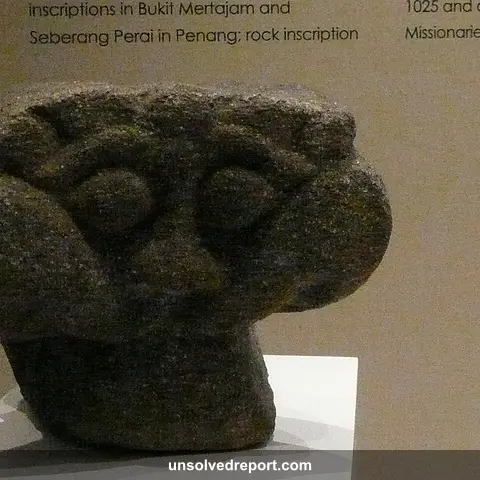
Bujang Valley: SE Asia's Oldest City Is 90% Buried
Beneath Malaysian palm groves lies what may be Southeast Asia's oldest civilization — iron furnaces, river jetties, and 90% still buried. So how old is it really?
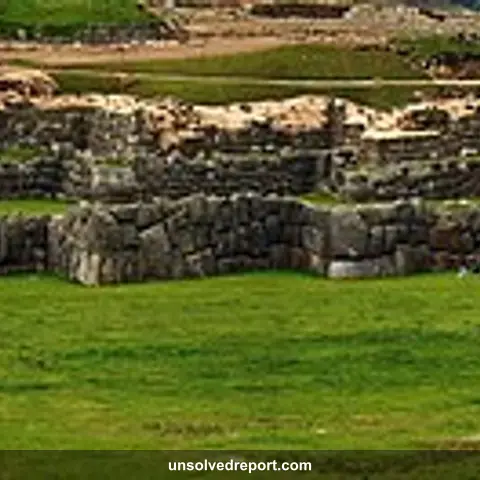
Sacsayhuaman: The 100-Ton Stones That Won't Budge
No mortar, no iron tools, no wheels, yet these 100-ton Inca stones fit so tight a paper can't slide between them. How did Sacsayhuaman get built?
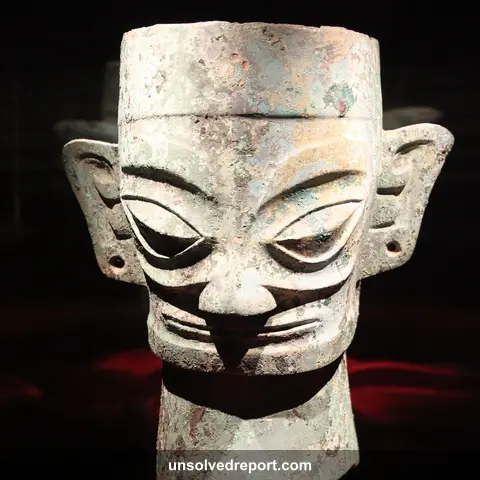
Sanxingdui Bronze Masks Mystery: China's Buried, Burned Gods
Sanxingdui's bronze masks bulge eyes on stalks and hide a 3,000-year secret — smashed, burned, buried by their makers. Why destroy your own gods?