Shag Harbour UFO 1967: The Object the Navy Never Found
In 1967 at Shag Harbour, three police officers watched a UFO sink into the Atlantic. Navy divers searched for days. So where did it go?
It was 11:20 at night when the lights came down over the water.
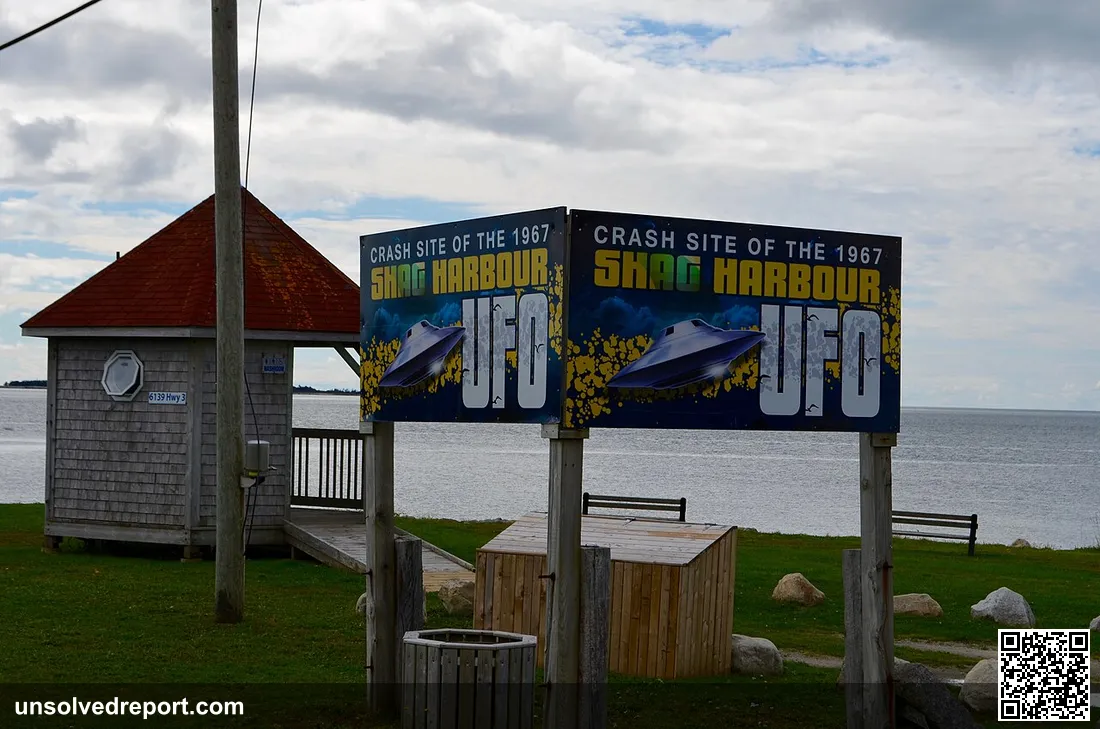
Four of them, glowing orange, drifting low and silent over a tiny fishing village on the southern tip of Nova Scotia. Then they tilted. Then they dropped, fast, slamming into the cold Atlantic with a flash and a boom that locals would later compare to a bomb going off. Within an hour, three uniformed Mounties were standing on the shore in the dark, staring at a pale yellow glow floating half a mile out — something that was very clearly still there. And nobody, to this day, knows what it was.
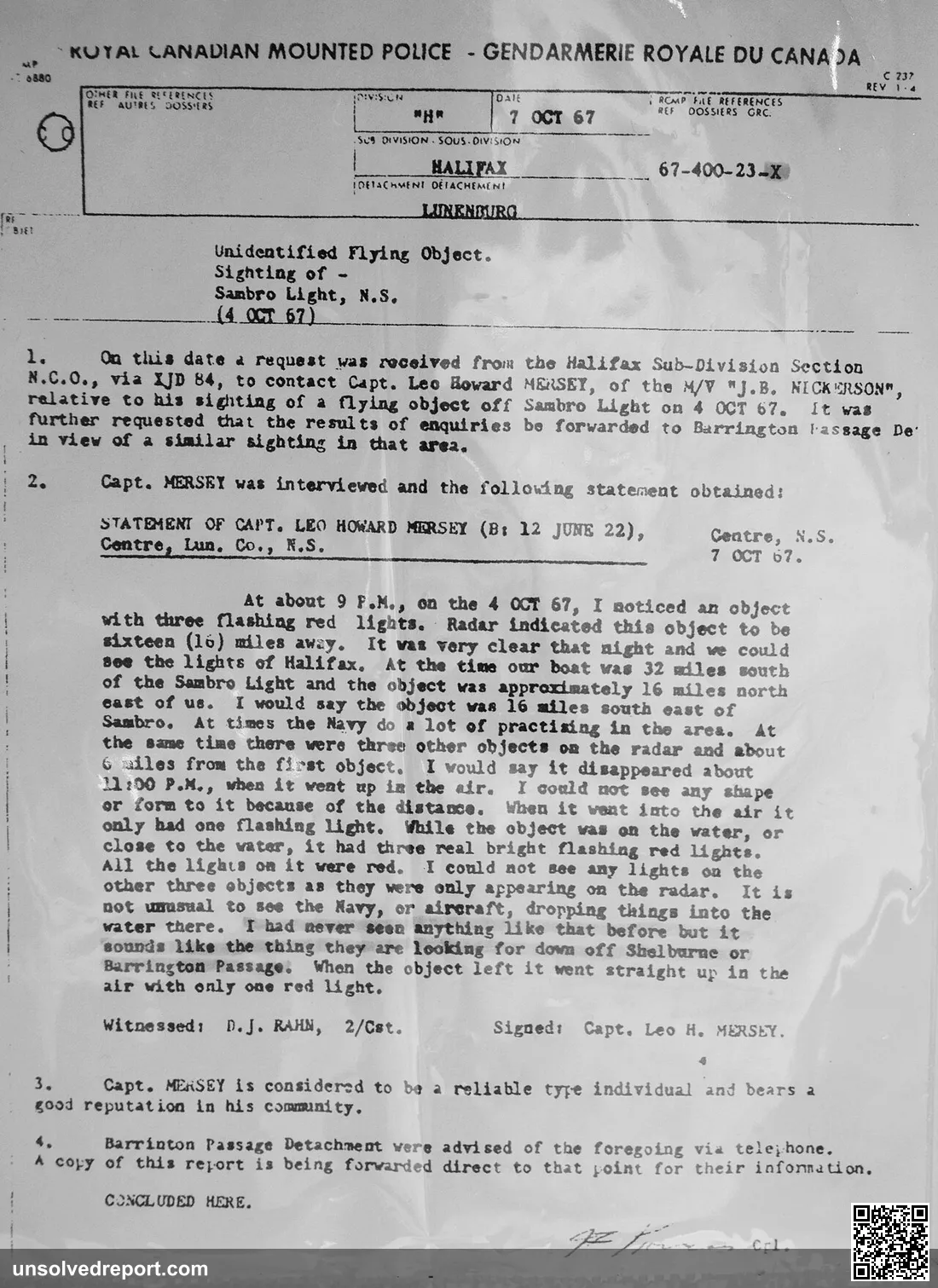
This is the Shag Harbour incident. And here is what makes it different from almost every other UFO story you have ever heard: the Canadian government wrote it all down. In their own files. In their own words. They even gave it a name. They called it a UFO.
The Documented Facts
On the night of October 4, 1967, a 20-year-old named Laurie Wickens and four friends were driving along the coast near Shag Harbour when they spotted a large object descending toward the water, just a few hundred metres offshore. Wickens did the most ordinary thing imaginable for someone who thinks they just saw a plane go down: he drove to the nearest phone and called the Mounties. He told them an airliner had crashed into the harbour (Wikipedia).
That is a detail worth holding onto. The first witnesses weren't crying "aliens." They thought people were drowning.
Three officers from the Royal Canadian Mounted Police detachment at Barrington Passage — Corporal Victor Werbicki and Constables Ron O'Brien and Ron Pond — raced to the scene. When they arrived, the object was still there: a pale yellow light, floating roughly half a mile out, drifting slowly with the ebb tide and leaving a trail of dense yellow foam behind it (Mysteries of Canada).
A Canadian Coast Guard cutter from nearby Clark's Harbour was dispatched, and local fishermen pushed their own boats out into the night to search for survivors. By the time the boats reached the spot, the light was gone — sunk beneath the surface. What remained was that strange foam, pale yellow and reportedly smelling of sulphur, spread across the water in a glittering slick. No bodies. No wreckage. No oil. No life raft. Just foam (Mysteries of Canada).
Then the authorities did something that turned a fishing-village rumour into a permanent piece of the historical record. The Rescue Coordination Centre in Halifax checked: was any aircraft missing? Overdue? Unaccounted for? The answer came back no — every plane was where it should be (Wikipedia).
So a priority telex went up the chain. Conventional explanations — aircraft, flares, and the rest — were dismissed, and the case was officially logged as a "UFO Report." The RCMP, the Rescue Coordination Centre, and the Royal Canadian Air Force classified the object as a UFO by definition, and that designation remains part of the official Canadian record to this day — much like the 1952 Washington DC UFO incident, where military radar operators reached the same official verdict (Shag Harbour UFO Incident Society).
It did not end there. Four days later, the Navy went in. Divers searched the seabed off Shag Harbour for several days, combing the bottom for any trace of the object that three police officers had watched float on the surface. The final report said what every search before it had said. Nil results. Nothing found (Wikipedia).
A 60-foot object falls out of the sky. Police see it floating. The Navy dives for it. And the ocean gives back nothing at all.
The Genuine Open Question
Here is the honest core of the mystery, stripped of all the hype: multiple credible witnesses — including three police officers — watched something solid hit the water, float, and sink, and a coordinated military search found absolutely no physical evidence that it had ever existed.
That is the part nobody has cracked. Not "was it aliens." The real, stubborn question is much simpler and much harder. Where did it go?
The witnesses don't appear to be liars or thrill-seekers — not unlike the hundreds of schoolchildren who reported a similarly inexplicable craft over Westall State School the year before. The reports weren't dismissed by the government as a hoax — they were filed, investigated, and preserved. Yet the one thing that would settle the case forever, an actual object, has never surfaced. Shag Harbour sits in an uncomfortable gap: too well-documented to wave away, too empty of hard evidence to prove anything at all.
Theories and Interpretations
Several explanations have been floated over the years. Treat everything in this section as interpretation and speculation — none of it has been confirmed.
A military or experimental aircraft. Some researchers suggest the object was a secret aircraft or test vehicle, possibly American, that came down off the Canadian coast during the Cold War. This is unproven, but it would tidily explain the official interest, the rapid search, and the silence afterward. The trouble is that no crash, no loss, and no recovery was ever publicly acknowledged.
A meteor or natural phenomenon. A fireball could produce lights and a noise. But this struggles to explain the slow-drifting, glowing object the officers reported watching float on the water afterward — meteors do not bob in the harbour and then submerge.
A misidentified ordinary object. Flares, aircraft lights, or some mundane event seen under confusing conditions. The Rescue Coordination Centre specifically considered and dismissed these conventional options before classifying the case as a UFO (Wikipedia).
An extraterrestrial craft. This is the explanation that made Shag Harbour famous and earned it the nickname "Canada's Roswell." It is also entirely unverified — there is no physical evidence, no recovered material, and no confirmation of anything alien. The "UFO" label in the files means unidentified, not extraterrestrial. Those are not the same word, and the difference is the whole story.
The most intellectually honest position is the least satisfying one: the documents are real, the search was real, the witnesses were real — and the object remains unidentified.
Nearly sixty years later, the foam is long gone and the file stays open. But Shag Harbour is not the only time a government quietly filed a sighting under "unknown" and then stopped talking, much like the Mantell UFO Incident a generation earlier — and some of those other cases left behind something far stranger than yellow foam.
Sources & Further Reading
- Shag Harbour UFO incident — Wikipedia
- The Shag Harbour UFO — Mysteries of Canada
- The Shag Harbour UFO Incident (1967) — Official Account, Shag Harbour UFO Incident Society
- Shag Harbour UFO Incident — Barrington Municipality
The Phoenix Lights of 1997: 10,000 Witnesses, One Giant V, No Answer
Phoenix Lights 1997: thousands watched a silent V glide over Phoenix. The Air Force blamed flares. So why did the governor call it real?
Fermi Paradox Explained: Why the Universe's Silence Is Terrifying
300 million habitable planets, billions of years, and total silence. So where is everybody? The Fermi paradox explained — and why the answer may be worse than you think.
Ariel School UFO: 62 Kids, One Alien Sighting, No Answers
62 Zimbabwe schoolkids said a UFO landed and black-eyed aliens spoke to them. A Harvard psychiatrist believed every one. So why can't anyone explain it?