Mount Nemrut: Stone Gods Guard a Lost King
Mount Nemrut's stone gods guard a king's hidden tomb. Seismic scans and 70 years of digging still haven't found his body. Where is he really buried?
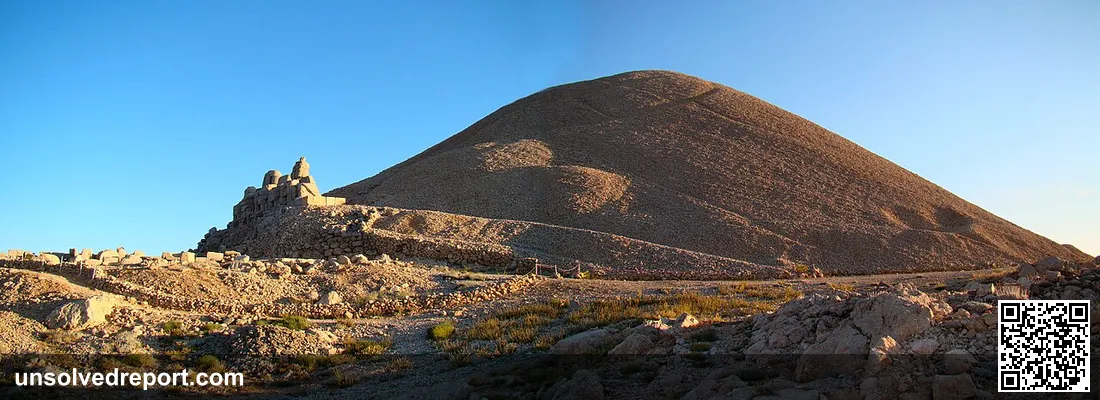
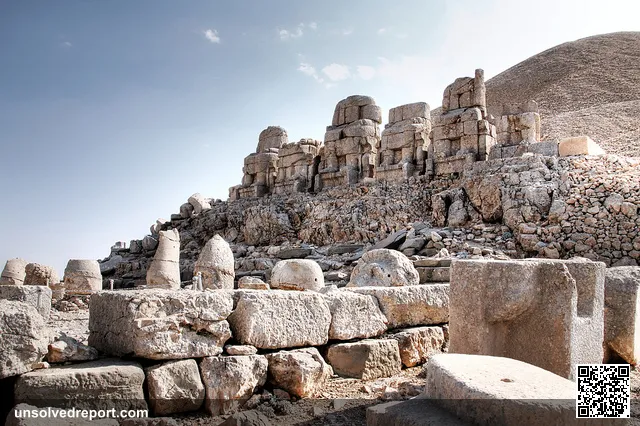
Stone heads the size of small cars lie scattered in the gravel of a 7,000-foot summit in southeastern Turkey, staring out over the empty highlands. They didn't fall by accident — they were knocked from the shoulders of seated stone giants centuries ago. A calm Apollo here. A grim Zeus there. An eagle. A lion. And behind them, a cone of crushed white rock rising fifty meters into the sky.
Somewhere inside that mountain — or under it — a king ordered his body laid to rest forever.
More than two thousand years later, nobody has ever found him.
This is Mount Nemrut. And here's the strange part: there are no curses, no aliens, no spooky legends needed. The mystery is real, it's written in stone, and an entire century of digging and the best machines we have still can't crack it.
A King Who Wanted to Be a God
The man behind the mountain was Antiochus I Theos of Commagene, ruler of a small, rich kingdom squeezed right between two superpowers: Rome on one side, the Parthian Empire on the other. Scholars put his reign at roughly 70 to 36 BCE (UNESCO World Heritage Centre; World History Encyclopedia).
Antiochus had a wild idea about who he was. He claimed he was descended from both worlds at once — from the Persian king Darius the Great on one side, and from Alexander the Great's Macedonian line on the other. So he did something no ordinary king would dare. He blended East and West into a brand-new royal religion, with himself near the top.
To house that religion, he built a place he called a hierothesion — a "tomb-sanctuary." It looks like he invented the word himself for the sacred burial sites he ordered built (UNESCO). Then he topped his mountain with something even stranger: a man-made hill of crushed limestone, a tumulus, about 50 meters (164 feet) tall and nearly 150 meters wide (UNESCO; National Geographic). Two huge terraces, one facing east, one facing west, spread out on either side.
Sitting Among the Gods
On those terraces, Antiochus seated his gods — and himself right beside them.
These are the famous statues: a row of giants carved from limestone, each one standing somewhere between 8 and 10 meters tall (World History Encyclopedia). And look closely at who they are. Every single one is two gods fused into one. Zeus-Oromasdes — Greek Zeus mixed with the Zoroastrian Ahura Mazda. Apollo-Mithras-Helios-Hermes. Artagnes-Herakles-Ares. The goddess Commagene herself. And there, enthroned among them as if he belonged, sat Antiochus — a man treating himself as the gods' equal.
He even left pictures to prove it. Carved relief panels show the king shaking hands with each god, one by one, in a gesture called dexiosis. A literal handshake between a man and a deity (World History Encyclopedia).
One carving, though, stands apart from all the rest. They call it the Lion Horoscope — a lion covered in nineteen stars that form the constellation Leo, a crescent on its neck, and three more stars floating above its back. Greek words name those three: Mars, Mercury, Jupiter (World History Encyclopedia). It's one of the oldest horoscopes ever carved in stone, in the same league as the Nebra Sky Disc as an early attempt to freeze the heavens in a physical object. Hold that thought — it matters later.
Then the whole thing vanished from the world's memory. For centuries, nobody important came. Until 1881, when a German engineer named Karl Sester, out surveying routes for transport, stumbled onto a row of giant stone heads and sent word back to scholars in Europe (Turkish Archaeological News). Study began the very next year. And in 1987, UNESCO added Nemrut Dağ to its World Heritage List (UNESCO).
The Question Nobody Can Answer
Here's where it gets good.
The inscriptions are crystal clear about what this place is. It's Antiochus's tomb. His eternal resting spot. He says so himself, in stone. And yet — after more than a hundred years of searching — no one has ever found his burial chamber (National Geographic; Turkish Archaeological News), a vanishing act that echoes the still-missing tomb of Genghis Khan half a world away.
The person who tried hardest was an American archaeologist named Theresa Goell. Starting in 1953, she dug at Nemrut for about twenty years, growing more and more obsessed with one goal: find the king (Turkish Archaeological News).
And the mountain beat her. Here's why — and it's almost diabolical. The tumulus isn't solid rock. It's millions of loose stones, each about the size of your fist, piled into a giant cone. That design fights back. Every time diggers pulled stones out to tunnel inward, the stones above just slid down and filled the hole right back up. Dig all day, and you'd end up exactly where you started (Turkish Archaeological News).
So Goell's team tried to cheat — with machines. In 1963 the Fondazione Lerici ran seismic profiles and electrical soundings through the mound. Later teams brought ground-penetrating radar and magnetic surveys (Turkish Archaeological News) — the same kind of scanning that eventually found a hidden void inside the Great Pyramid. All that technology, all those years.
None of it has ever confirmed a single chamber.
So the real question splits in two, and both halves are genuinely open: Where is Antiochus buried — and is he even down there at all? Maybe his body rests deep under the rubble, untouched and perfect, exactly as he wanted. Or maybe it's somewhere the mountain was never built to reveal.
Three Ways to Read the Riddle
What follows are interpretations — some from scholars, some pure speculation. Here's where the honest guessing begins.
One: the tomb is still down there, sealed and whole. This is what a lot of researchers believe, and it's beautifully simple — the chamber exists, it's buried under or inside the tumulus, and that loose-stone trick has been doing its job flawlessly for two thousand years. If they're right, this could be one of the last unrobbed royal tombs left from the ancient world (National Geographic), a puzzle not unlike the still-unopened tomb of Qin Shi Huang, where fear of what's inside has kept excavators out for decades. Possible — but unproven. No survey has ever spotted a clear empty space inside.
Two: the whole thing is a decoy. Some scholars speculate the Commagene kings built these big, obvious, hard-to-miss "tombs" on purpose — as bait for grave robbers — while the real body lay hidden somewhere else nearby (HeritageDaily). If that's true, Nemrut might be a fake-out: a monument with no king inside it at all. It's a delicious idea. But no inscription, no discovery, has ever pointed to a secret second grave.
Three: that lion isn't a map — it's a date. Remember the Lion Horoscope? Some read it as a frozen snapshot of the night sky on one exact night. A widely cited interpretation matches its planets to 7 July 62 BCE — maybe the day Antiochus took the throne, or the day the monument was founded (Turkish Archaeological News). Others push back hard: astronomers González-García and Belmonte argue for different star alignments and a later date entirely (World History Encyclopedia). Either way, the lion tells us when something mattered to the king. Not where he's hiding. And that ongoing argument? It's part of what makes this story so honest — the record is still being written.
Think about what this king pulled off. He wanted to sit forever among the gods, so he built a mountain that quietly, stubbornly refuses to hand him over. Two thousand years of shovels and scanners and radar. And the mountain is still winning.
Some mysteries get solved when someone finally digs deep enough. This one might be waiting for a machine that hasn't been invented yet — or for nothing at all, because the king made sure of it.
Sources & further reading
- UNESCO World Heritage Centre — Nemrut Dağ (Site 448)
- World History Encyclopedia — Exploring Mount Nemrut: A Meeting Point Between East & West
- National Geographic — The eighth wonder of the ancient world may have an untouched tomb
- Turkish Archaeological News — Mount Nemrut
- HeritageDaily — Nemrut: The Mountain Tomb
- CNN Travel — Mount Nemrut: Where colossal stone gods guard a 2,000-year-old mystery
Dhar Tichitt: 4,000 Years Ago, West Africa Built 500 Stone Towns—Then Emptied Them
Hundreds of dry-stone towns rose in Mauritania by 2200 BC, then went silent by 300 BC. New 2026 radiocarbon dates are finally testing why — and where the builders went.
Venus of Willendorf Mystery: The Journey Nobody Can Explain
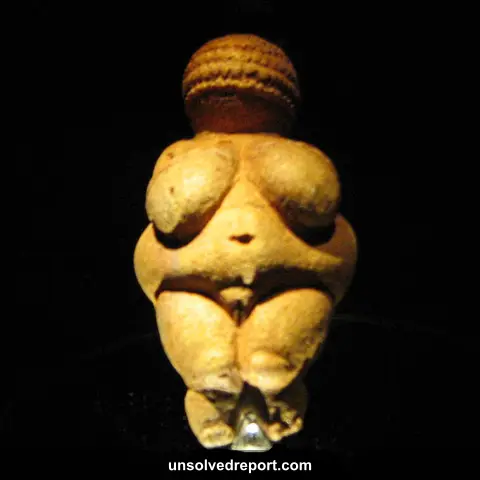
Venus of Willendorf mystery: a CT scan found her stone traveled 730 km from Italy 30,000 years ago. No one can explain how she crossed the Alps.
Tartaria Tablets: Older Than the First Writing?
Tartaria tablets: three clay pieces from 1961 Romania may predate Sumerian writing entirely. So why, after 60+ years, can no one prove what the marks say?