Voyager Interstellar Magnetic Field Anomaly: 40 Degrees Wrong
Voyager's interstellar magnetic field anomaly: two probes, two crossings, six years apart — same impossible reading. Why won't the compass swing back?
August 25, 2012. A spacecraft the size of a small car, twelve billion miles from home, slips through an invisible wall — and everyone watching expects its compass to swing. For 35 years, the plan had been simple. The Sun lives inside a giant magnetic bubble. Outside that bubble, the galaxy has its own magnetic field, tilted a different way. So the instant Voyager 1 crossed from one into the other, the needle should lurch hard, like a compass yanked between two magnets.
It didn't. The needle barely twitched.
And when scientists checked which way the field out there was pointing, it sat about 40 degrees off — pointing nowhere near where the rest of astronomy swore "magnetic north" for our corner of the galaxy should be. Decades on, they're still watching that compass slowly, quietly turn.
What the instruments actually recorded
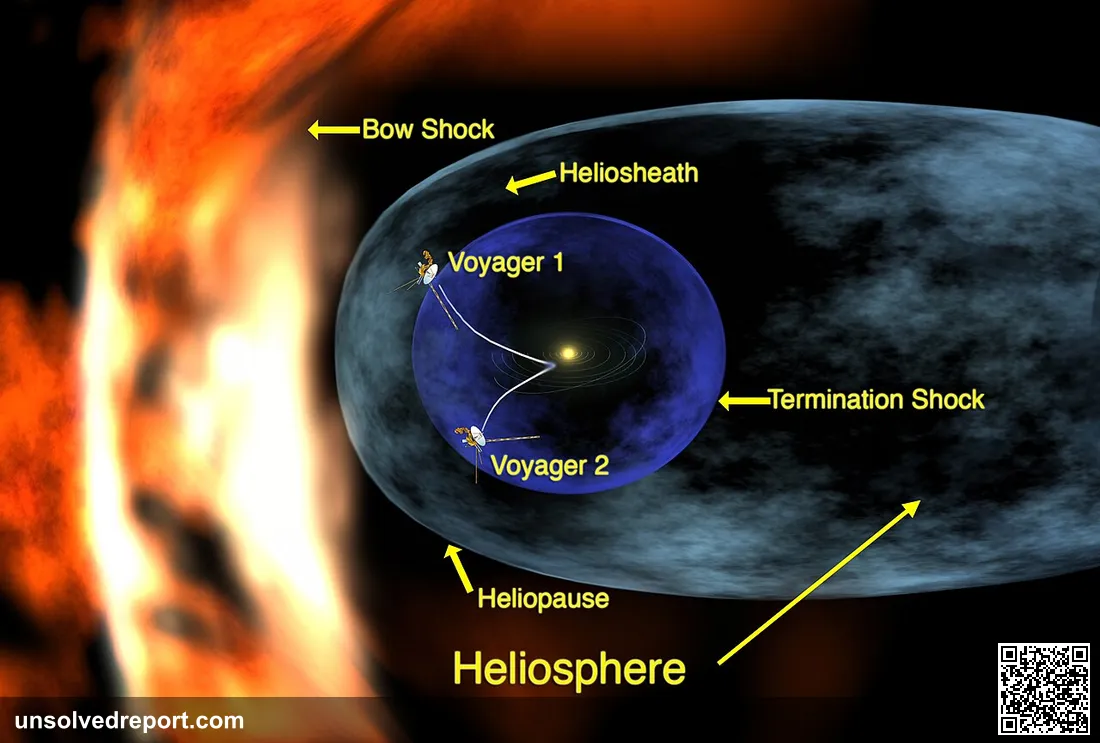
Voyager 1 left Earth in 1977. After a grand tour past the outer planets, it kept going, and going, until it became the first thing humans ever built to reach interstellar space — the void between the stars. NASA pins the exact moment it crossed the heliopause — the boundary where the Sun's outward wind finally surrenders to the galaxy — at August 25, 2012, roughly 122 astronomical units out (one AU is the Earth–Sun distance, so think 122 times the entire span from here to the Sun) (Physics Today / AIP).
Here's where it gets strange. Look at the magnetometer — the onboard instrument that reads magnetic fields. Between late July and late August 2012, the field's strength did exactly what you'd hope: it jumped several times, even roughly doubling, to about 0.4 nanotesla. But the field's direction? It "barely budged" (Physics Today / AIP). Len Burlaga, who has worked on Voyager's magnetometer team at NASA Goddard for decades, put the shattered expectation in the plainest words possible: "We figured that in a completely different region [the field direction] wouldn't be the same" (Physics Today / AIP). It was supposed to be different. It wasn't.
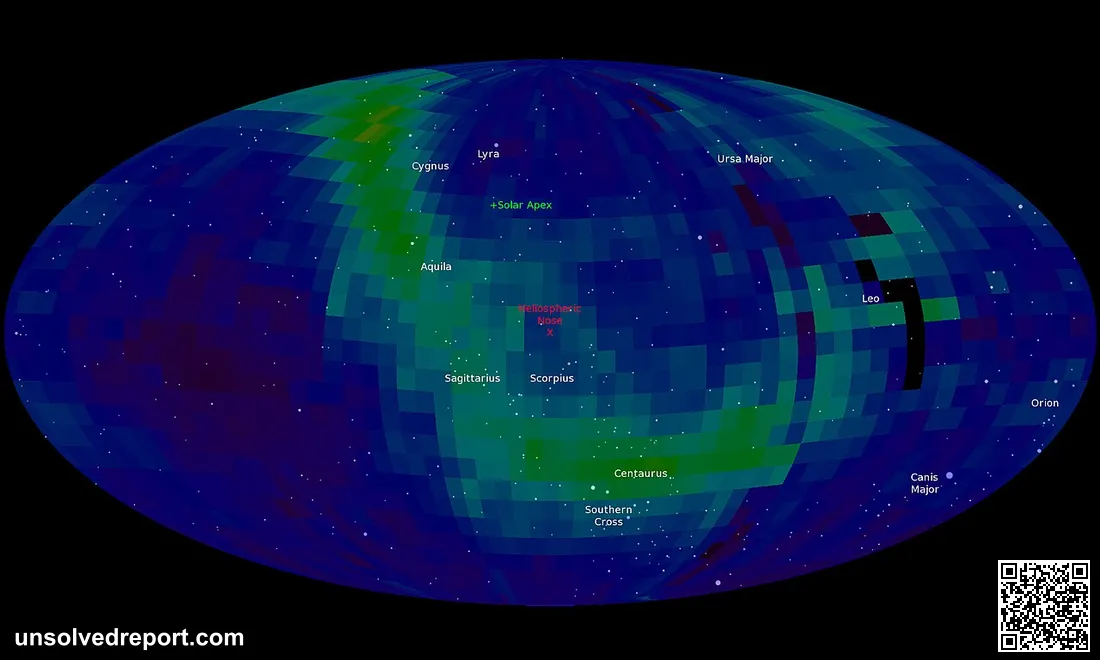
What turned a surprise into a genuine head-scratcher was a second, totally separate measuring stick. Back in 2009, NASA's Interstellar Boundary Explorer — IBEX — caught something eerie: a thin, glowing arc of energetic neutral atoms drifting in from beyond the Sun's reach. They called it the "IBEX ribbon." That ribbon is thought to point along the true, undisturbed magnetic field of our galactic neighborhood — the real magnetic north of local space (NASA / SwRI). In 2016, a team led by Eric Zirnstein of the Southwest Research Institute, writing in The Astrophysical Journal Letters, used that ribbon plus other clues to lock down the field's direction — and it lined up beautifully with starlight-polarization readings and with the way incoming interstellar gas gets deflected (NASA / SwRI). Three independent methods, all agreeing.
And Voyager 1, sitting right there, touching the field directly? It read more than 40 degrees off all of them (NASA JPL).
Maybe it was a fluke. One spacecraft, one crossing, one weird reading. Then came the twin.
On November 5, 2018, Voyager 2 punched through the heliopause too — at about 119 AU, on the opposite side of the Sun from its sibling (Nature Astronomy). Different spacecraft, different hemisphere, six years later. Surely it would see the textbook swing. Burlaga, lead author on the Voyager 2 magnetic-field paper, reported "essentially no change" in field direction as it crossed — the same uncanny calm as Voyager 1, the same flat refusal of the prediction every model had made (Nature Astronomy).
The question that won't go away
Strip it down to one honest sentence: why does the magnetic field just outside the Sun's bubble point so differently from the field that IBEX, polarized starlight, and interstellar gas all insist is out there — and why did neither Voyager catch the sharp directional flip the models swore was coming?
This isn't a broken sensor. Two spacecraft. Two hemispheres. Two crossings, six years apart. The same surprising stillness in direction, both times. The gap was so jarring that the original 2012 analysis, published in Science, said the readings called into question "the very definition of the heliopause" (Physics Today / AIP). Think about that — the data was strange enough to make scientists wonder whether they even knew where the edge of the solar system was.
And the puzzle has been stubborn. A 2023 preprint (still not peer-reviewed when this was written) figured that, as of roughly late 2022, the true undisturbed interstellar field still differed from what both Voyagers were measuring by big margins — tens of degrees of direction. The "wrong way" reading didn't just appear and vanish. It dug in and stayed.
So what's actually going on out there?
The draping idea (the front-runner, and well-supported). The most accepted answer is almost reassuring: Voyager isn't tasting pure interstellar space yet. It's parked in a region where the galaxy's field is bent. Picture an elastic cord stretched over a beach ball — it wraps, compresses, and twists around the curve. The interstellar magnetic field does the same thing as it drapes over the Sun's bubble, getting squeezed and rotated right where the spacecraft happen to be sitting (NASA JPL). A 2015 study led by Nathan Schwadron of the University of New Hampshire, in The Astrophysical Journal Letters, found the field around Voyager 1 has been slowly turning ever since the crossing — which is exactly the slow rotation draping should produce. "This study provides very strong evidence that Voyager 1 is in a region where the magnetic field is being deflected," Schwadron said (NASA JPL). His team figured the disturbance reaches stunningly far out — maybe 400 to 500 AU from the Sun — and made a bet: if the turning kept up its pace, Voyager 1 might finally see the IBEX direction "around 2025," the sign it had reached cleaner, less-twisted space.
The modeling read (an interpretation on top of that). A 2020 peer-reviewed analysis in Astronomy & Astrophysics by Vladislav Izmodenov and Dmitry Alexashov backed the same picture: the Voyagers are reading a distorted field, not the real local one. Running global models of the heliosphere, they worked backward to a true, undisturbed field of about 3.7–3.8 microgauss (A&A). They also noticed the two spacecraft sample the boundary in different ways — which means the Sun's bubble is lopsided, "blunt" on one side and "oblong" on the other (A&A). Seen this way, the anomaly isn't a contradiction at all. It's a map of the dent the Sun leaves in the galaxy around it.
The dissent (a real fight at the time, now a minority view). Early on, some researchers — George Gloeckler and Lennard Fisk among them — read the quiet field a different way. To them, the calm meant Voyager 1 hadn't actually left yet. They predicted the real crossing would come closer to 160 AU, complete with a clean 180-degree flip (Physics Today / AIP). Later plasma-density data, and Voyager 2 echoing its twin, swung the consensus toward a genuine 2012 crossing. But that argument is a good reminder of just how fiercely scientists were debating where the boundary even lived.
Here's the part that makes this mystery feel good rather than creepy: it's testable. The draping idea makes a promise you can actually check — keep turning, and one day the compass should swing into line. That 2025 target always carried a quiet "if the trend holds," and the latest estimates suggest the field has been creeping toward agreement slower than the hopeful version predicted. So the simplest version of the tilted-compass riddle is half-solved: the field looks wrong because we're still riding inside the galaxy's bow wave around the Sun. But the exact shape of that wave — and when, or even whether, these aging instruments will reach truly pristine space — is still wide open. Two spacecraft built in the 1970s are still out there in the dark, beaming home the very data that will decide it.
Sources & further reading
- NASA JPL — Voyager 1 Helps Solve Interstellar Medium Mystery: https://www.jpl.nasa.gov/news/voyager-1-helps-solve-interstellar-medium-mystery/
- NASA Science — Voyager 1 Helps Solve Interstellar Medium Mystery: https://science.nasa.gov/missions/voyager-program/voyager-1-helps-solve-interstellar-medium-mystery/
- Physics Today (AIP) — The confounding magnetic readings of Voyager 1: https://physicstoday.aip.org/opinion/the-confounding-magnetic-readings-of-voyager-1
- Nature Astronomy — Magnetic field and particle measurements made by Voyager 2 at and near the heliopause (Burlaga et al., 2019): https://www.nature.com/articles/s41550-019-0920-y
- NASA — IBEX Observations Pin Down Interstellar Magnetic Field (Zirnstein et al., 2016): https://www.nasa.gov/missions/ibex/nasas-ibex-observations-pin-down-interstellar-magnetic-field/
- Astronomy & Astrophysics — Magnitude and direction of the local interstellar magnetic field inferred from Voyager data (Izmodenov & Alexashov, 2020): https://www.aanda.org/articles/aa/full_html/2020/01/aa37058-19/aa37058-19.html
Przybylski's Star: The Sky's Most Impossible Light
Przybylski's Star glows with plutonium and promethium, elements that decay in years, not eons. Sixty years on, nobody can explain why they're still there.
Impossibly Early Galaxy Problem: JWST Found What Shouldn't Exist
JWST just found galaxies too big, too bright, and too early to exist under our own laws of physics. Is cosmology broken — or is something stranger going on?
Axis of Evil Cosmology: The Line in the Sky Nobody Can Erase
Axis of evil cosmology: two separate satellites found the same impossible line in the oldest light in the universe. Is it a glitch, or something worse?