Impossibly Early Galaxy Problem: JWST Found What Shouldn't Exist
JWST just found galaxies too big, too bright, and too early to exist under our own laws of physics. Is cosmology broken — or is something stranger going on?
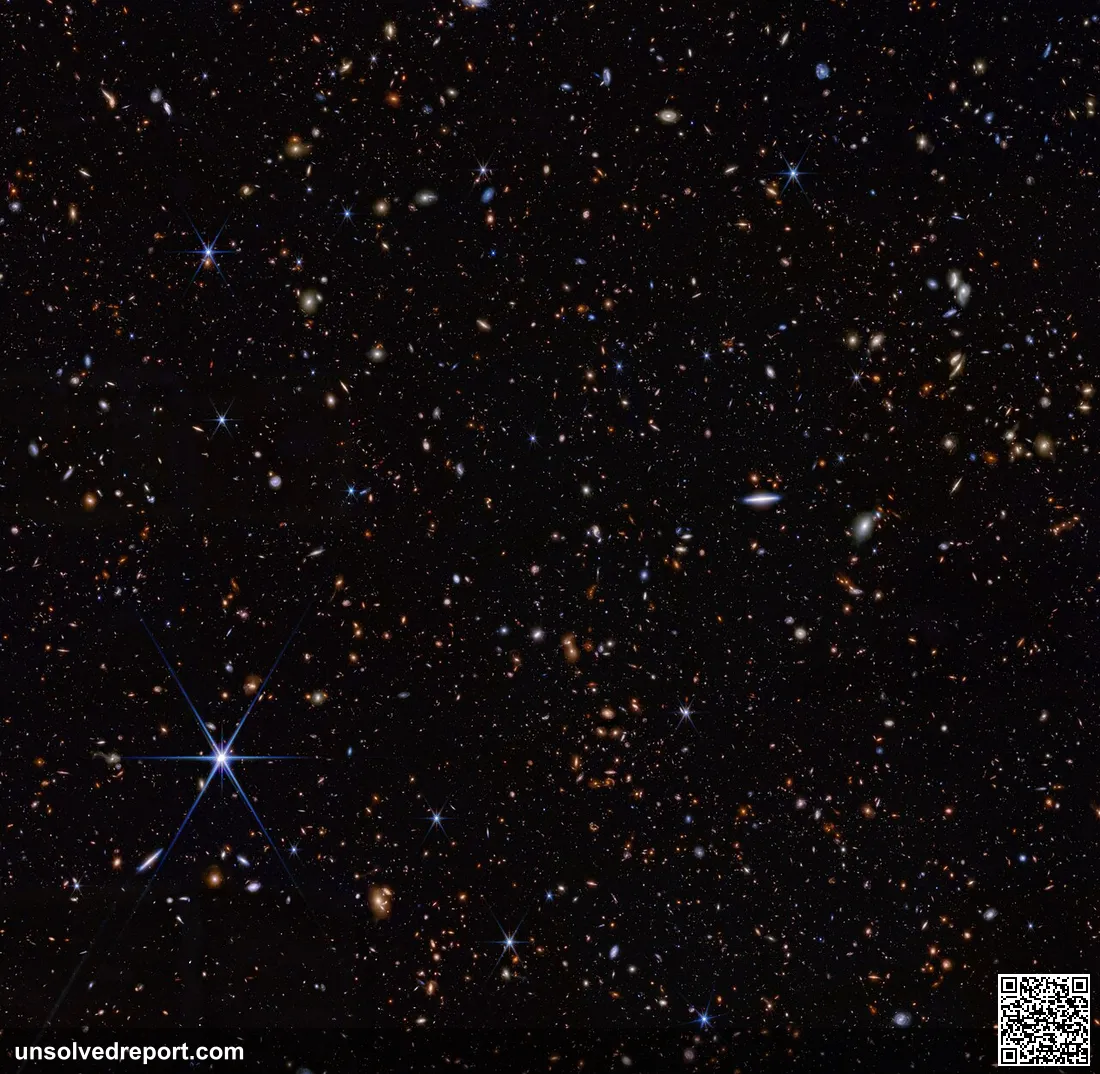
2022. The James Webb Space Telescope opens its golden eye and stares deeper into space — and further back in time — than anything humans have ever built. Astronomers brace themselves for what they expect to see: a faint, fuzzy, just-getting-started universe. The cosmic equivalent of a newborn, all smudge and no shape.
That is not what showed up.
Instead, Webb kept catching galaxies that looked weirdly grown-up. Too bright. Too big. And way, way too early — sitting there fully formed when the universe should barely have warmed up. Newspapers slapped one word on them: "impossible." Scientists, being scientists, gave it a calmer name: the impossibly early galaxy problem. It's one of the most genuinely thrilling open questions in astrophysics right now — and a front-row look at science scrambling to make sense of a surprise in real time.
What we actually know
Start with the clock. The universe is about 13.8 billion years old. Webb has now confirmed galaxies that were already shining unbelievably close to the very beginning.
In 2024, the JWST Advanced Deep Extragalactic Survey (JADES) team nailed down a monster called JADES-GS-z14-0, sitting at a redshift of roughly 14.3. Translation: the light we're seeing left that galaxy less than 300 million years after the Big Bang — back when the cosmos was a mere 2% of its current age (NASA; ESA/Webb).
Here's the part that made astronomers do a double take. It wasn't just far away — it was substantial. The thing stretches more than 1,600 light-years across. It blazes with the light of young stars, not the roar of a feeding black hole. And it already carries dust and heavier chemical elements — the leftovers of stars that had to be born, live, and die before this snapshot was even taken (NASA; Astronomy & Astrophysics). Generations of stars, in a universe that had barely gotten going.
Then the record fell again. In 2025, a team unveiled MoM-z14 at redshift 14.4 — visible just about 280 million years after the Big Bang (Big Think; Live Science). Closer to the beginning. Even sooner than anyone expected.
But "too early" is only half the puzzle. The other half is "too big." That one traces back to a much-debated 2023 study. Ivo Labbé and his colleagues, writing in Nature, spotted six red galaxy candidates at redshifts 7.4 to 9.1 — roughly 500 to 700 million years after the Big Bang. The shocker was their apparent weight: stellar masses reaching up to about 10¹¹ times the mass of the Sun (Nature; Science News). That's a stack of stars rivaling our entire Milky Way — except crammed into a far tinier space, and existing when the universe was practically a toddler, echoing the same head-scratching feeling astronomers got from the Methuselah star, an object that once seemed to be older than the universe itself. If those numbers held, some of these galaxies looked up to a hundred times heavier than the standard playbook said was possible for that moment in time.
And then — credit where it's due — the authors flagged the catch themselves. Those masses were photometric estimates, the kind that need spectroscopic follow-up to confirm. And some of the objects, they warned, might not be plain star-packed galaxies at all (Nature). Hold that thought. It matters later.
So is cosmology broken?
Here's where the mystery gets its teeth.
Our reigning map of the cosmos is called Lambda Cold Dark Matter — ΛCDM for short. And it is good. Stunningly good. It explains the afterglow of the Big Bang, the way space keeps expanding, and the vast cobweb of galaxies strung across the sky. It's not the only crack in that picture, either — cosmologists are already wrestling with the Hubble tension, where two different ways of measuring the universe's expansion rate stubbornly refuse to agree. So when galaxies start showing up "too early," your first instinct is to ask whether the whole model just cracked.
Slow down. ΛCDM doesn't actually forbid early galaxies. What it pins down is how fast and how efficiently ordinary matter is allowed to clump together into stars, using invisible dark matter as the scaffolding. And these Webb galaxies seem to be straining against that speed limit: too much light, and maybe too much mass, gathered far too quickly.
So the real question isn't the dramatic "is cosmology broken?" It's something sharper and frankly more fun: is this surprise whispering to us about deep, fundamental physics — or is it just the messy, chaotic reality of how the very first stars and black holes were actually born?
Cosmologist Mike Boylan-Kolchin put it perfectly: "Most people would put their money on the astrophysical explanation right now" — before adding that the chance of something deeper "means it's really worth following it up until it's excluded" (Scientific American). Lean one way, but don't slam the door. That cautious, eyes-open stance is exactly where the field honestly stands.
The suspects
So who — or what — is making these galaxies look impossible? Below are the leading explanations. Most of them are astrophysical: tweaks to how galaxies form, not a rewrite of the universe itself. Read them as interpretations, not verdicts.
Suspect 1 — It's mostly light, not mass (bursty star formation). A lot of researchers think these galaxies are showmen. They look far more impressive than they really are because their light arrives in violent, sudden bursts. When a galaxy slams out new stars in short, furious episodes, exploding supernovae and dazzling young stars can make it flare up way brighter than its modest weight would ever suggest — then dim back down (Scientific American; Physics/APS). In other words: at cosmic dawn, brightness is a liar. Don't trust it to tell you how heavy something is.
Suspect 2 — The early universe was just better at building stars. A close cousin of that idea, explored in recent modeling, says the earliest, smallest clumps of dark matter were unusually good at turning raw gas into stars — better than their modern descendants. No exotic new physics needed. Just an efficiency that quietly cranks up the number of bright galaxies and keeps everything tidily inside ΛCDM (IOPscience / Astrophysical Journal).
Suspect 3 — Hidden black holes faked the weight ("little red dots"). This one's gaining serious ground. Some of the reddest, most "massive-looking" early objects turn out to be tiny, fierce things nicknamed little red dots. The trick: buried inside is a hungry, growing black hole — an active galactic nucleus — pumping out much of the glow. When astronomers ran follow-up spectroscopy on Labbé-style candidates, at least one wasn't a giant ball of stars at all. It was powered by a black hole (UNCOVER, Astrophysical Journal). And a 2026 Nature analysis pushed even further, suggesting some of these black holes might be far punier than first thought — because dense gas, not blistering speed, is what's smearing out their spectral lines (Nature Astronomy). If a chunk of that early "mass" is really just black-hole glare, the whole crisis shrinks fast.
Suspect 4 — Genuinely new physics (very speculative). A handful of papers swing for the fences: primordial black holes that formed early and seeded galaxies, gravity that behaves differently than we think, or dark energy doing something strange in the young cosmos (arXiv preprint, not peer-reviewed). Treat these as long shots. The work above is an arXiv preprint that hasn't passed peer review, and most cosmologists keep exotic answers in a locked drawer marked "last resort" — to be opened only after every ordinary explanation has failed.
And here's the part I love most. This whole story is self-correcting, right in front of us. Every new record-breaker, every fresh spectrum, screws the question a little tighter. The early universe was clearly busier, faster, and more dramatic than anyone dared to model before Webb — but so far, every "impossible" has quietly melted into "unexpected, and explainable." Maybe the final answer is clever astrophysics. Maybe it's a real crack in the foundations of the cosmos. Either way, Webb has handed us a front-row seat to one of the great detective stories of our time — and the next clue is already on its way down from orbit.
Sources & further reading
- NASA Science — Webb Finds Most Distant Known Galaxy (JADES-GS-z14-0)
- ESA/Webb — JADES-GS-z14-0 image and facts
- Astronomy & Astrophysics — The eventful life of GS-z14-0 at z = 14.32
- Big Think (Ethan Siegel) — JWST breaks its own record with MoM-z14
- Nature (Labbé et al. 2023) — A population of red candidate massive galaxies ~600 Myr after the Big Bang
- Science News — JWST found six galaxies that may be too hefty for their age
- Scientific American — JWST's Puzzling Early Galaxies Don't Break Cosmology, but They Do Bend Astrophysics
- Physics / APS — JWST Sees More Galaxies than Expected
- Astrophysical Journal — Evolving Star Formation Efficiency as the Key to Early Galaxy Abundance
- Astrophysical Journal (UNCOVER) — Ubiquity of AGN in Red Sources at z > 5
- Nature Astronomy (2026) — The composite spectrum of little red dots

Axis of Evil Cosmology: The Line in the Sky Nobody Can Erase
Axis of evil cosmology: two separate satellites found the same impossible line in the oldest light in the universe. Is it a glitch, or something worse?
The Great Attractor: The Pull You Can't See or Stop
Something is dragging the Milky Way at 600 km/s toward a spot hidden behind our own galaxy. Astronomers call it the Great Attractor. What is it, really?
Great Pyramid's Big Void: A 100-Foot Room No One Has Entered
ScanPyramids detected a 100-foot void hidden inside the Great Pyramid in 2017 — and no human has ever seen inside it. So what's really in there?