Przybylski's Star: The Sky's Most Impossible Light
Przybylski's Star glows with plutonium and promethium, elements that decay in years, not eons. Sixty years on, nobody can explain why they're still there.
There is a star you cannot see. It hangs 356 light-years away in the southern constellation Centaurus, glowing at magnitude 8 — too faint for your eyes, hidden until you point a telescope at it. By itself, that makes it nobody. A dim speck among billions.
Then you split its light into a rainbow. And the rainbow lies.
Spread the light of HD 101065 into a spectrum and you get a fingerprint no other star has ever matched. Some of the elements written into that light are so fragile, so quick to crumble away, that by every rule of physics we know, they should not be there. They should have vanished long ago. Yet there they are, shining back at us. Astronomers have stared at this problem for more than sixty years and still cannot close the case. This is the real, still-open puzzle at the heart of Przybylski's Star.
A Star That Wouldn't Behave
It started with one stubborn spectrum. In 1961, a Polish-Australian astronomer named Antoni Przybylski looked at this star's light and found it simply would not fit the standard scheme used to sort stars into neat categories (Wikipedia: Przybylski's Star). The object wasn't new — Benjamin Apthorp Gould had logged it back in 1873 — but Przybylski was the first to see how strange its light really was. The star carries his name now, because he was the one who noticed it was breaking the rules.
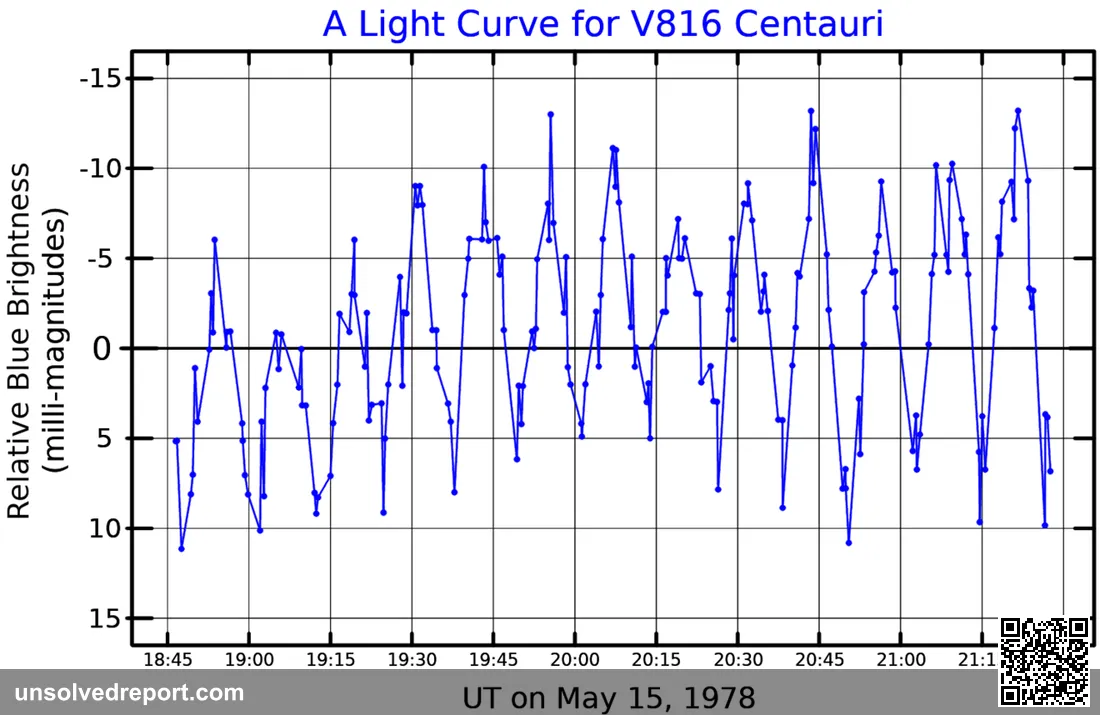
Here's what kind of star it is. HD 101065 belongs to a weird family called the "Ap" stars — chemically peculiar — and to an even rarer branch within it, the rapidly oscillating Ap stars, or roAp for short. These stars pulse. They swell and shrink in fast little heartbeats; this one ticks through a cycle roughly every 12 minutes, a rhythm first caught in 1979 (arXiv: Hubrig et al. 2018). It is also gripped by a fierce magnetic field — longitudinal readings reaching around negative 2.5 kilogauss, first measured in the 1970s — and it turns with almost unbelievable slowness. Decades of magnetic data hint at a single rotation taking something like 188 years, though astronomers are quick to warn that's a best guess, not a locked answer (Oxford / MNRAS, 2018). Think about that. While this star turns once, you would be born, grow old, and your grandchildren would too.
But the rotation isn't the headline. The headline is what the star is made of — a question even the Sun struggles to answer about itself.
Przybylski's Star is strangely poor in the ordinary metals — iron, nickel, the common iron-group stuff that fills most stars. And it is fabulously, almost absurdly rich in rare-earth elements, the lanthanides, packed in at roughly a thousand times what the Sun carries (Wikipedia; MNRAS, 2000). These rare earths crowd the spectrum so thickly — a tangle astronomers call line "blanketing" — that just confirming plain old iron lines becomes a fight. By several accounts, it's the only stellar spectrum we know where the rare earths so completely take over the light.
And then come the elements that turned a peculiar little star into a legend.
Over the decades, researchers have reported absorption lines they pinned to short-lived actinides — actinium, protactinium, neptunium, plutonium, americium, curium, berkelium, californium and einsteinium — plus technetium and promethium (Wikipedia; Centauri Dreams, 2017). Read that list again. Several of those are elements we mostly know from bomb tests and reactor cores. And that is the part that breaks your brain.
Elements That Shouldn't Still Be Burning
Here's why those names are a problem. Most elements in a star are basically immortal — they last as long as the star does, billions of years. These don't.
Promethium has no stable form at all. None. Its longest-lasting version falls apart with a half-life of just about 17.7 years (Wikipedia). Seventeen years. Technetium's toughest isotopes survive a few million years — which sounds like forever until you remember a star lives for billions, making millions an eyeblink. So picture the math: if these elements are truly sitting in the star's atmosphere right now, then any batch made back when the star was born would have decayed to nothing ages ago. For them to still be there, something has to be making more. Almost continuously. Like a factory that never shuts off.
That is the question nobody has answered. How could elements that crumble in years or in a geological heartbeat still be glowing in the visible skin of a slow-turning, magnet-bound star?
But before you reach for anything wild, here's the twist the headlines skip: the detections themselves are shaky. In 2023, Andrievsky and colleagues went back and re-examined the case for promethium specifically, picking through selected Pm I and Pm II lines. Their verdict was deliberately cautious — right now it's impossible to say for certain that promethium is there at all, mostly because nearly every line that might be promethium is smeared together with lines from other heavy elements in a spectrum so crowded it's a nightmare to untangle (arXiv: Andrievsky et al. 2023; Astronomische Nachrichten). Other recent work hasn't confirmed technetium or promethium either (Wikipedia). So part of the mystery isn't the star — it's our eyes. In a spectrum this dense, telling a real promethium line apart from an overlapping rare-earth line is brutally hard. The star may be less impossible than it first looked. Or our instruments just aren't sharp enough yet to call it.
The Best Guesses So Far
So what could be going on? Scientists have a handful of leading ideas. Every one is a work in progress, not a final answer.
The favorite: elements sorting themselves. For Ap stars in general, the accepted reason for their bizarre chemistry isn't nuclear fireworks — it's sorting. In a calm, slowly spinning atmosphere, gravity drags most elements downward while radiation pressure shoves others upward, especially heavy elements bristling with absorption lines that catch the starlight and ride it like a sail (arXiv: Turcotte, "Diffusion and Settling in Ap/Bp Stars"). The strong magnetic field locks this layering in place. It's a tidy story that explains both the rare-earth flood and the lazy rotation. What it doesn't explain so easily is how elements with half-lives of mere decades got there to be lifted in the first place.
The wildest: a hidden island of stability. In 2017, physicists Vladimir Dzuba, Victor Flambaum and colleagues floated a jaw-dropping idea: maybe those short-lived actinides are the crumbs left behind by undiscovered, long-lived superheavy elements (arXiv: Dzuba et al. 2017; Centauri Dreams, 2017). Nuclear theory whispers of an "island of stability" — superheavy nuclei (around element 114, with a magic neutron count of 184) that could outlast their crumbly neighbors by a long stretch. If such elements lurked in this star, their slow decay would keep churning out the lighter radioactive bits we think we see, refilling the factory forever. The snag, which the authors own up to, is that nobody has ever made such a superheavy element in a lab and watched it live long enough to test the idea. The island is, so far, theoretical land.
The fading idea: a dead-star neighbor. An older guess imagined a nearby neutron star blasting the atmosphere with particles, forging fresh radioactive isotopes on the spot. But the evidence pulled the rug out: no neutron star has turned up near it, and a possible companion glimpsed in Gaia data seems to sit far in the background, just a line-of-sight coincidence, not actually tied to the star (Wikipedia; Centauri Dreams, 2017).
And yes — you've probably seen this star on a breathless "alien technology" list somewhere, right next to Tabby's Star. Set that aside. Nothing in the evidence supports it. As astronomer Jason Wright has pointed out, even when strange stars draw exotic attention, "perfectly natural explanations" reliably turn up in the end (Centauri Dreams, 2017). The honest position in 2026 is quieter, and frankly far more thrilling: this is a genuine, unsolved natural puzzle. As one recent overview put it, the star "remains an unresolved mystery rather than a settled case" (Centauri Dreams, 2026). Maybe the answer is elements quietly sorting themselves. Maybe it's a missing corner of the periodic table. Maybe it's just sharper instruments finally cutting through a fiendishly tangled spectrum. Either way, that faint, lonely sun in Centaurus is still holding its breath — and its secret — while we keep looking for the next light that refuses to make sense.
Sources and Further Reading
- Wikipedia: Przybylski's Star (HD 101065)
- Andrievsky et al. (2023), "An enigma of Przybylski's star: is there promethium on its surface?" — arXiv / Astronomische Nachrichten
- Dzuba, Flambaum et al. (2017), "Isotope shift and search for metastable superheavy elements in astrophysical data" — arXiv
- Hubrig et al. (2018), "Magnetic and pulsational variability of Przybylski's star" — MNRAS / Oxford / arXiv
- Cowley et al. (2000), "Abundances in Przybylski's star" — MNRAS / Oxford
- Turcotte, "Diffusion and Settling in Ap/Bp Stars" — arXiv
- Centauri Dreams: "The Challenges of Przybylski's Star" (2017) and "Still Bizarre After All These Years" (2026)
Impossibly Early Galaxy Problem: JWST Found What Shouldn't Exist
JWST just found galaxies too big, too bright, and too early to exist under our own laws of physics. Is cosmology broken — or is something stranger going on?

Axis of Evil Cosmology: The Line in the Sky Nobody Can Erase
Axis of evil cosmology: two separate satellites found the same impossible line in the oldest light in the universe. Is it a glitch, or something worse?
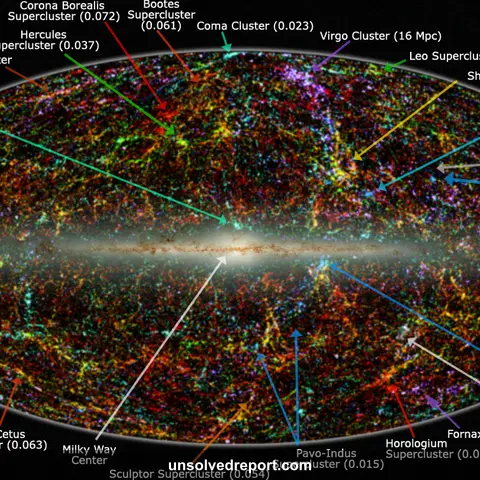
The Great Attractor: The Pull You Can't See or Stop
Something is dragging the Milky Way at 600 km/s toward a spot hidden behind our own galaxy. Astronomers call it the Great Attractor. What is it, really?