WD 1145+017: The Disintegrating Planet Nobody Has Ever Seen
WD 1145+017: a dead star shredding a planet in real time, yet no one has ever actually seen the thing being destroyed. Here's why that's still a mystery.
A dead star is eating a planet, and for the first time, we get to watch.
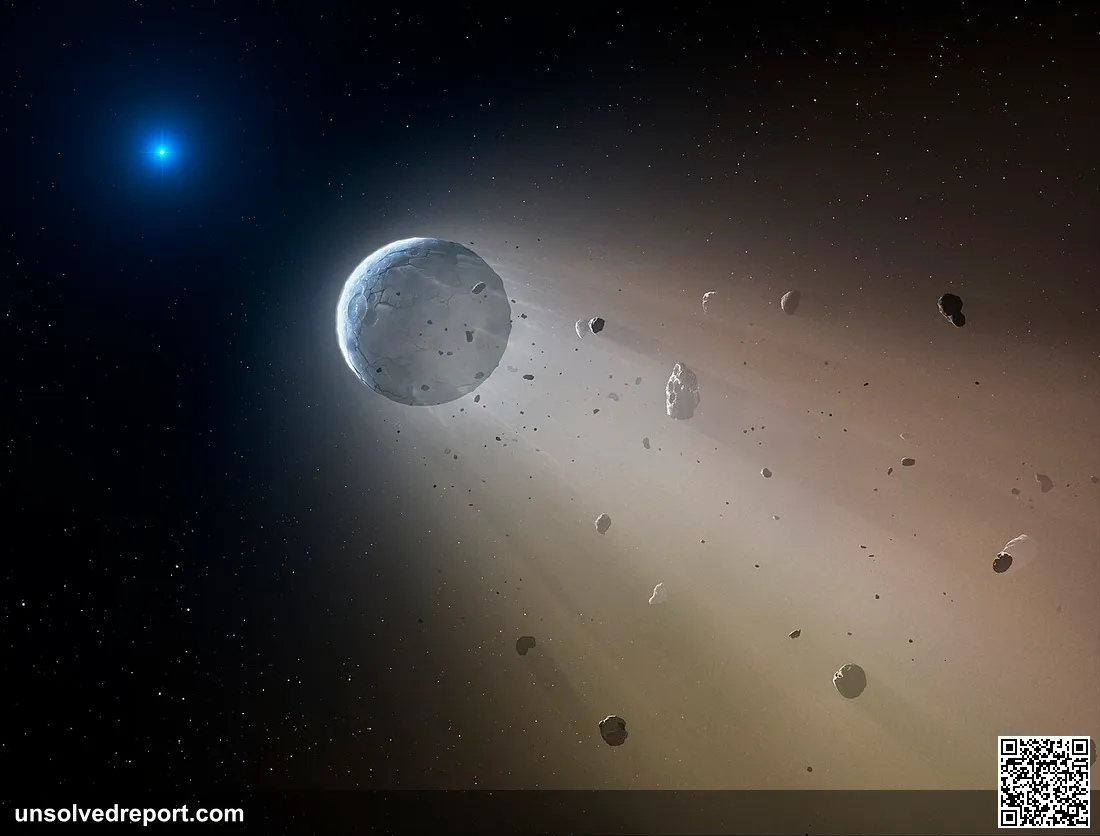
Out in the constellation Virgo, about 475 light-years from here, the burned-out ember of a long-dead sun is doing something astronomers had predicted for years but never actually caught in the act. It is tearing a rocky world to shreds and dragging the rubble down onto itself, piece by piece. The star is called WD 1145+017. The crumbling body circling it — there may be more than one — handed science its first live, front-row view of a planetary system being recycled by the corpse of its own sun. Everything about it sounds like fiction. None of it is. It's all built from careful measurements. And right at the center, there's still one honest puzzle nobody has cracked.
What We Actually Know
It started with a flicker.
In 2015, during NASA's Kepler K2 mission — the second life of the famous planet-hunting telescope — astronomers spotted something odd in the light of this faint star. A team led by Andrew Vanderburg published the find in Nature: the starlight was dimming on a clockwork beat, dipping roughly every 4.5 hours, with hints of several slightly different rhythms ranging from about 4.5 to 4.9 hours (Vanderburg et al., 2015, Nature; AAS Nova). Something was passing in front of the star, over and over, faster than you can watch a movie.
The star doing the eating is strange all on its own. A white dwarf is what's left when a Sun-like star runs out of fuel, throws off its outer layers, and collapses into an Earth-sized cinder that just slowly cools off forever. This one runs hot — a surface near 15,000 K — and packs about 0.63 times the Sun's mass into a ball barely bigger than our planet (Wikipedia summary of published parameters). Now here's the strange part. A clean white dwarf should show nothing but hydrogen or helium in its light, because anything heavier sinks out of view within days to years. It's like dropping pebbles into a pond — they vanish to the bottom and the surface goes smooth again. Yet this star's light is streaked with magnesium, aluminum, silicon, calcium, iron, and nickel — the exact chemistry of rock and metal (MNRAS, Croll et al.). Those pebbles aren't sinking. They're still falling. Something rocky is raining down on this star right now. And around it: a glowing disk of dust, plus rings of gas that later observations would reveal.
But the real giveaway is the flickering itself.
A normal planet crossing its star makes a clean, tidy dip — same shape, same depth, every single time, like a coin sliding across a flashlight. WD 1145+017 does nothing of the sort. Its dips plunge deep — ground-based telescopes clocked some of them swallowing 40 percent of the star's light, and later watches caught dips anywhere from roughly 10 to 60 percent. And they're lopsided, with a slow tail of recovery, as if something is dragging behind (Croll et al., MNRAS; Alonso et al., A&A). Here's the part that stunned people: the dips keep changing. Within months of the discovery, astronomers using telescopes including the Thai National Telescope watched a whole crowd of overlapping events, each lasting just 3 to 12 minutes, pop up, deepen, and fade away inside a single observing run (AAS Nova). That's not solid rock blocking the light. That's clouds — dust and gas streaming off small bodies, comet-like tails trailing from rocky chunks orbiting right at the white dwarf's Roche limit. The Roche limit is the line of no return: cross it, and the star's tidal pull becomes stronger than the body's own gravity, and the body starts to come apart.
And this isn't a one-off freak show. Across the sky, a big slice of white dwarfs — quoted at roughly a quarter to a half, depending how you count — show this same "pollution" of heavy elements, and the stuff falling in looks chemically just like the rocky worlds of our own inner solar system (Veras review literature; A&A, Koester et al.). For decades, that process was just a story written in chemistry. WD 1145+017 is where it became something we can actually watch unfold.
The Part Nobody Can Answer
So here's the honest mystery. What, exactly, is being destroyed out there — and how big is it?
We have never seen it. Not once. After a full decade of staring, no telescope has laid eyes on the thing causing all this. We only know it's there because of the dust it leaves behind, like reading footprints in snow without ever spotting the animal. Its mass is barely pinned down — researchers have tried to box it in by watching how the orbits wobble, but the estimates stay frustratingly loose, anywhere from something the size of an asteroid to a far chunkier minor planet (Gurri et al., MNRAS, "Mass and eccentricity constraints"). And is it even one object? Or a swarm of pieces that all snapped off the same parent? The multiple, drifting rhythms hint at several fragments — but how many, and how big each one is, nobody can say yet.
The whole thing is also maddeningly moody. Those dramatic, deep dips of 2015 and 2016 went quiet in some later seasons, then flared back up, then settled again — long-term studies have logged this on-again, off-again behavior without ever cracking a formula that predicts it (long-term variability study, arXiv). Why does the dust switch on and off? How long does any single fragment last before it's gone? How do the gas rings, the dust disk, and the crumbling bodies feed off one another? All still open. We've walked in on a planet dying in slow motion — but we've only caught the middle of the film, not the start and not the end.
The Best Explanations We've Got
The grind-down (the mainstream model). Most astronomers tell the story like this: a leftover asteroid or minor planet got nudged inward — maybe shoved by some bigger planet that survived the star's death — until it crossed the Roche limit and started to crack apart. Fragments drift onto slightly different orbits, smash into each other, grind themselves to powder, and throw off bursts of dust that stretch into tails and eventually spiral down onto the star (Veras et al., MNRAS road-map). One clean chain of cause and effect, linking the flickers, the dust disk, and the metal-stained starlight all together. It's the best-supported version of events — though for this exact system, the details are still modeled, not measured.
The comet tails (reading the dust). A close cousin of that idea, drawn straight from the shape of the dips: the fragments are actively boiling off material. Sitting point-blank in front of a star many times hotter than the Sun, they shed gas and dust into the comet-like tails we infer from those lopsided, ever-shifting dips (Vanderburg et al.). This isn't a rival origin story — it's a reading of the same data, and it slots right into the grind-down picture.
The contested fine print. Some researchers have floated different layouts for the star's dust clouds and gas rings, hunting for a better fit to the spectra (A&A 2022, alternative models). These are real scientific tweaks, still argued over in the journals — not fringe claims, just open debate.
And to be clear about where this story lives: there's nothing here that needs anything beyond plain physics. No spacecraft. No signal. No intelligence. Just gravity, heat, and rock, playing out at a dead star. What makes WD 1145+017 worth sitting with is darker and quieter than any alien tale. It's a preview of our own ending. Billions of years from now, when the Sun burns out and shrinks into a white dwarf, the worlds that survive may meet this same slow, grinding fate — and maybe Earth among them. For once, we're watching the future from the outside, through a telescope, at a safe distance. The facts are solid. It's the fine print — what it is, how big, why it flickers — that's still out there, waiting.
Sources & further reading
- Vanderburg et al. (2015), Nature — A disintegrating minor planet transiting a white dwarf (CfA preprint copy): https://lweb.cfa.harvard.edu/~avanderb/wd1145_017.pdf
- AAS Nova — Disintegrating Planetary Bodies Around a White Dwarf: https://aasnova.org/2016/02/15/disintegrating-planetary-bodies-around-a-white-dwarf/
- Wikipedia — WD 1145+017 (summary of published parameters): https://en.wikipedia.org/wiki/WD_1145%2B017
- Gurri, Veras & Gaensicke (2017), MNRAS — Mass and eccentricity constraints on the planetary debris orbiting WD 1145+017: https://academic.oup.com/mnras/article/464/1/321/2194672
- Croll et al. (2017), MNRAS — Multiwavelength/infrared and optical transit observations: https://academic.oup.com/mnras/article/463/4/4422/2646518
- Alonso et al. (2018), MNRAS — Fast spectrophotometry of WD 1145+017: https://academic.oup.com/mnras/article/481/1/703/5078878
- Veras et al. (2022), MNRAS — A road-map to white dwarf pollution: tidal disruption, eccentric grind-down, and dust accretion: https://academic.oup.com/mnras/article/509/2/2404/6408484
- Koester, Gaensicke & Farihi (2014), A&A — The frequency of planetary debris around young white dwarfs: https://www.aanda.org/articles/aa/full_html/2014/06/aa23691-14/aa23691-14.html
- Long-term variability in debris transiting white dwarfs (2024), arXiv: https://arxiv.org/pdf/2404.04422
- A&A (2022) — WD 1145+017: Alternative models of the atmosphere, dust clouds, and gas rings: https://www.aanda.org/articles/aa/full_html/2022/04/aa41924-21/aa41924-21.html
The Cosmological Lithium Problem: Why 2/3 of Big Bang Lithium Is Missing
Big Bang physics predicts triple the lithium the oldest stars actually have. A 2024 interstellar gas measurement just made the gap harder to explain away.
Neutron Star Maximum Mass: The Line Nobody Can Find
A neutron star dies and becomes a black hole somewhere between 2.2 and 2.9 solar masses. Astronomers already found one that shouldn't exist. Where's the real line?

6478 Gault: The 'Dead' Asteroid That Grew Two Comet Tails
6478 Gault is a dry rock, not a comet — yet in 2019 it sprouted two glowing tails and nobody agrees on why it happens when it does. Here's the evidence.