PSR B1257+12: The Pulsar Planets Mystery Nobody Can Explain
PSR B1257+12: the first exoplanets ever confirmed orbit a corpse star, not a sun. So how did they survive the blast that made it? Nobody fully knows.
The star is already dead. And three planets are still circling its body.
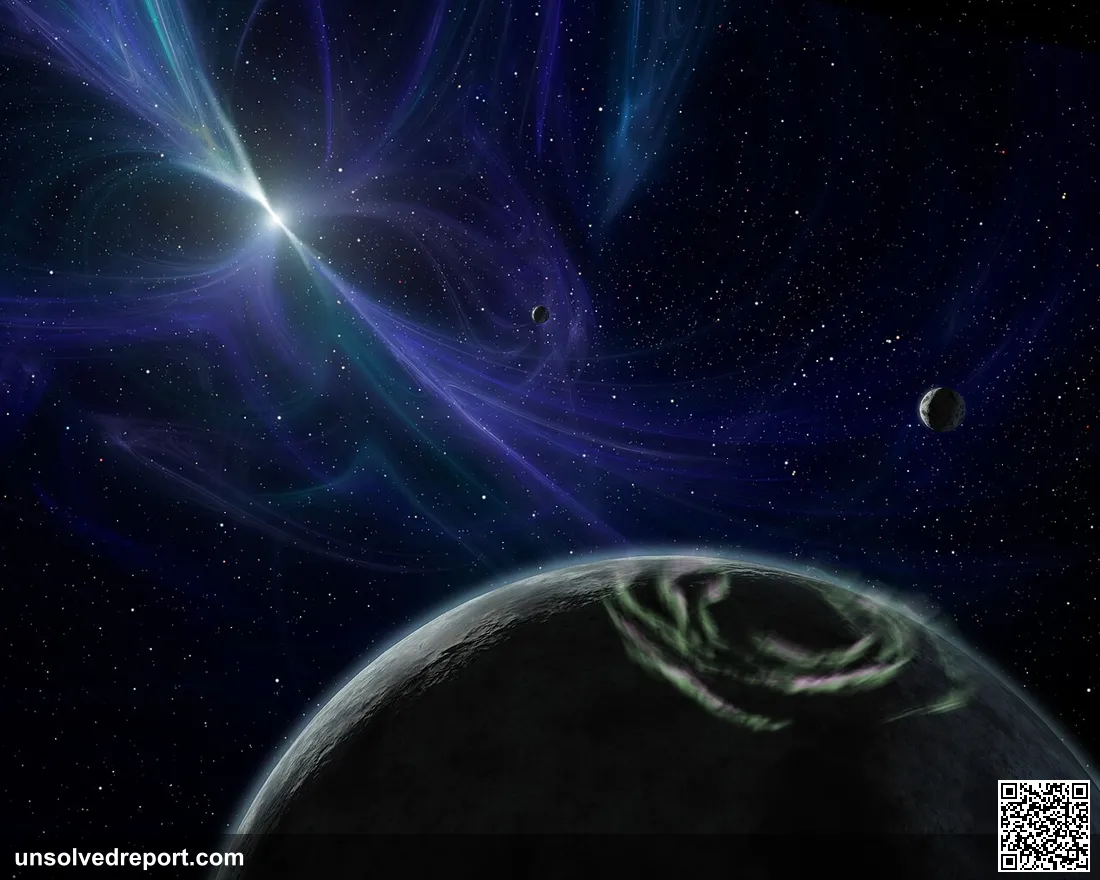
Picture the thing they orbit: a cinder no bigger than a city, spinning 160 times every single second, drowning everything around it in radiation that would kill you instantly. No dawn. No dusk. Just a spinning corpse and a sky that never warms.
Now here's the part that still bothers astronomers, decades later. These weren't just any planets. They were the first planets ever confirmed beyond our solar system. Not orbiting a friendly, Sun-like star somewhere cozy. Orbiting a grave. The system has a name — PSR B1257+12 — and the question it asks is one we still can't fully answer.
What We Actually Know
Start with the monster at the center. PSR B1257+12 is a millisecond pulsar: the leftover heart of a massive star that died screaming in a supernova. It sits about 2,300 light-years away in the constellation Virgo, and it spins. Fast. Around 160.8 times per second — a full rotation every 6.2 milliseconds (Wikipedia, "PSR B1257+12"). Like every pulsar, it fires beams of radio waves across space with the steadiness of a metronome. And that steadiness is exactly what gave the secret away.
A Polish astronomer named Aleksander Wolszczan caught the pulsar's heartbeat using the giant Arecibo Observatory in Puerto Rico. Then, with Dale Frail, he dropped a bombshell in the journal Nature on January 9, 1992: there were planets out there, circling the corpse (Space.com). How do you spot a world you can't see? You listen to the beat. A pulsar's pulses arrive so perfectly on time that an unseen planet, tugging the star a hair toward Earth and then away, throws the rhythm off by the tiniest fraction. Tick... tick... a stumble. Those little stumbles were gravity's fingerprints (astrobites). The first two planets were nailed down in a follow-up paper in Science in 1994, when Wolszczan piled on more evidence — including the way the planets quietly pull on each other (Science, vol. 264, 1994).
Three worlds, confirmed. And in December 2015, through the public NameExoWorlds campaign run by the IAU, they finally got names worthy of where they live. The pulsar became Lich — a fictional undead creature — and its planets were christened Draugr, Poltergeist, and Phobetor (Wikipedia, "PSR B1257+12"). Ghosts and the undead, orbiting a dead star. Whoever named them knew exactly what they were doing.
And the numbers we have on them are eerily precise:
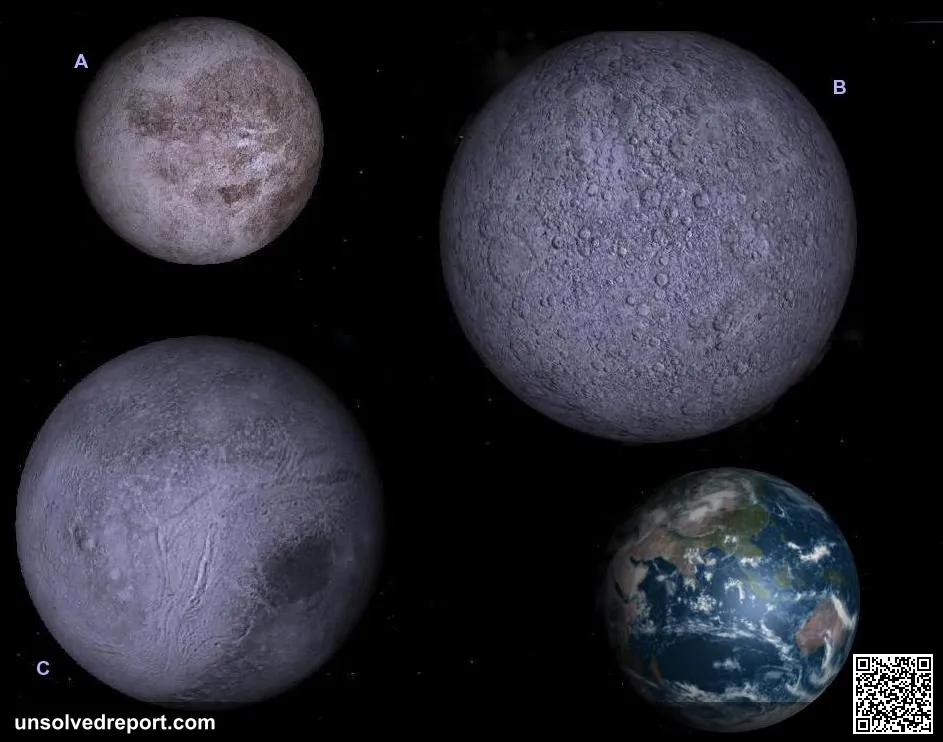
- Draugr (PSR B1257+12 b): around 0.020 Earth masses — roughly twice the mass of the Moon — looping around every 25.262 days at 0.19 AU. It's the lightest planet with a well-measured mass known anywhere (Wikipedia, "PSR B1257+12 b"). A speck.
- Poltergeist (PSR B1257+12 c): about 4.3 Earth masses, circling every 66.54 days at 0.36 AU.
- Phobetor (PSR B1257+12 d): about 3.9 Earth masses, circling every 98.21 days at 0.46 AU.
Poltergeist and Phobetor were the two spotted first. Tiny Draugr only crept out of the refined data in 1994. All three huddle closer to their pulsar than Mercury hugs the Sun, and the two bigger ones move in a near-perfect 3:2 dance — a gravitational lockstep that actually helped astronomers prove the planets were real and not noise (arXiv: "Resonance in PSR B1257+12 Planetary System").
One quick caution, because honesty matters here. There was a fourth suspect. Back in 1996, astronomers floated a possible fourth body — first imagined as a Saturn-sized giant way out, later downgraded to something dwarf-planet-sized. But that signal was eventually thrown out when more observations showed the wobble wasn't actually periodic (Wikipedia, "PSR B1257+12"). The three real planets, though? They've held firm for more than thirty years.
The Question Nobody Can Answer
So we know the planets are there. That's not the mystery.
The mystery is how on Earth they got there.
Here's the problem. A star big enough to blow up as a supernova and leave a neutron star behind starts out as a giant — at least eight times the mass of our Sun. So imagine that star already had planets before it died. Those planets had to survive a nightmare. When the supernova goes off, it hurls away most of the star's mass. And a planetary system that suddenly loses most of the gravity holding it together does something dramatic: it flings its planets out into the cold dark of interstellar space. The blast wave, the radiation, the shrapnel of ejected matter — all of it should rip worlds apart or boil them away entirely (Universe Magazine). And there's a second catch: astronomers don't even think stars that massive usually make planets to begin with. So the idea that these three just rode out the explosion in their old orbits is, by almost any reckoning, wildly improbable.
And yet — there they are. Three of them. In tidy, nearly circular orbits. Two locked in that graceful resonance. The whole thing looks calm. Organized. Like a tiny, well-mannered solar system that has no business existing.
That neatness is the real twist. It's a clue and a headache at once. Wreckage that barely survived a catastrophe shouldn't line up this beautifully. The honest answer from science is that we still don't know how the PSR B1257+12 planets came to be. They're the worlds that, by every rule we have, shouldn't be there.
So Where Did They Come From?
Several ideas are on the table. None of them has won. These are scientific hypotheses, and the field hasn't agreed on an answer — so read them as best guesses, not verdicts.
Born from the ashes (the fallback-disk idea). When the star explodes, not everything escapes. Some of the blasted-out material loses its nerve, falls back toward the neutron star, and settles into a spinning disk — a metal-rich, slowly cooling ring that looks an awful lot like the planet-making disks around newborn stars. In this version, the pulsar's planets aren't survivors at all. They're a second generation, built fresh from the corpse's own debris (arXiv: "Stability and Evolution of Supernova Fallback Disks"). And it fits beautifully: planets that grow up together inside one disk naturally fall into those tidy, resonant orbits. The snag? The pulsar drenches such a disk in ferocious radiation that tends to heat it up and evaporate it before it can finish the job.
A wreck of two dead stars (the merger idea). Another popular contender says the planets formed from a disk made when material from a companion star — or two white dwarfs crashing together — got torn apart and smeared into orbit around the neutron star (Wikipedia, "PSR B1257+12"). And one wild branch of this idea gets stranger still: the leftover debris could be so rich in carbon that it might crystallize, conjuring the speculative image of worlds laced with diamond (arXiv: "Merger of a White Dwarf-Neutron Star Binary"). Diamond planets around a dead star — but to be clear in plain terms, that's a model on paper, not something anyone has seen.
Why we almost never find them. Whatever actually happened, one thing is certain: pulsar planets are rare. Painfully rare. And that rarity tells its own story. One analysis figures that only about 1% of neutron-star progenitors even have the right setup — a low-mass companion that somehow survives the supernova still bound in orbit — to make pulsar planets possible at all (AAS Nova). Which is exactly what you'd expect for worlds built from the rare, lingering leftovers of a star's death.
No aliens here. No secret signal, no fingerprints of design, nothing waiting in the dark beyond physics shoved to its absolute limit. And honestly? What PSR B1257+12 offers is stranger than any conspiracy and somehow more comforting: proof that the universe can build planets in the unlikeliest grave imaginable — and that it still won't tell us exactly how. The very first worlds we ever found beyond our Sun turn out to be among the hardest to explain. The dead star is keeping its secret. For now.
Sources and Further Reading
- Wikipedia, "PSR B1257+12"
- Wikipedia, "PSR B1257+12 b (Draugr)"
- Wolszczan, Science, 264:538 (1994), "Confirmation of Earth-Mass Planets Orbiting PSR B1257+12"
- Space.com, "Exoplanet Anniversary: 1st Alien Worlds Confirmed 25 Years Ago"
- astrobites, "The First Exoplanet Discovery"
- AAS Nova, "Why Are Pulsar Planets Rare?"
- arXiv, "Stability and Evolution of Supernova Fallback Disks"
- arXiv, "Resonance in PSR B1257+12 Planetary System"
- Universe Magazine, "What Are Pulsar Planets?"
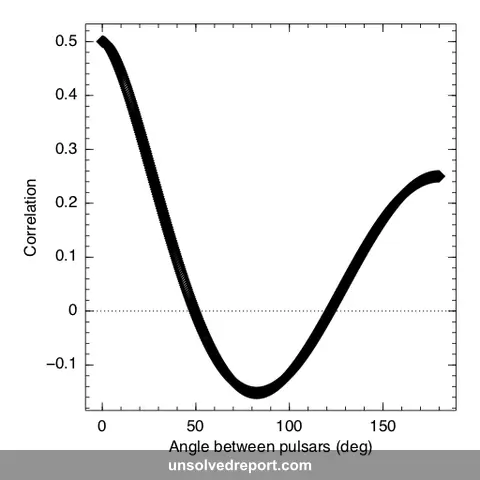
Nanohertz Gravitational Wave Background: The Hum Nobody Can Name
In 2023, dead stars across the sky drifted out of step together in a pattern no noise can fake. What's making them do it? Scientists still aren't sure.
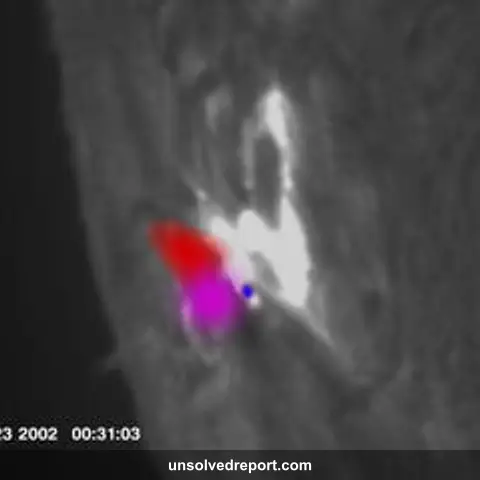
511 keV Positron Annihilation: The Galaxy's Antimatter Fountain Nobody Can Explain
The Milky Way's core glows with antimatter dying by the trillion-trillion every second, at exactly 511 keV. Fifty years of data and still no source. Here's why.
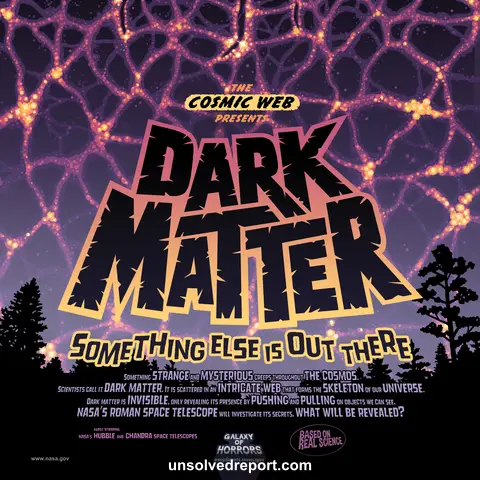
NGC 1052-DF2: The Galaxy With No Dark Matter Nobody Can Explain
NGC 1052-DF2 shouldn't exist—a galaxy with almost no dark matter, then a second one turned up nearby. So what's really missing? Here's what the data says.