Whydah Gally: The Pirate Wreck Still Hiding 90% of Its Gold
Whydah Gally shipwreck: the only pirate wreck ever proven real. So why is over 90% of Black Sam Bellamy's legendary gold still buried off Cape Cod?
April 26, 1717. A nor'easter is screaming across Cape Cod, and a few hundred feet from a beach in Wellfleet, Massachusetts, a fast three-masted galley is being smashed to pieces. Inside her hull: what may have been four and a half tons of stolen gold and silver. Aboard her: roughly 146 men. By morning, 144 of them are dead.
The ship was the Whydah Gally. Her captain was Samuel "Black Sam" Bellamy. And here's the part that still won't let people sleep — for more than two and a half centuries, both the ship and her mountain of treasure simply disappeared into the surf. Gone. When a diver finally found the wreck in 1984, he proved every wild story about it was true. But he didn't find the gold. Not most of it. By all accounts, it is still down there.
How a slave ship became a pirate's flagship
The Whydah was never meant to fly a black flag. She was a slave ship.
She was ordered up around 1715 in London by Sir Humphrey Morice — a Member of Parliament and one of England's biggest slave merchants — and launched in 1716. Her name came from the West African slave-trading Kingdom of Whydah, in what is now Benin. According to Wikipedia's heavily sourced entry, she was a square-rigged galley about 110 feet long, rated near 300 tons, bristling with 18 cannons, and fast — up to 13 knots. She was built for the brutal triangular trade: manufactured goods down to West Africa, enslaved Africans across to the Caribbean, then precious metals and goods back to England.
It was on that final leg home, in late February 1717, that Bellamy ran her down.
National Geographic reports that the Whydah was crossing the Windward Passage under Captain Lawrence Prince when Bellamy's pirates chased her for three days near the Bahamas. Prince gave up. Bellamy took the ship, made her his flagship, and piled on more cannons and crew. And here's the thing that stops you cold: Bellamy had been a pirate for barely a year. One year. Yet in that single year, he and his crews are documented to have seized dozens of vessels. Guinness World Records calls him the wealthiest pirate of the entire era, with a haul worth roughly $120 million in today's money. National Geographic puts it closer to $140 million. Hold those numbers loosely, though — they're inflation-adjusted estimates, not a tally from a ledger.
Then the sea came for him.
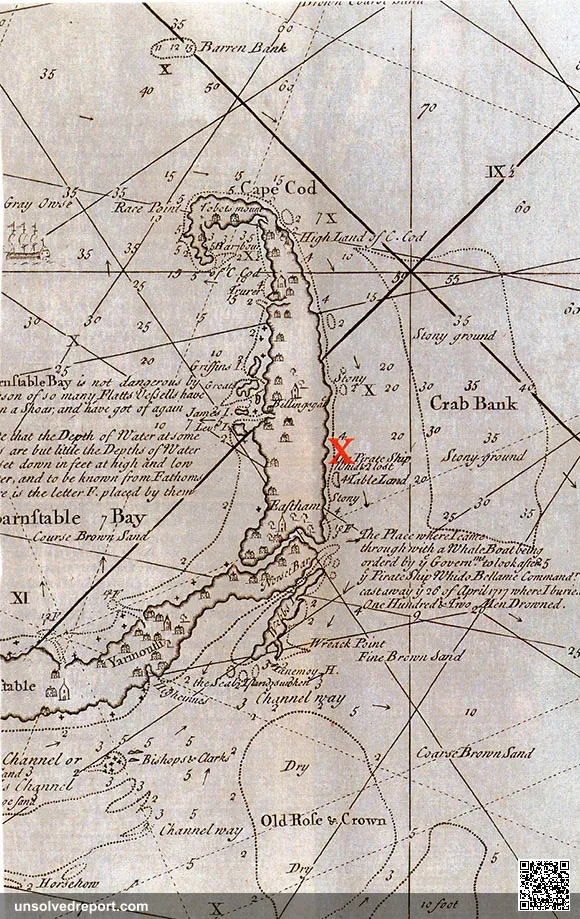
On April 26, 1717, that violent nor'easter drove the Whydah onto a sandbar in shallow water, just a few hundred feet from shore near present-day Marconi Beach in Wellfleet. The mast snapped. The ship rolled into deeper water and went under. Roughly 144 people drowned in the dark. Two men from the Whydah crawled out alive: a Welsh carpenter named Thomas Davis, and a teenaged Miskito pilot named John Julian (that's per Wikipedia, citing the trial record).
The survivors from a captured companion sloop were rounded up, and in October 1717 six pirates went on trial for piracy in Boston. All six were hanged on November 15, 1717 — confessing, the records note, in the shadow of the famous Puritan minister Cotton Mather. Two more men, judged to have been forced into the crew, walked free.
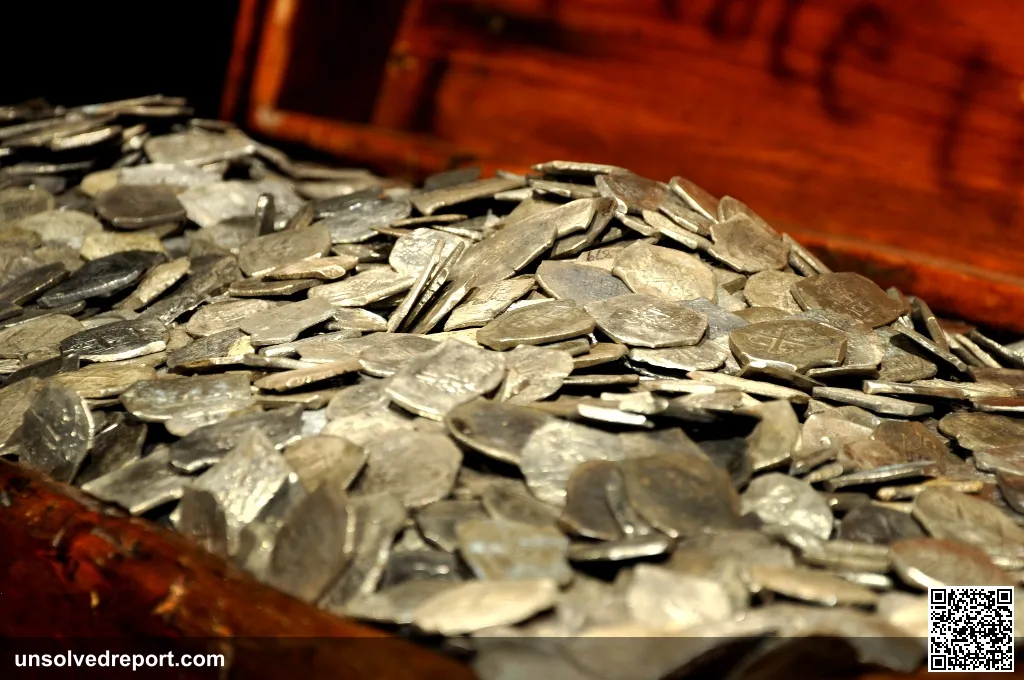
And it was in that Boston courtroom that the legend of the treasure was born. Surviving crew testified that the plunder — some four and a half to five tons of silver, gold, gold dust, and jewelry — had been split into roughly 180 fifty-pound sacks and packed between the ship's decks. That one detail, repeated by Wikipedia and museum sources alike, is where the famous "180 sacks" comes from.
For 267 years, that's where the trail went cold.
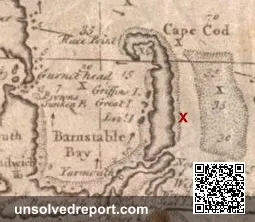
Then, in 1984, underwater explorer Barry Clifford found the wreck — guided in part by an old map of the site drawn by the salvager Cyprian Southack back in 1717. In 1985, Clifford's team brought up the ship's bronze bell. Wipe away the centuries of crust, and there it was, cast into the metal: THE WHYDAH GALLY 1716.
No one had ever done this before. That inscription didn't just suggest the ship's identity — it nailed it shut. As National Geographic and the recovery team describe it, the Whydah is the world's first and only fully authenticated Golden Age pirate shipwreck. The only one. Since then, more than 200,000 artifacts have surfaced — coins, cannons, weapons, nearly 400 pieces of Akan goldwork from West Africa, and around 200 manilla brass bracelets once used as African currency.
So the wreck is real. The pirate was real. The bell proves it. Which leaves one enormous, glittering question hanging in the cold Atlantic.
Where did all the gold go?
Here's the puzzle that just won't die. Barry Clifford has said publicly that his teams have recovered well under 10 percent of what the survivors swore was aboard. Under ten percent.
Do the math against that 180-sack testimony and it means the overwhelming majority of Bellamy's gold and silver is still on the seafloor right now — scattered across the sand, buried deep, and locked inside the iron-and-stone lumps called "concretions" that make recovery a nightmare.
So why is so much of it still lost? The honest answer is a brutal mix of physics and geography. The ship didn't sink politely. She exploded apart in pounding surf and spat her cargo across a wide debris field, which the Atlantic then buried under feet of restless, shifting sand. The treasure doesn't come up as shiny coins. It comes up welded into concretions that can weigh thousands of pounds, each one needing months of careful lab work just to crack open. There is no neat chest sitting under a tidy X.
Which leaves a real, unsolved question at the heart of all this: how much treasure is actually down there? Is the "180 sacks" a precise inventory — or a rough, maybe even exaggerated, number blurted out by terrified men on trial for their lives? Nobody has ever settled it.
And then there's a second mystery, one that's harder to shake because it's so human.
In 2018, researchers pulled a femur — a thigh bone — out of a 3,600-pound concretion. Working with scientists at the University of New Haven, they hoped to match its DNA against a living descendant of Bellamy's family. Could this be the captain himself? As phys.org and WBUR reported, the test came back negative. The bone belonged to a man with general ties to the Eastern Mediterranean — not Bellamy. Black Sam's own remains have never been identified. Skeletal remains of several crew have since come up from the wreck. But the captain? Still missing. Somewhere out there, under the sand, or scattered, or simply gone.
Sorting the truth from the campfire stories
Before you fall too hard for the romance, let's separate the documented record from the tales that grew on top of it.
Start with the Maria Hallett legend — the Cape Cod woman said to be Bellamy's lover, sometimes called the "Witch of Wellfleet." It's a gorgeous story. It is also, almost certainly, just a story. As the New England Historical Society and other regional historians point out, there's rich documentation of Bellamy's piracy — but essentially none confirming that Hallett ever existed. Enjoy her as folklore. Don't mistake her for history.
Now, the missing gold. Here the experts split into two camps. The optimists, some of them tied to the recovery effort, figure the bulk of the hoard is simply still buried and will keep surfacing for decades — and the steady trickle of new finds backs them up. The skeptics fire back: maybe some treasure washed ashore in 1717 and got quietly pocketed by locals (Southack himself griped about looting at the time), or maybe the trial-era tonnage was puffed up in the first place. Both ideas are reasoned guesses. Neither is proven.
But one thing isn't up for debate at all — and it might matter more than the gold.
As U.S. National Park Service underwater archaeologist Dave Conlin put it to National Geographic, "Slave ships made excellent pirate ships. They were designed to be fast." The Whydah is a rare, solid, physical record of two Atlantic histories tangled together: the slave trade and Golden Age piracy. So whatever fortune still lies buried off Wellfleet, the wreck has already surrendered something arguably worth more than gold — proof that it all really happened.
And the sea? The sea is still holding the rest. Patiently. Just offshore. Waiting for the next storm to move the sand.
Sources & further reading
- Whydah Gally — Wikipedia: https://en.wikipedia.org/wiki/Whydah_Gally
- We're still finding treasure from this 'golden age' pirate shipwreck — National Geographic: https://www.nationalgeographic.com/history/article/whydah-gally-pirate-ship
- Sam Bellamy became world's richest pirate despite ruling oceans for just two years — Guinness World Records: https://www.guinnessworldrecords.com/news/2023/11/sam-bellamy-became-worlds-richest-pirate-despite-ruling-oceans-for-just-two-years-761798
- Black Sam Bellamy, The Pirate Who Fought Smart, Harmed Few, Scored Big — New England Historical Society: https://newenglandhistoricalsociety.com/black-sam-bellamy-pirate-fought-smart-harmed-scored-big/
- Was pirate Black Sam Bellamy found? DNA test could tell — Phys.org: https://phys.org/news/2018-02-museum-discuss-efforts-bones-pirate.html
- Avast, Mateys! The Bones From That Cape Cod Shipwreck Aren't Bellamy's — WBUR: https://www.wbur.org/news/2018/05/25/pirate-bones-cape-cod-samuel-bellamy
- The Whydah Gally: Brief History of a Cape Cod Pirate Ship — Yankee/New England: https://newengland.com/yankee/history/whydah-gally-history-cape-cod-pirate-ship/
- Pirate bones found on Cape Cod shipwreck — Divernet: https://divernet.com/scuba-news/pirate-bones-found-on-cape-cod-shipwreck/

Amber Room: Poland Dug a New Search Site — and Found a Tank
Looted in 36 hours in 1941, worth up to $500M, officially burned in 1945 — yet in 2025 Poland granted a new dig permit. Where does the Amber Room stand now?
Golden Sun Bird Mystery: The Vanished City China Can't Explain
A 20-gram gold disc dug up by accident in 2001 may be the only clue to where an entire Bronze Age civilization went. So where did Sanxingdui's people actually go?
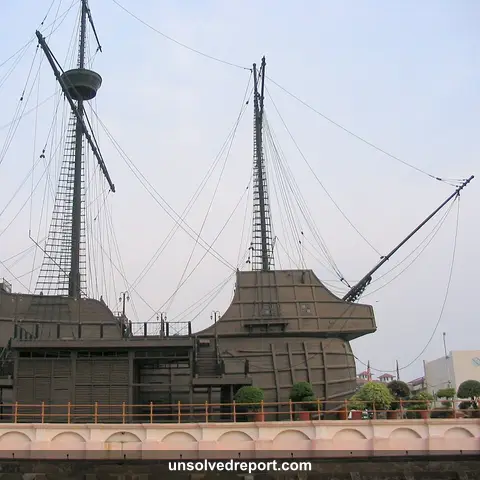
Flor de la Mar: The Richest Wreck Never Found
A Portuguese carrack sank off Sumatra in 1511 loaded with a sultan's fortune. Centuries later, still no proof the Flor de la Mar was ever found. Here's why.