Deep Sea Mysteries: 10 Real Sounds and Sights No One Can Explain
A roar heard 3,000 miles away. A whale no one answers. A light that swallows the horizon whole. Ten real deep sea mysteries — so why can't anyone close the file?
More than 80 percent of the ocean has never been mapped, explored, or even seen by human eyes. Sit with that for a second. We have sharper maps of Mars and the Moon than we do of our own seafloor. So when the deep — that crushing, lightless world a few thousand feet down — keeps handing us puzzles our best instruments and brightest minds can't crack, it's really no surprise at all.
Everything below is real. It happened. Hydrophones actually recorded these sounds. Submersibles actually photographed these things. Researchers actually logged them in peer-reviewed papers and government archives. And every case shares one honest, unsettling thread: we know something happened down there, and we still can't say exactly why — the same open-file feeling astronomers get from unexplained fast radio bursts flashing in from deep space. Here are ten deep sea mysteries that remain wide open.
1. The Bloop
In 1997, a sound came up out of the remote South Pacific so loud it shouldn't have been possible. The U.S. National Oceanic and Atmospheric Administration's underwater microphones caught it: an enormous, ultra-low-frequency pulse that sensors more than 3,000 miles apart could all hear. Nicknamed "the Bloop," it rose in pitch in a way that looked, eerily, like something a living thing might make. NOAA eventually decided the most likely culprit was an icequake — a fracturing iceberg shedding its bulk. Tidy enough. Except no one ever matched the Bloop to a specific glacier, and that strange, almost organic shape to the recording keeps the argument alive.
2. Julia
Two years later, in March 1999, the dark spoke again. NOAA's equatorial Pacific hydrophone array picked up a roughly 15-second sound so loud the entire array heard it at once. The agency labeled it "Julia." The leading guess: a colossal iceberg grinding against the seafloor somewhere near Antarctica. Here's the catch — the iceberg responsible was never found, and nothing in the archive has ever matched Julia since. One shout from the dark. No author. No echo.
3. The Slow Down
Some sounds end fast. This one took its time. Recorded in 1997, the "Slow Down" got its name because its frequency slid steadily downward over about seven minutes — an unusually long, smooth decline. NOAA's best read is that it was an Antarctic iceberg running aground, slowing as it scraped to a stop. Reasonable. But sounds resembling the Slow Down have reportedly turned up on later occasions too, which is a problem if you're betting on a one-time grounding. Why would a single iceberg dragging to a halt keep happening? Nobody has fully squared that.
4. Upsweep
Most of these mysteries are one-offs. Upsweep keeps a calendar. First caught when NOAA's Pacific array switched on in 1991, it's a seasonal sound — it swells in spring and autumn and has come and gone, like clockwork, for decades. Researchers tracked it to a patch of underwater volcanic activity in the South Pacific, hinting at seawater meeting molten lava. Fine. But the exact mechanism that produces such a steady, long-running, season-keeping signal has never been confirmed, and the source point keeps quietly drifting over time. The ocean's most punctual riddle, and we still don't know how it works.
5. The 52-Hertz Whale
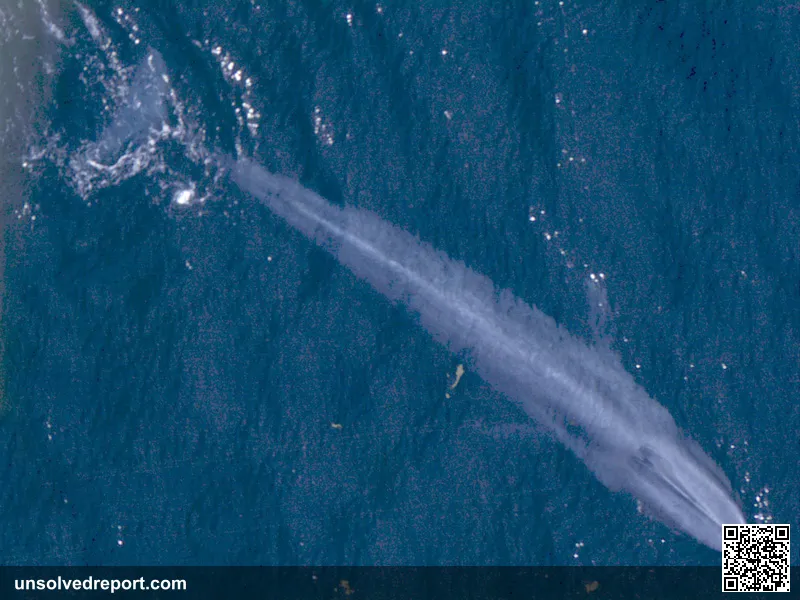
Out in the Pacific, something has been singing alone since the late 1980s. Hydrophones keep finding a single whale that calls at around 52 hertz — far higher than the roughly 15 to 25 hertz of blue whales, and unlike the calls of fin whales too. They call it "the loneliest whale in the world." It sings at a pitch no other whale is known to answer, and trackers have followed its voice across the Pacific for years. Is it a hybrid? A deformity? The last of some population we never knew existed? Scientists still can't agree on what it is — or whether it's really as alone as that strange, unanswered note makes it sound.
6. The Eltanin Antenna
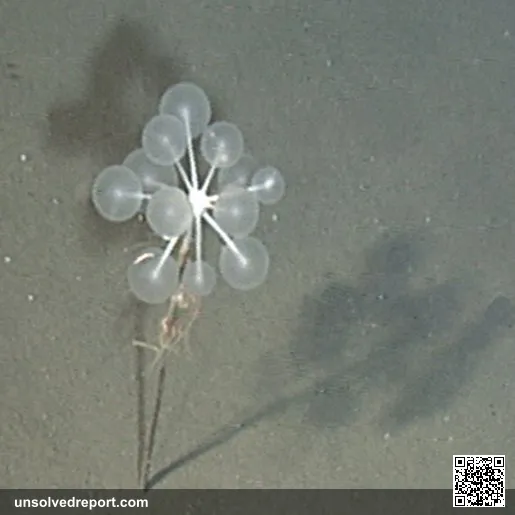
In 1964, the research vessel USNS Eltanin took a photograph 13,500 feet down, off the southern tip of South America, and the image is hard to look away from even now. Sitting on the seafloor was a symmetrical, pole-like structure, branching off at perfectly even angles — for all the world like the Eltanin Antenna, a television antenna someone had planted in the abyss. For decades it circulated as an "unexplained" object. Marine biologists have since pinned it down: a carnivorous sponge of the genus Chondrocladia. And yet the deeper puzzle holds. How does geometry that precise, that engineered-looking, simply grow in total darkness? It remains one of the most haunting images the ocean has ever given up.
7. The Deep-Sea "Brinicle"
Picture a finger of ice reaching down from the underside of polar sea ice — slowly, deliberately — and freezing every starfish and urchin solid the instant it touches bottom. Divers and camera crews have filmed it. They call it the "brinicle," or, less gently, the "ice finger of death." The physics: supercold, hyper-salty brine sinks and flash-freezes the water it passes through, building a tube of ice on the way down. But getting one to reach all the way to the seabed intact, instead of melting apart en route, takes conditions so specific they're nearly impossible to predict. Hardly anyone has ever watched one form from start to finish.
8. Brine Pools and Their "Shorelines"
There are lakes at the bottom of the sea. Real ones, with rippling surfaces and distinct "shorelines" — and you can drown in them. Submersibles, especially in the Gulf of Mexico, have found pools so dense with dissolved salt that they refuse to mix with the ocean above, lying there like ponds within the water. Wander in and the extreme salinity can kill you, which is why the rims are sometimes ringed with mussels and the bodies of animals that didn't make it back out. How do these underwater shorelines stay so stable for so long? And what kind of strange, possibly ancient microbial life thrives in that toxic water? Researchers are still arguing about both.
9. The Milky Sea Glow
For centuries, sailors swore they had seen the ocean catch fire with cold light — whole nights when the sea glowed a steady, ghostly white from horizon to horizon, so bright crews sometimes mistook it for fields of snow. "Milky seas." The likely source is vast colonies of bioluminescent bacteria, and in recent years satellites have finally confirmed the glows are real, sprawling across stretches of ocean larger than some countries. So far, so good. What no one can fully explain is the trigger: why a milky sea ignites when it does, why the bacteria glow continuously instead of flashing, and how blooms that enormous assemble out in the open ocean in the first place.
10. The Forgotten Slow Pulse of the Mid-Ocean
And then there are the sounds we can't even name. Down in the deep, instruments keep logging faint, rhythmic acoustic and pressure signals that don't match any known whale call, ship, or earthquake — including a long-running family of low-frequency "hums" picked up at sites all over the world. Some have been traced to ocean waves pushing on the seafloor. But certain local pulses, recorded by individual observatories, shrug that explanation off. With so little of the deep wired for sound, every unmatched pulse is the same quiet reminder: the abyss makes noises we have no word for, and it does it all the time — not unlike the Taos Hum, a sound on land that has resisted every instrument sent to find it.
---
Ten cases, one pattern. The deep sea is not silent, not empty, and definitely not simple. It's loud, crowded, and strange — and our sensors keep catching the edges of events we can't cleanly explain. Most of these will probably surrender to better instruments and patient science someday. For now, they sit in the open file, waiting.
Want the full story behind any one of these? Each has its own case file — the evidence, the leading theories, and the questions still hanging in the dark.
How solved is each one, really?
Line these ten up side by side and a spectrum appears — from cases with a confident leading answer that just lacks a smoking gun, to phenomena we've barely watched happen even once. The table below sorts them by how close each is to a settled explanation, using only the facts laid out above.
| # | Case | The core unsolved question | Best-supported explanation / status |
|---|---|---|---|
| 6 | The Eltanin Antenna | Is the "antenna" a built object? | Solved as to identity — a carnivorous sponge of the genus Chondrocladia; the open puzzle is only how such precise geometry grows in the dark |
| 1 | The Bloop | What made the 1997 South Pacific pulse heard 3,000+ miles away? | Leading answer stands (icequake / fracturing iceberg), but never matched to a specific glacier |
| 3 | The Slow Down | Why did the 1997 signal slide downward over ~7 minutes? | Best read is an iceberg running aground — but similar sounds reportedly recurred, which a one-time grounding can't explain |
| 4 | Upsweep | What drives a seasonal signal that has recurred for decades? | Traced to South Pacific volcanic activity (seawater meeting lava); exact mechanism unconfirmed and the source point drifts |
| 9 | The Milky Sea Glow | What triggers ocean-wide glows now confirmed by satellite? | Bioluminescent bacteria confirmed as the source; the trigger, the continuous glow, and how the blooms assemble remain unexplained |
| 2 | Julia | What produced the ~15-second 1999 sound the whole array caught? | Suspected iceberg grinding the seafloor near Antarctica — but the iceberg was never found and nothing has matched Julia since |
| 7 | The Deep-Sea "Brinicle" | How does an ice finger reach the seabed intact? | Physics understood (sinking supercold brine), but the exact conditions are near-impossible to predict and rarely filmed forming |
| 8 | Brine Pools | Why do the underwater "shorelines" stay stable, and what lives in them? | Dense, unmixing salt water observed directly; both the stability and the microbial life are still argued over |
| 5 | The 52-Hertz Whale | Is it one animal, and what is it? | Real, tracked for years since the late 1980s — but hybrid, deformity, or last-of-a-population all remain on the table |
| 10 | The Mid-Ocean Slow Pulse | What are the unmatched local pressure/acoustic pulses? | Some global "hums" tie to waves pushing on the seafloor; specific local pulses shrug that off, and most of the deep isn't even wired for sound |
The rough rule the ranking exposes: the ocean is best at handing us a plausible category of answer — an iceberg, a bacterium, a sponge — while withholding the specific event, mechanism, or specimen that would close the file. Only the Eltanin Antenna crossed fully from "unexplained object" to a named organism.
Sources & further reading
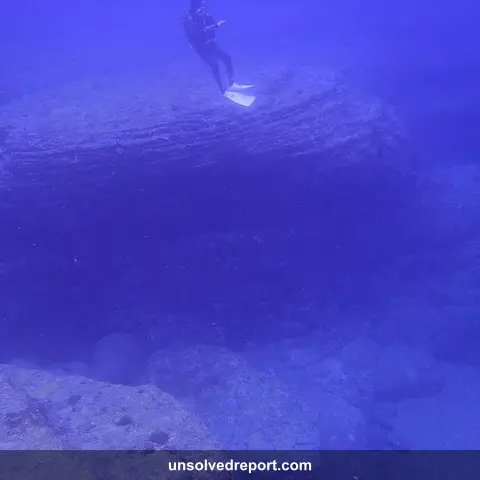
Yonaguni Monument: The Underwater 'Pyramid' Japan Won't Call Real
26 meters down off Japan sits a 'staircase' officials won't call a ruin. Is Yonaguni Monument a lost city, or does the rock hide a simpler answer?

Lycurgus Cup Mystery: The Roman Glass That Bleeds Red
A 1,600-year-old Roman cup turns jade green to blood red depending on where the light hits it. Scientists found the nanotech inside — but not who built it, or why.
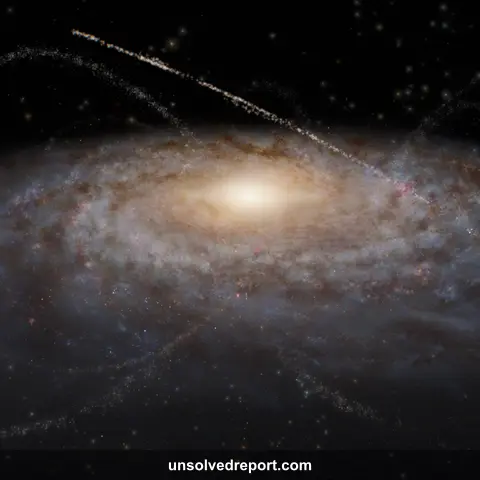
GD-1 Stellar Stream: An Invisible Object Too Dense to Explain
Something invisible punched a hole through the GD-1 stellar stream — and it's too dense to be ordinary dark matter. So what actually hit it?