Eltanin Antenna: The 1964 'Alien Machine' That Was Alive
A 1964 Navy photo two miles deep showed what looked like a built antenna on the seafloor. It wasn't. Here's the 1971 identification — and what's been found since.
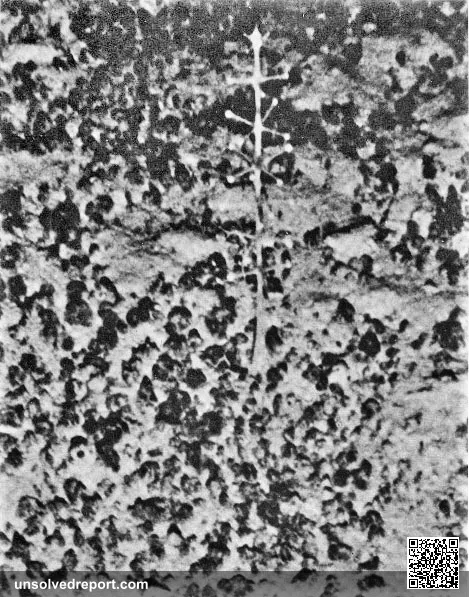
A camera shutter clicks two miles down, in black water that has never once been touched by sunlight. The frame comes back showing a slender pole rising straight out of the mud, crossed by neat horizontal bars set at clean right angles. It looks built. It looks like a television aerial standing alone on the floor of the abyss. That one black-and-white photo, snapped on August 29, 1964, fed one of the weirdest rumors in ocean history for decades. The real answer, confirmed in 1971 and still being filled in by scientists today, turned out to be stranger than any of the rumors: it was alive, and it was hunting.
> ### The 60-Second Brief
> - August 29, 1964: USNS Eltanin photographs the object at 3,904 m (12,808 ft) depth, 1,000 miles west of Cape Horn.
> - December 5, 1964: The New Zealand Herald prints the photo as "Puzzle Picture From Sea Bed," launching the mystery.
> - 1968: Paranormal author Brad Steiger calls it "an astonishing piece of machinery" in Saga Magazine — the line that seeded the alien legend.
> - 1971: Oceanographers Heezen and Hollister identify it in print as the sponge Cladorhiza concrescens — a species already 84 years old in the scientific record at that point.
> - 1995: A Nature paper confirms the first carnivorous sponge, proving the Eltanin sponge's entire family, the Cladorhizidae, are predators, not filter feeders.
> - September 27, 2024: A Scientific Reports paper describes 6 new Cladorhizidae species off Western Australia, collected by ROV — evidence the family is still being actively catalogued 60 years after the "antenna" photo.
What we actually know
Mark the date: August 29, 1964. The oceanographic research ship *USNS Eltanin was working roughly 1,000 miles west of Cape Horn, at position 59°07′S, 105°03′W, over about 3,904 meters (12,808 feet) of water when it snapped the picture (Wikipedia: Eltanin Antenna). The Eltanin* was not some random boat with a camera. Launched in 1957 as a U.S. Navy cargo icebreaker, it was reclassified in 1962 as an oceanographic research ship and became one of the first vessels devoted to year-round Antarctic science. Its magnetic surveys of the seafloor helped confirm the theory of seafloor spreading and continental drift (Wikipedia: USNS Eltanin). This was serious science, not a ghost hunt.
The object itself was small. A vertical stalk about a meter tall, topped and ringed by perpendicular crossbars. The world first saw it when the New Zealand Herald printed the photo on December 5, 1964, under the headline "Puzzle Picture From Sea Bed" (Wikipedia: Eltanin Antenna).
And there it might have stayed, a forgotten curiosity buried in a newspaper archive. Then, four years later, paranormal author Brad Steiger dug it back up. In a 1968 article for Saga Magazine, Steiger called the object "an astonishing piece of machinery ... very much like the cross between a TV antenna and a telemetry antenna" (Wikipedia: Eltanin Antenna). That one sentence lit the fuse. The "Eltanin Antenna" became a fixture of fringe literature, recast as a sunken alien transmitter — the sort of hardware that proponents of the Fermi paradox imagine a visiting civilization might leave behind — a relic of a lost civilization, a secret Cold War listening post. Take your pick.
The real answer arrived without fanfare. In 1971, oceanographers Bruce C. Heezen and Charles D. Hollister published their landmark seafloor atlas, The Face of the Deep (Oxford University Press). They reprinted the Eltanin image and named the "antenna" for what it was: a living thing. Cladorhiza concrescens, a deep-sea sponge. They added, drily, that it "somewhat resembles a space-age microwave antenna" (Wikipedia: Eltanin Antenna).
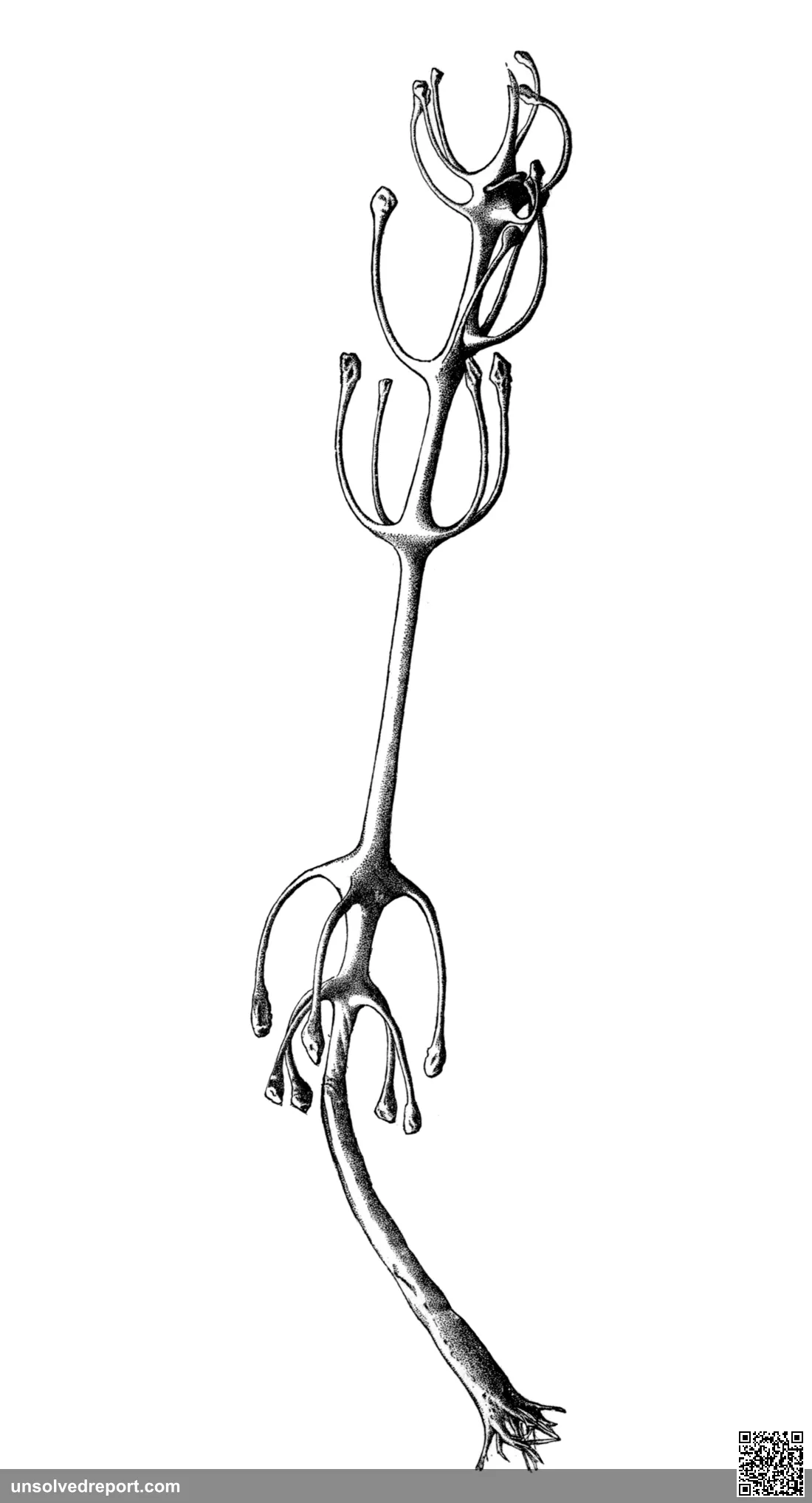
Here's the part the legend never mentions. That sponge already had a long paper trail. It was first formally described as Cladorhiza concrescens by Oscar Schmidt in 1880, from specimens hauled up during deep-sea dredging supervised by the Harvard zoologist Alexander Agassiz aboard the U.S. Coast Survey steamer Blake in the Gulf of Mexico (World Register of Marine Species). Agassiz drew these sponges himself, describing "a long stem ending in ramifying roots, sunk deeply into the mud," the stem bearing "nodes with four to six club-like appendages." Today the species goes by Chondrocladia concrescens (WoRMS). So the "alien machine" had been a known, catalogued animal for 84 years before the Eltanin ever pointed a lens at one. Decades before Steiger ever picked up his pen.
The question worth asking
Now we reach the genuinely good part of this mystery, because the real puzzle was never "is it a machine?" The real puzzle is this: what kind of creature builds a structure this rigid, this geometric, on a flat plain of bare mud?
Think about what scientists believed for most of history. Every sponge they knew was a passive filter feeder, pulling water through its pores and straining out specks of food. A meter-tall sponge with stiff, antenna-like arms made no sense under that rule. The arms looked too deliberate. Too architectural. Too much like a design. And the truly surprising answer didn't fully land until the 1990s, long after everyone agreed the photo was "explained."
In 1995, French marine biologists Jean Vacelet and Nicole Boury-Esnault reported something extraordinary in the journal Nature: the first confirmed carnivorous sponge, caught in a Mediterranean cave grabbing live crustaceans (Nature, 1995, vol. 373). It broke a textbook certainty in half. As it turned out, an entire deep-sea family, the Cladorhizidae, the very family the Eltanin sponge belongs to, had given up filter feeding completely. They are predators (NIWA: Beware the carnivorous sponge).
So the question that photo posed back in 1964 was, in a way, running ahead of the science meant to answer it. The structure looked purposeful because, biologically, it is.
What it was, and what it wasn't
The legend (and it is only a legend). The story that made the Eltanin Antenna famous, the alien artifact, the sunken super-civilization, the secret submarine relay, rests on nothing but Steiger's 1968 magazine description and the picture's surface resemblance to hardware. No physical evidence. No recovered object. No corroborating data of any kind. These are folklore that grew up around a striking image — much like the 1,400 artillery shells fired at an unidentified object over Los Angeles in 1942 — and that's exactly how you should hold them: as speculation, not fact.
The science (and this part is solid). The agreed-upon answer is the carnivorous sponge Chondrocladia concrescens, and its "antenna" look is pure structure. The sponge's body is stiffened by a skeleton of microscopic silica needles called spicules. Those needles hold the central pole upright and splay the side branches outward, producing the symmetrical, right-angled silhouette that fooled the eye (Deep Sea News). As one marine biologist put it, "it's fairly symmetrical and the offshoots are all 90 degrees apart." Exactly the qualities our brains read as manufactured.
The arms are weapons. Those branches aren't aerials. They're traps. The surface of a cladorhizid sponge is studded with tiny hook-shaped spicules that work like biological Velcro. A small crustacean drifts into the arms, brushes against them, and sticks fast. Then sponge cells creep over the captive and slowly digest it alive (NIWA; Scientific American). The geometry that screamed "engineering" is actually a feeding strategy tuned for one of the hungriest places on Earth, an abyssal plain where meals are rare and a patient predator with a wide reach wins.
The Eltanin Antenna survives as a little classic of "Strange History" for one reason: both halves of it are true at the same time. The photograph really did capture something that looks machine-made on the dark floor of the sea. And the answer, a silica-boned predator that turns its own skeleton into a snare, is arguably more wonderful than the myth that hid it for so long. The abyss didn't plant an antenna down there. It grew a hunter. We just mistook the hunter for a transmitter, in much the same way a burst of radio noise once got mistaken for a message from the stars. And if a sponge can wear the disguise that well, you have to wonder what else is standing quietly in the dark, waiting to be misread.
Timeline: how a sponge became an "antenna"
Every entry below is anchored to a source already cited above. Read top to bottom and the "mystery" dissolves into a paper trail — the animal was catalogued 84 years before the camera ever found one, and the "alien" reading was bolted on 4 years after the photo, then quietly retired 3 years after that.
| Date | Event | Source |
|---|---|---|
| 1880 | Oscar Schmidt formally describes the species as Cladorhiza concrescens, from specimens dredged under Alexander Agassiz aboard the steamer Blake in the Gulf of Mexico | WoRMS |
| Aug 29, 1964 | USNS Eltanin photographs the object at 59°07′S, 105°03′W over 3,904 m (12,808 ft) of water | Wikipedia: Eltanin Antenna |
| Dec 5, 1964 | New Zealand Herald prints the photo under the headline "Puzzle Picture From Sea Bed" | Wikipedia: Eltanin Antenna |
| 1968 | Brad Steiger, in Saga Magazine, calls it "an astonishing piece of machinery ... very much like the cross between a TV antenna and a telemetry antenna" — the phrasing that seeds the alien legend | Wikipedia: Eltanin Antenna |
| 1971 | Heezen & Hollister reprint the image in The Face of the Deep and identify it as the sponge Cladorhiza concrescens | Wikipedia: Eltanin Antenna |
| 1995 | Vacelet & Boury-Esnault confirm the first carnivorous sponge in Nature, revealing the Cladorhizidae — the Eltanin sponge's own family — as predators | Nature 373: 333–335 |
Weighing the two readings
Two explanations compete for the same photograph. Here is what actually backs each one, and what would settle the matter.
The "antenna / artifact" reading. Strength of evidence: effectively none — it rests entirely on Steiger's 1968 magazine prose and the picture's surface resemblance to hardware (Wikipedia). Methodological weakness: no object was ever recovered, no material analysed, no second sighting of an "antenna" logged; the claim is built on a single low-resolution frame interpreted by eye. What would resolve it: physical retrieval and analysis of the object — which, when specimens of this species were dredged, showed biological tissue and silica, not manufactured components.
The carnivorous-sponge reading. Strength of evidence: strong and convergent. The species was described from real specimens in 1880 (WoRMS); the object was identified as that sponge by specialists in 1971; and the 1995 Nature work plus later surveys establish the whole Cladorhizid family as predatory (Nature; NIWA). The right-angled geometry is explained mechanically, by a silica-spicule skeleton (Deep Sea News). Methodological weakness: the specific individual in the 1964 frame was never itself collected, so identification is by morphological match to a known species rather than a recovered voucher — a normal limitation of seafloor photography, not a genuine rival to the alien claim. What would resolve it further: a directly sampled specimen from that exact site — the kind of routine confirmation modern deep-sea imaging pairs with collection.
The family is still being catalogued (2024)
Note: this development does not concern the Eltanin case directly — no new evidence about the 1964 photograph itself has surfaced. It is included because it shows the sponge family the "antenna" belongs to remains an active area of discovery.
On September 27, 2024, a team of researchers published a paper in Scientific Reports describing six new carnivorous sponge species in the family Cladorhizidae — the same family as the Eltanin "antenna" sponge — collected from Western Australia's Cape Range and Bremer Canyon systems: Abyssocladia johnhooperi, Abyssocladia aurora, Abyssocladia janusi, Axoniderma challengeri, Cladorhiza vanessaekins, and Nullarbora ningalooa (Scientific Reports, 2024). The specimens were gathered by the remotely operated vehicle SuBastian, working off research vessel Falkor, using manipulator jaws and suction during 2020 expeditions (PMC). Sixty years after a Navy camera mistook one of these sponges for hardware, ROVs are still finding new members of the same carnivorous family on canyon floors most of the world has never photographed.
Frequently Asked Questions
What was the Eltanin Antenna, really?
It was a deep-sea sponge, Cladorhiza concrescens (now Chondrocladia concrescens), photographed by USNS Eltanin on August 29, 1964, at 3,904 meters depth off Cape Horn. Its rigid, right-angled shape comes from an internal skeleton of silica spicules, not from any manufactured material (Wikipedia: Eltanin Antenna; Deep Sea News).
Who first said it looked like an alien antenna?
Paranormal author Brad Steiger, in a 1968 article for Saga Magazine, described it as "an astonishing piece of machinery ... very much like the cross between a TV antenna and a telemetry antenna." That single sentence, published four years after the photo and three years before its scientific identification, is the entire origin of the alien-artifact legend (Wikipedia).
When was the sponge identification confirmed?
In 1971, oceanographers Bruce C. Heezen and Charles D. Hollister reprinted the image in their atlas The Face of the Deep and identified it as Cladorhiza concrescens, noting it "somewhat resembles a space-age microwave antenna" (Wikipedia).
Is Chondrocladia concrescens dangerous to humans?
No. It lives roughly 3,900 meters down, far beyond any human contact, and its Velcro-like hooked spicules are built to snag small crustaceans that drift into its arms, not anything larger (NIWA).
How long was the sponge known to science before the photo?
84 years. Oscar Schmidt formally described Cladorhiza concrescens in 1880 from specimens dredged under Alexander Agassiz aboard the steamer Blake — decades before the Eltanin ever photographed one in 1964 (WoRMS).
Are carnivorous sponges still being discovered?
Yes. As recently as September 2024, researchers described six new Cladorhizidae species off Western Australia using ROV-collected specimens, confirming the family remains under active study six decades after the Eltanin photo (Scientific Reports, 2024).
The Eltanin Antenna endures because the photograph and the explanation are both, in their own way, true: something on the seafloor really did look built, and the thing that actually built itself there is still being found, arm by silica arm, in canyons no camera had reached until an ROV got there decades later.
Sources & further reading
- Wikipedia — Eltanin Antenna: https://en.wikipedia.org/wiki/Eltanin_Antenna
- Wikipedia — USNS Eltanin: https://en.wikipedia.org/wiki/USNS_Eltanin
- World Register of Marine Species (WoRMS) — Chondrocladia concrescens (Schmidt, 1880): https://marinespecies.org/aphia.php?id=881551&p=taxdetails
- Vacelet, J. & Boury-Esnault, N. (1995). 'Carnivorous sponges.' Nature 373: 333–335: https://www.nature.com/articles/373333a0
- NIWA — Beware the carnivorous sponge (CenSeam): https://niwa.co.nz/water-atmosphere/vol14-no1-march-2006/beware-carnivorous-sponge-censeam-global-census-marine-life-seamounts
- Scientific American — New carnivorous harp sponge discovered in deep sea: https://www.scientificamerican.com/blog/running-ponies/new-carnivorous-harp-sponge-discovered-in-deep-sea/
- Deep Sea News — Alien Antenna on Deep-Sea Floor (Jan 2024): https://deepseanews.com/2024/01/alien-antenna-on-deep-sea-floor/
- Heezen, B. C. & Hollister, C. D. (1971). The Face of the Deep. Oxford University Press.
- Scientific Reports (2024) — New carnivorous sponges (Porifera: Cladorhizidae) from Western Australia, collected by ROV: https://www.nature.com/articles/s41598-024-72917-8
- PMC — Full text, ROV collection details (SuBastian/Falkor, 2020): https://pmc.ncbi.nlm.nih.gov/articles/PMC11436925/

Lake Vostok: 2 Miles Under Ice, a DNA Result No One Can Explain
Sealed under 2 miles of Antarctic ice for millions of years, Lake Vostok gave up a DNA sample scientists still can't classify. What's really down there?

The Lost Ninth Legion: How 5,000 Men Vanished
Five thousand Roman soldiers marched into the 2nd century and never marched out. No battle. No bodies. No record. Here's what the stones actually say.

Sungbo's Eredo: The 100-Mile Wall Hidden in a Forest
Sungbo's Eredo: a 100-mile wall hidden in Nigeria's rainforest for centuries, taller than a six-story building. Who built it — and for what vanished queen?