Galileo Project: Harvard's $100M Hunt for Real Alien Technology
Avi Loeb's Galileo Project dredged the Pacific for alien wreckage and scans the sky nightly. What did they find, and why won't the debate die?
Picture a telescope on the roof of a Harvard observatory, swiveling its electronic eye across the sky all night, every night. It isn't looking at distant galaxies. It's watching for something flying overhead that shouldn't be there.
The man who built it is a real Harvard astrophysicist. He has a real budget, real instruments, and a very unusual question: what if some of the strange things in our sky, or drifting through our solar system, were built by someone who isn't from Earth?
His name is Avi Loeb. And instead of just arguing about it on the internet, he decided to go look. With cameras. With a boat. With magnets dragged across the ocean floor.
The Documented Facts
The Galileo Project is a genuine scientific research effort, not a conspiracy hobby. It launched on July 26, 2021, founded by Harvard astronomy professor Avi Loeb, not long after the 2021 Pentagon UAP report put 143 unexplained sightings on the government's own record, with the stated goal of searching for evidence of alien technology using "transparent, validated and systematic scientific research" (The Galileo Project, Harvard; Scientific American).
It started with about $1.8 million in private donations, much of it from science-equipment business leaders like Frank Laukien of Bruker Corporation (Scientific American). Loeb has estimated the full vision would cost roughly $100 million (Wikipedia).
The project follows three avenues. First, build telescope systems with AI that can photograph and classify anything anomalous in the sky. Second, study interstellar objects passing through our solar system, like the famous visitor 'Oumuamua. Third, search Earth's orbit for any non-human-made satellites (Wikipedia). The first observatory telescope went up on the Harvard College Observatory roof in 2022 (Wikipedia).
Why does Loeb care so much about photographs? His logic is blunt: "It's very easy to answer by taking a high-resolution photograph" (Scientific American). No fuzzy videos. No shaky witness stories. Just clear data.
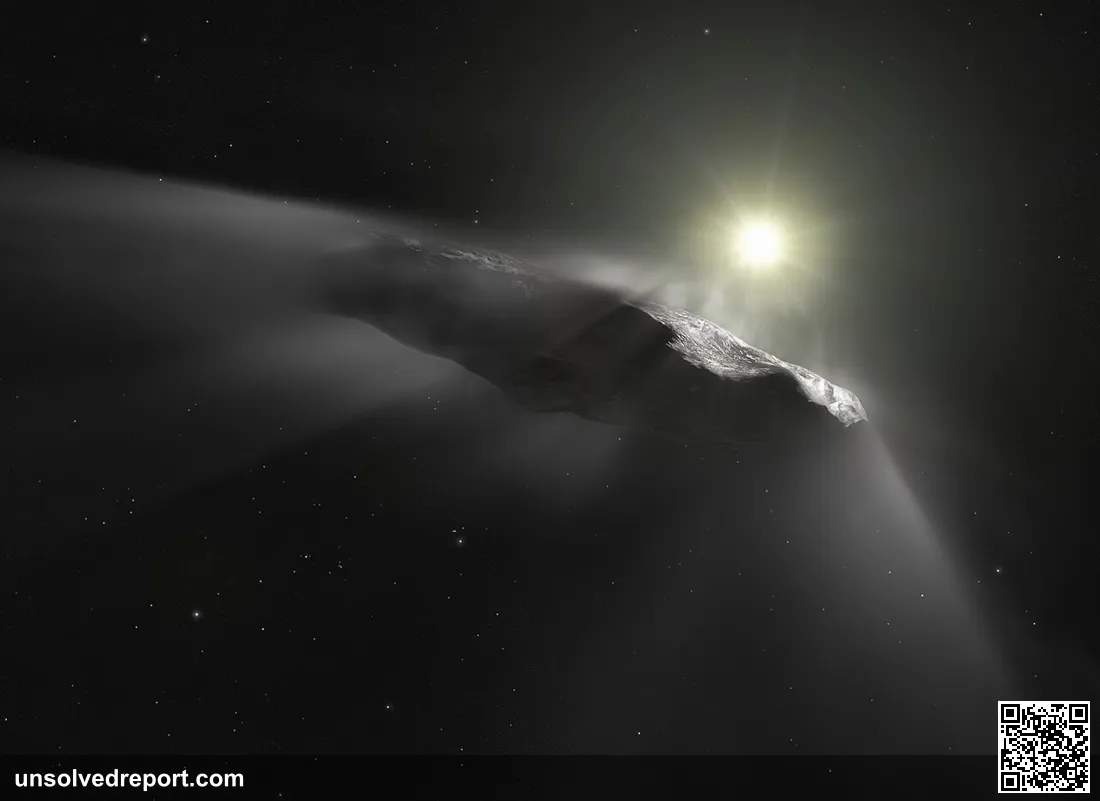
Loeb's interest didn't come from nowhere. In 2017, the Pan-STARRS telescope in Hawaii spotted the first known object to enter our solar system from interstellar space. Astronomers named it 'Oumuamua, Hawaiian for "a messenger from afar arriving first" (NASA Science). It was strangely elongated, and it sped up slightly as it left, in a way comets usually do but this object did without showing a normal comet's tail. Loeb co-authored a paper suggesting one explanation could be a thin, sail-like artificial object, perhaps only a fraction of a millimeter thick, pushed by sunlight (Space.com).
Then he did something even bolder. In June 2023, Loeb led an expedition off Papua New Guinea to recover fragments of a meteor, called IM1, that had burned up over the Pacific on January 8, 2014, and which some data suggested came from outside our solar system. Dragging a magnetic sled across the seafloor, the team collected hundreds of tiny metallic spheres, each smaller than a millimeter (Space.com; The Galileo Project). Some had an unusual chemical mix, rich in beryllium, lanthanum, and uranium, that Loeb's team nicknamed "BeLaU" (The Galileo Project).
The Genuine Open Question
Here's the honest part: nobody has found alien technology. Not a single confirmed artifact, photo, or signal.
The real open question is narrower and more interesting. Are any of these anomalies, the elongated 'Oumuamua, the unusual ocean spherules, the unexplained objects in military sky footage like the 2004 Tic Tac encounter, actually evidence of something built beyond Earth? Or do they all have natural, ordinary explanations we simply haven't pinned down yet?
The deepest disagreement isn't really about aliens. It's about whether the evidence so far holds up, and Loeb's own colleagues are sharply split on that.
Theories and Interpretations
Let's be clear about what is fact and what is speculation.
The artificial-origin idea (labeled speculation, unproven). Loeb argues we should seriously consider that 'Oumuamua or the IM1 fragments could be technological, an echo of the same alien-megastructure hypothesis once floated for Tabby's Star's bizarre dimming. He is careful to frame this as a hypothesis worth testing, not a conclusion. No mainstream evidence confirms it, and most astronomers reject the alien interpretation of 'Oumuamua.
The "it's natural" view (the mainstream position). Many scientists think these objects are unusual but entirely natural, and that the data linking the ocean spherules to a true interstellar meteor is shaky. Matthew Genge of Imperial College London argues you fundamentally cannot tie tiny seafloor spheres to one specific fireball: "There never has been a micrometeorite derived from a specific fireball event, and never will be, since it is an impossibility" (Space.com). Peter Brown of Western University adds that government sensors "systematically overestimate" meteor speeds, which undercuts the claim that IM1 was even interstellar (Space.com).
The "good idea, fair criticism" middle ground. Some researchers like the method even if they doubt the findings. Jason Wright of Penn State has praised Loeb's willingness to collect data systematically (Scientific American), yet has also called some of his claims "unambiguously counterproductive" for the field (Space.com).
The conspiracy fringe (clearly unproven, not science). Online, all this gets blended into stories of secret government UFO crash retrievals and hidden alien craft. Those claims are not what the Galileo Project is about, and they are unsupported by verifiable evidence. Loeb's whole pitch is the opposite: stop trading rumors, start collecting public data.
The fairest summary? Loeb is asking a legitimate scientific question with legitimate tools. Whether his specific answers survive scrutiny is exactly what's still being fought over, out in the open, the way science is supposed to work.
And if a single rocky visitor from another star could spark a Harvard expedition to the bottom of the Pacific, what happens when the next interstellar object shows up, and early data starts whispering "anomaly" all over again?
Sources & Further Reading
- The Galileo Project (Wikipedia overview)
- Avi Loeb's Galileo Project Will Search for Evidence of Alien Visitation, Scientific American
- Interstellar meteor fragments found? Harvard astronomer's claim sparks debate, Space.com
- Spherule analysis finds evidence of extrasolar composition, The Galileo Project
- 'Oumuamua, NASA Science
- Wild Idea: What If 'Oumuamua Is an Alien Light Sail? Space.com
- Harvard Prof. Loeb Launches 'Galileo Project', The Harvard Crimson
SETI at 65: One Unexplained Signal, Six Decades of Silence
65 years of SETI: Project Ozma, the Big Ear, a signal that got stronger on reanalysis, and why the silence itself is the strangest data point of all.

Varginha UFO Incident: The Red-Eyed Alien Nobody Can Explain
The Varginha UFO incident: a red-eyed alien, a dead soldier, zero physical evidence in 30 years. So what did three terrified girls actually see?

1952 Washington DC UFO Incident: 3 Radars, 1 Lost Tape, 74 Years
3 radars tracked it, jets chased it, and in 2026 a lawmaker says MIT has a tape of the Air Force briefing that followed. What the 1952 DC UFO case still can't explain.