Giants of Mont'e Prama: The 3,000-Year Army Someone Smashed
A farmer's plow hit a stone head in Sardinia and uncovered a buried army of giants, all shattered. Nobody agrees who smashed them, or why. Here's what we know.
March 1974. Two farmers are plowing a field near a low hill called Mont'e Prama, in Cabras, out on Sardinia's Sinis peninsula. The blade catches on something hard. They dig. Staring back at them from the dirt is a giant stone head.
That head was just the beginning. Under that quiet stretch of central-western Sardinian farmland lay a buried army of larger-than-life sandstone warriors, carved roughly three thousand years ago by a people who left behind no writing to tell us a single thing about them.
These are the Giants of Mont'e Prama. Here is what we can prove, what nobody can explain, and how careful scholars try to read the silence.
What we actually know
It really did start with a plow. In 1974, farmers including Sisinnio Poddi and Battista Meli kept turning up odd fragments while clearing their fields. When the landowner realized one chunk was a colossal head, he called in archaeologists, and the digs that followed ran from the mid-1970s all the way to 1979 (Wikipedia; Smithsonian Magazine). The figures are cut from local sandstone and tower to roughly 2 to 2.5 meters, well over the height of a real person (Wikipedia).
Who carved them? The Nuragic people, Sardinia's Bronze and Iron Age civilization. They take their name from the thousands of stone towers, the nuraghi, that still stud the island today (The Metropolitan Museum of Art). Most scholars date the statues to somewhere between the 11th and 8th centuries BC, the same turbulent centuries in which the Sea Peoples were reshaping the Mediterranean, with many leaning toward the later end of that window, anchored by the burials and finds around them (Wikipedia; ANSA).
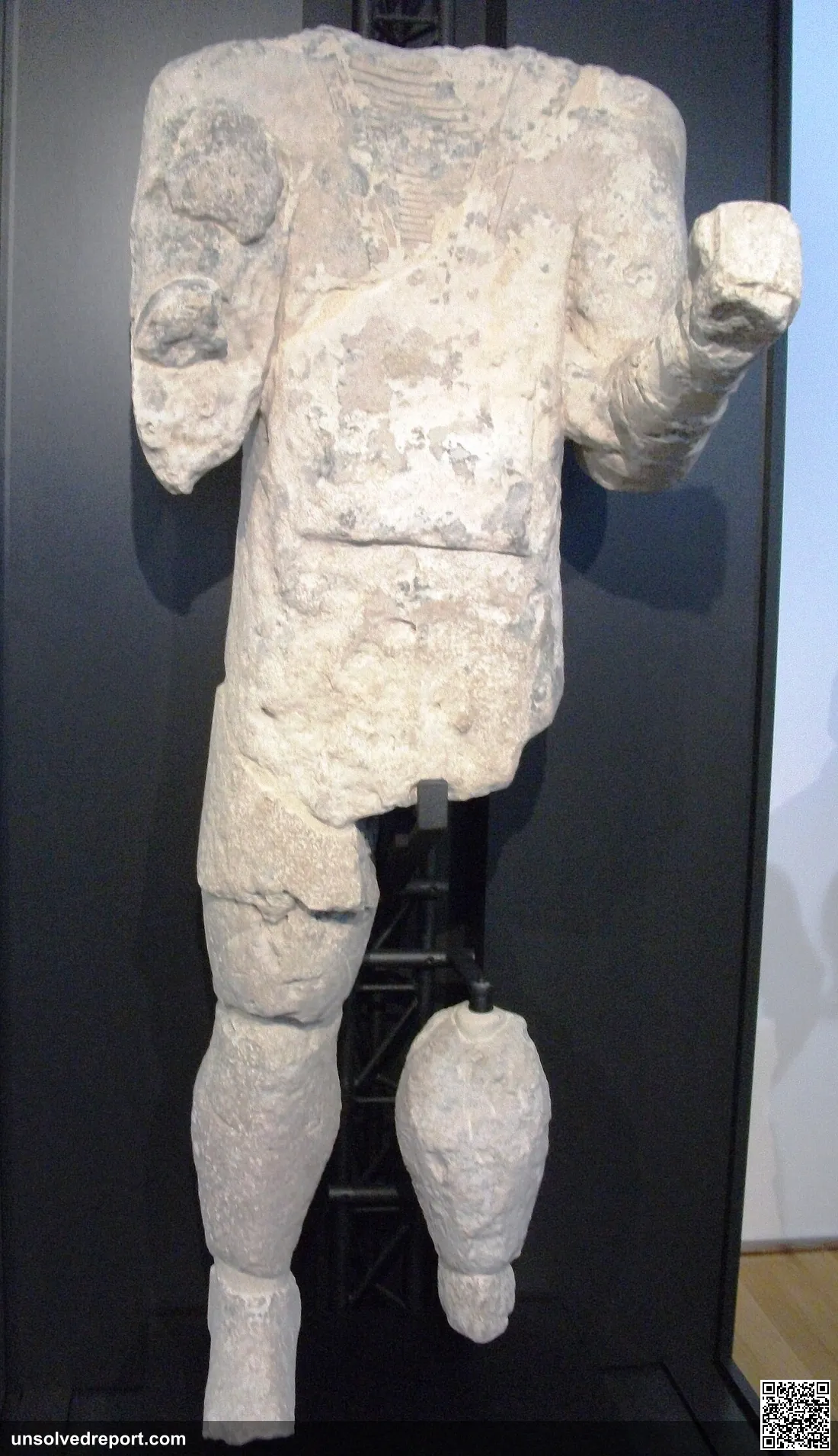
Here's the unsettling part. The giants were not found standing tall. They were found in ruins. Excavators pulled roughly 5,000 fragments out of the ground, including about 15 heads and 22 torsos, strewn across the soil above an ancient cemetery (Wikipedia). The pieces then sat in museum storage for some three decades before a marathon restoration effort from 2007 to 2012 fit the shattered warriors back together (Wikipedia). Today 44 sculptures stand split between the Giovanni Marongiu Civic Archaeological Museum in Cabras and the National Archaeological Museum in Cagliari (monteprama.it).
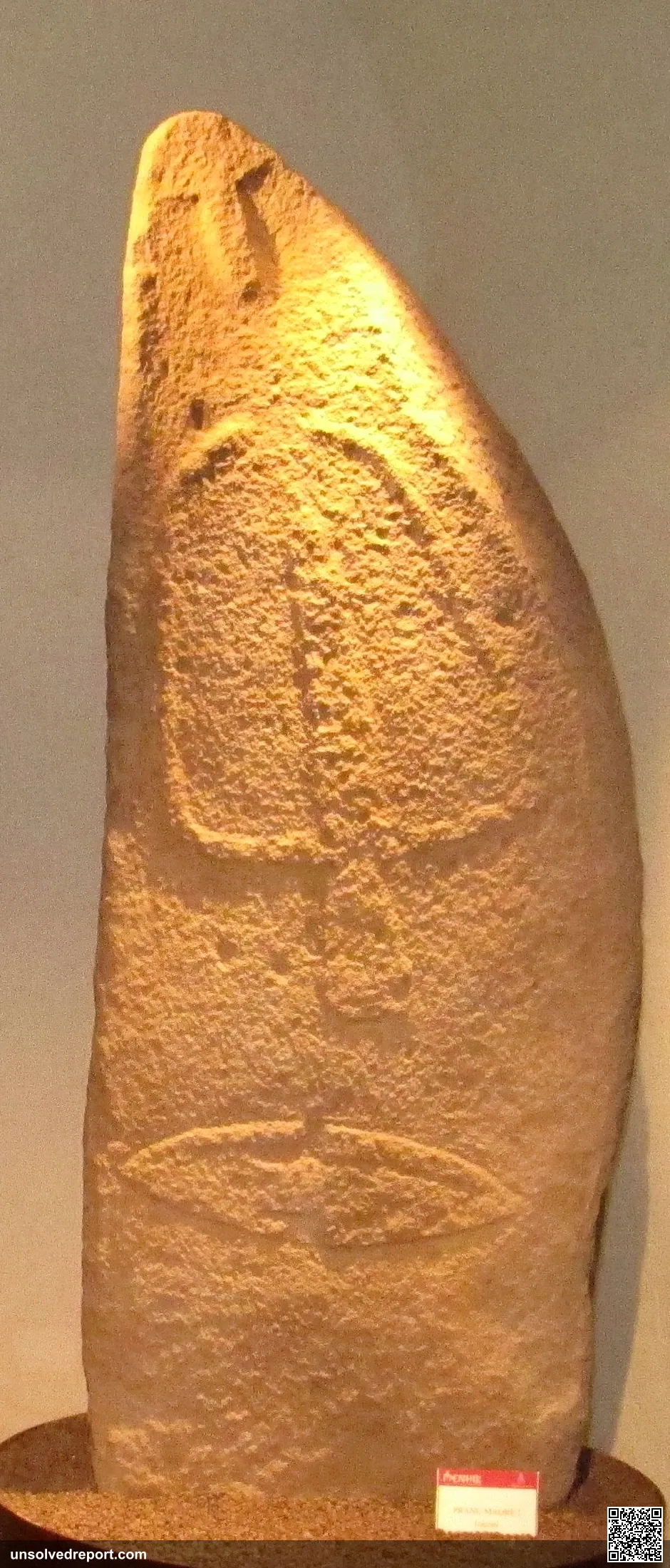
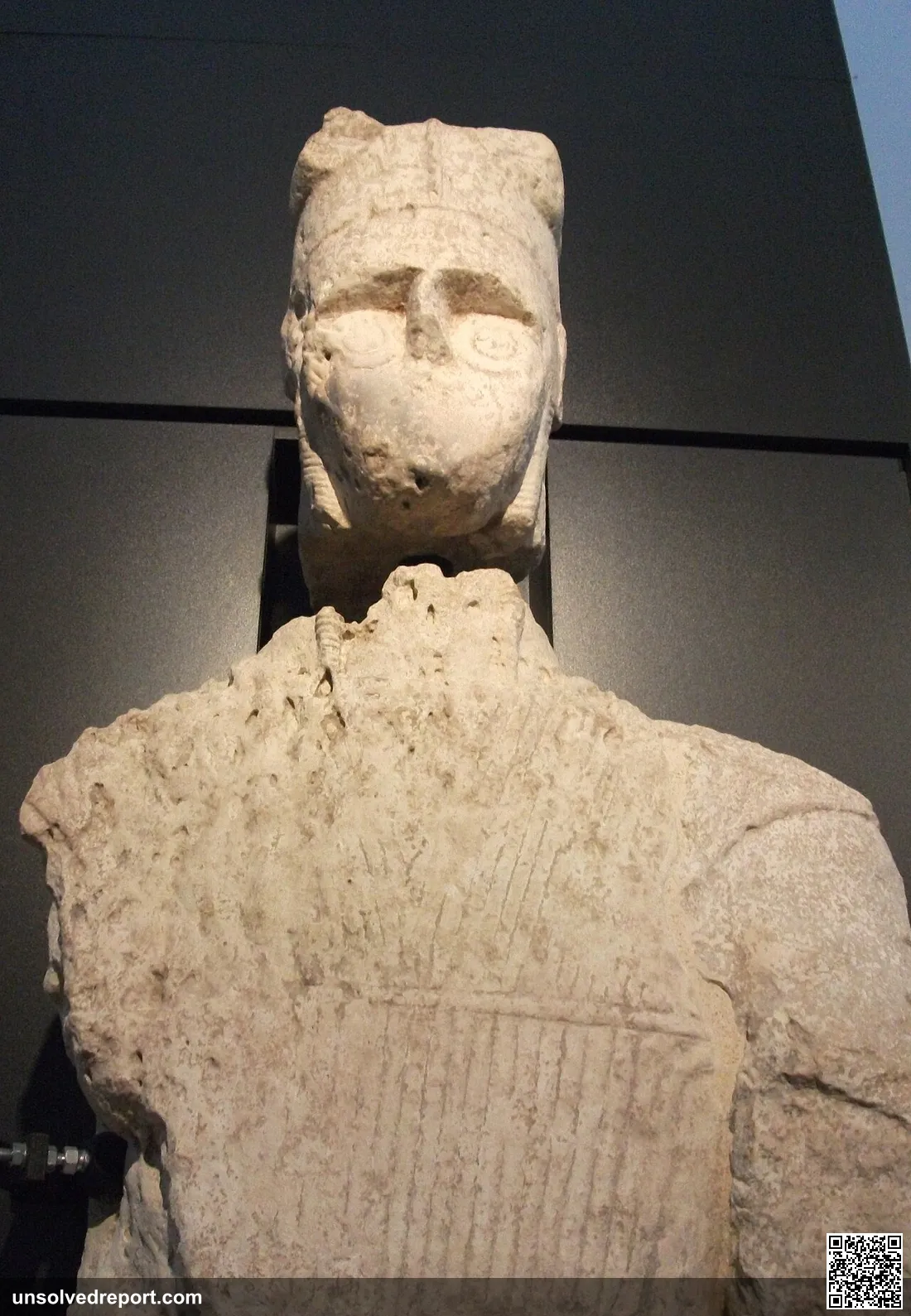
And they have faces you don't forget. The figures come in clear types, boxers, archers, and warriors, all cut in a bold, geometric style, with heavy brows and eyes carved as concentric circles, almost like staring discs (Wikipedia). Mixed in among the human figures, diggers also found finely detailed limestone models of nuraghi, miniature versions of the island's signature towers (SardegnaTurismo).
Now look beneath the statues. There lies a necropolis, in use for several centuries at the start of the first millennium BC. It grew in stages, beginning with simple well tombs and shifting later to grander slab-covered graves lined up along a funerary road. The dead were laid down curled in crouched positions, often with a limestone slab shielding the head (monteprama.it). And the tombs gave up almost nothing in the way of grave goods, the rare exception being a single imported Egyptian scarab, a far cry from the sheer hoarded wealth uncovered at Iron Age Mediterranean sites like El Carambolo (monteprama.it).
And the story did not close in the 1970s. In 2014 a fresh dig uncovered two statues of a new "Cavalupo" boxer type, marked by a large flexible shield wrapped across the chest (Arkeonews). Then in 2022, just days after fieldwork started up again, two more torsos of that same rare type surfaced. Italy's culture minister at the time called it "an exceptional discovery," and superintendent Monica Stochino predicted more surprises were coming (ANSA; Smithsonian Magazine).
The questions that won't go away
Two big questions sit at the center of Mont'e Prama. Neither has a real answer.
The first one is blunt: what were the giants for? The Nuragic people wrote nothing down, so the statues can't tell us themselves. Even now, ongoing excavations are still trying to pin down how the sculptures relate to the cemetery beneath them, and whether a temple ever stood on the spot at all (monteprama.it). The site's official account openly leaves the original purpose unsettled, with researchers turning over the possibilities, a hero shrine, a temple, a sanctuary (monteprama.it).
The second question is the eerie one: why were they smashed? The giants came out of the ground in pieces, scattered across the very tombs they seem to have guarded. Did they topple slowly over the centuries, or did someone tear them down on purpose? And if someone did, who, and when? Nobody knows. The official account admits the statues may have been broken deliberately in some later era, "but we cannot rule out other times and causes" (monteprama.it). As the Smithsonian put it, summing up where the scholarship stands, it's still unclear whether the Nuragic people broke their own statues or whether outsiders did it later (Smithsonian Magazine).
So here's the honest tally. We know who probably carved these giants, roughly when, and that they stood watch over a cemetery used for ages. We do not know what they meant to the people who made them. And we do not know what brought them crashing down.
What the theories say
A warning before we go further: everything below is interpretation and hypothesis, not settled fact. Serious scholars genuinely disagree, and the evidence is still full of holes.
Theory 1: Guardians of the dead. One leading idea casts the giants as funerary monuments, raised over the necropolis to stand like ancestral watchmen over the buried, not unlike how Easter Island's moai were raised to watch over their own communities (Smithsonian Magazine). Some reconstructions even imagine them lined up in a great arc, boxers, archers, and warriors set in deliberate order (Wikipedia).
Theory 2: Symbols of community and identity. A related reading, floated around the 2022 finds, wonders whether the colossal figures stood for social roles, for the identity of the community, or for the clout of the elite families who held the rich Sinis peninsula (ANSA).
Theory 3: A temple or sanctuary complex. Other proposals tie the statues to a sacred building, perhaps as monumental figures inside a temple or a heroon, a shrine to honored ancestors or heroes, weaving architecture together with funeral ritual, in the same Mediterranean tradition of monumental religious building as Malta's Ggantija temples (monteprama.it; Wikipedia).
The wreckage splits opinion too. The scientific director of the recent campaigns has leaned toward natural collapse over violence, while other accounts keep deliberate destruction firmly in play (ANSA; monteprama.it).
What makes the Giants of Mont'e Prama so hard to look away from is that the mystery is still being dug out of the ground in real time. The excavations rolled on through 2022, and superintendents have flatly predicted more is waiting to be found (monteprama.it; ANSA). Every fresh torso lifted from the Sardinian dirt drops one more piece onto a puzzle these silent stone warriors have guarded for three thousand years. And somewhere under that hill, the rest of the answer may still be lying in the dark, waiting for the next blade to catch.
Sources & further reading
- The Metropolitan Museum of Art — The Giants of Mont'e Prama: https://www.metmuseum.org/perspectives/sardinian-giants
- Smithsonian Magazine — Archaeologists Unearth 3,000-Year-Old Giant Statues in Sardinian Necropolis: https://www.smithsonianmag.com/smart-news/archaeologists-reveal-3000-year-old-giant-statues-sardinian-necropolis-180980061/
- Wikipedia — Giants of Mont'e Prama: https://en.wikipedia.org/wiki/Giants_of_Mont'e_Prama
- Official Mont'e Prama archaeological site (monteprama.it): https://monteprama.it/en/monte-prama/
- ANSA (English) — Two more Giants discovered at Mont'e Prama: https://www.ansa.it/english/news/lifestyle/arts/2022/05/07/two-more-giants-discovered-at-monte-prama_1df5612a-8f6e-4b4c-8c0b-291a9091ffcd.html
- SardegnaTurismo (Region of Sardinia official tourism) — Sardinia, the land of Giants: https://www.sardegnaturismo.it/en/sardinia-land-giants
- Arkeonews — Two more Giants discovered at Mont'e Prama in Sardinia: https://arkeonews.net/two-more-giants-discovered-at-monte-prama-in-sardinia-italy/
Bir Hima Petroglyphs: The 7,000-Year Wall Nobody Can Fully Date
Bir Hima's rock art spans 7,000 years - cattle, camels, a war dated to the month. So why can't experts agree how old the oldest carvings really are?
Hvalsey Church: 400 Years of Norse Vanished, No Note
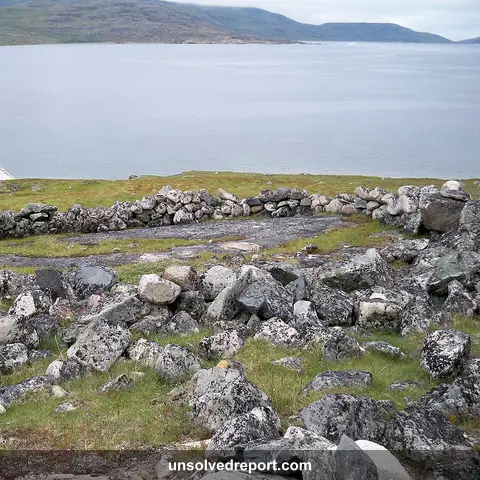
Hvalsey Church still stands 600 years later — the people who built it don't. A 1408 wedding was Norse Greenland's last recorded word, then total silence. What happened to them?

Mysterious Disappearances in History: 12 Unsolved Vanishings
12 mysterious disappearances history never solved — a vanished colony, a missing aviator, three lighthouse keepers gone overnight. A new expedition is about to test one of them.