Hvalsey Church: 400 Years of Norse Vanished, No Note
Hvalsey Church still stands 600 years later — the people who built it don't. A 1408 wedding was Norse Greenland's last recorded word, then total silence. What happened to them?
September 1408. A bride and groom stand inside a cold stone church on the edge of a Greenland fjord. Two priests say the words. Guests have crossed the water to be there. The granite walls around them were quarried and stacked so carefully that you could walk into that same building today, six hundred years later, and it would still be standing.
We know the bride's name. We know the groom's name. We know the date.
And then — nothing. The written record of an entire society just stops. No farewell. No last letter. No "we are leaving, and here is why." The Norse had farmed southern Greenland for more than four hundred years. After that wedding, they vanish from history, and not one of them left a note saying where they went.
Here's what makes it so chilling: nothing about that day was dramatic. It was just a wedding. An ordinary, happy, ordinary day — and it turned out to be the final page. This is the true story of what we actually know about these people, and the real mystery that nobody has been able to close.
What we know for sure
Start at the beginning. Around 985 CE, settlers led by Erik the Red sailed to southwestern Greenland and stayed. They built two communities: a big one near present-day Qaqortoq — the Eastern Settlement, around 500 farms at its peak — and a smaller one near modern Nuuk, the Western Settlement, with about 90 farmsteads (World History Encyclopedia). Christianity showed up around the year 1000, the same conversion-era world that later buried its dead in ship graves like Sutton Hoo. In time the colony even had its own bishop and a cathedral at Garðar. This was not a few lost sailors. This was a society — with churches, farms, herds, and a place in the medieval world, the same North Atlantic world that left behind treasures like the Cuerdale Hoard.
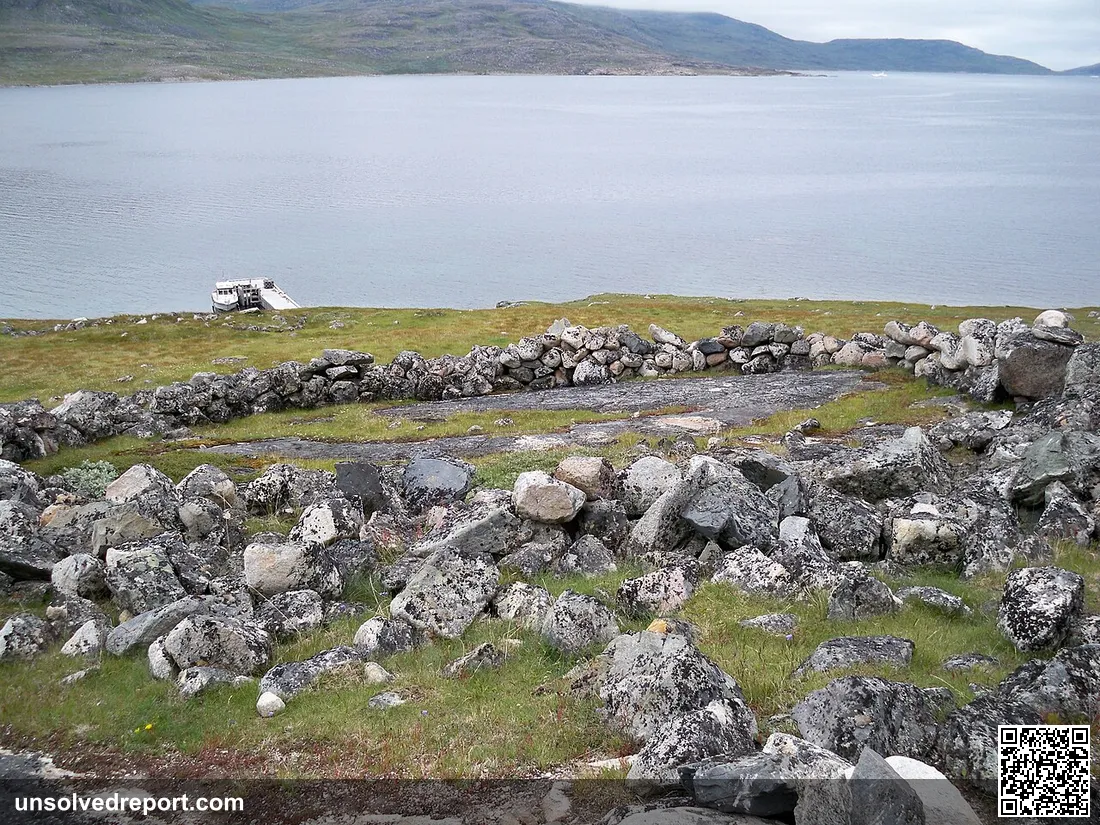
Then there's the church itself. Hvalsey went up in the early 14th century, built from granite fieldstones laid by hand — some of them weighing four or five tonnes, or more. The walls run about 1.5 meters thick. The whole building measures roughly 16 by 8 meters (Wikipedia, Hvalsey Church). It is the best-preserved Norse ruin anywhere in Greenland, and today it's part of the UNESCO World Heritage site Kujataa. Think about that: a building shrugged off six centuries of Arctic weather while the people who raised it disappeared.
Now the wedding. The couple were Thorstein Olafsson and Sigrid Björnsdóttir, married on 14 or 16 September 1408. We only know it happened because Icelanders wrote letters about it, and a priest at Garðar was mentioned in them — and those letters are the last written record of the Greenlandic Norse that exists (Wikipedia). Here's the strange part: the happy couple sailed home and settled down on Sigrid's family farm in Iceland. They got their ending. Everyone else in Greenland? After this, the paper trail goes dark.
Where the writing runs out, the dirt takes over. Radiocarbon dates and excavations suggest the Western Settlement was basically empty by around 1400. A cleric named Ivar Bardarson, who visited in the mid-1300s, reportedly found it already abandoned — gone, just like that. The Eastern Settlement clung on longer; most historians now put its end around 1450. One piece of Norse clothing dug up there was radiocarbon-dated to roughly 1430, give or take 15 years (World History Encyclopedia). A buried garment, and a date, and silence.
A few more hard facts sharpen the picture. The Icelandic Annals record that in 1379, Inuit killed 18 Norse Greenlanders. Bishop Alf died in 1378 — and was never replaced. And the whole economy leaned on one thing: walrus ivory, the most prized trade good medieval Greenland had to sell. Hold onto that last one. It matters more than it looks.
The question nobody can answer
So here is the mystery, plain and simple: we do not know what happened to the people.
The writing stops in 1408. The archaeology fades out around the middle of the 1400s. And no source from the time reports a famine, a massacre, a plague, or any kind of organized escape from Greenland. A whole community of farmers and hunters and churchgoers walked off the stage of history — much like the residents of Mohenjo-daro did millennia earlier — and not one of them left a final scene.
There was nobody in Greenland writing it down at the end. When Europeans finally came back in force, centuries later, they found ruins and Inuit communities. No Norse descendants. No story. Just empty stone.
Scholars argue mostly between two doors. Either the last Norse died where they stood — or they left, sailing back toward Iceland and Scandinavia. And here's a clue that keeps the second door open: archaeologists noticed that surprisingly few valuables were left lying around the sites, which some read as the sign of an orderly packing-up rather than a sudden disaster (Science/AAAS). But "they didn't leave much behind" is a hint, not a confession. The honest truth is that nobody can yet say what became of the last Greenland Norse.
The leading theories
What follows are ideas and live hypotheses — not settled answers. And most researchers today don't bet on a single cause. They think several things piled on at once.
The ivory market crashed. This is the one to watch. Scientists at Cambridge and Oslo pulled ancient DNA from walrus tusk offcuts found in medieval European workshops, and published it in Proceedings of the Royal Society B. What they found: Greenland's Norse may have held a near-monopoly on Western Europe's ivory for more than two hundred years (University of Cambridge). For centuries, that was their golden ticket. Then the bottom fell out — cheaper elephant ivory flowed back into European markets, fashions changed, and the colony's lifeline frayed. As Dr. James Barrett put it, an "overreliance on a single commodity... may have also contained the seeds of its vulnerability." It's a leading idea — though the team is the first to say the evidence is still incomplete.
The cold came. The Norse arrived during the warm centuries known as the Medieval Warm Period, then lived to watch the colder Little Ice Age creep in. Shorter summers, harder winters, and a farming-and-herding life that suddenly had less room to breathe. But — and scholars stress this — these people adapted for generations. Cold weather alone is too neat an answer.
The sea took the land. A 2023 study in PNAS modeled sea-level rise of up to about 3 meters near the Eastern Settlement across the four centuries the Norse lived there — the readvancing ice sheet pressing down the crust and dragging water toward the shore. The researchers estimated that roughly 204 square kilometers of land could have flooded, swallowing exactly the kind of fertile lowland the Norse depended on (PNAS). Picture the good fields slowly going under, year after year. It's a newer idea, and it adds one more squeeze to the pile.
Cut off, and on edge. The official trade ship that ran between Norway and Greenland sank in 1369, and few known voyages followed. Add the loss of a resident bishop, and the chaos of the Black Death tearing through Europe, and the colony drifted further and further out of reach of the world. That 1379 killing in the Icelandic Annals sometimes gets pointed to as a sign of friction with the expanding Inuit Thule culture — but careful historians warn against turning a single line in a chronicle into a long, grinding war.
So which was it? Increasingly, historians shrug and say: all of it. A small, isolated colony — not unlike the community that vanished from Lake Anjikuni centuries later — living and dying by one export, getting squeezed at the same time by markets, weather, water, and sheer distance. But notice what none of these theories can give us — the missing last chapter. The documented account of where the Hvalsey wedding guests, and their children, actually went.
The church still stands above the fjord, its empty windows framing nothing but sky. In a way it's the most honest witness we have: a building that outlived everyone who built it, and quietly kept their last recorded day safe — long after their story slipped off the edge of the written world. And it leaves you with a question that won't sit still: how does an entire people leave a world this carefully built, and not leave a single word behind?
Sources and Further Reading
- Hvalsey Church — Wikipedia
- The Disappearance of Norse Greenland — World History Encyclopedia
- Lost Norse of Greenland fuelled the medieval ivory trade — University of Cambridge
- Ancient DNA reveals the chronology of walrus ivory trade — Proceedings of the Royal Society B
- Sea-level rise in Southwest Greenland as a contributor to Viking abandonment — PNAS
- Why did Greenland's Vikings disappear? — Science/AAAS
- Hvalsey Church Ruins — Visit Greenland

Mysterious Disappearances in History: 12 Unsolved Vanishings
12 mysterious disappearances history never solved — a vanished colony, a missing aviator, three lighthouse keepers gone overnight. A new expedition is about to test one of them.
Tarim Basin Mummies Mystery: The DNA Twist Nobody Predicted
Their faces looked distinctly European. Then a 2021 DNA study on the Tarim Basin mummies revealed a twist nobody predicted. So who were they?
Western Deffufa: The 4,000-Year Giant That's Almost Solid Inside
The Western Deffufa is a 65-ft mud-brick giant in Sudan that's almost solid inside. So what happened in there? Even archaeologists disagree.