JuMBOs: 40 Pairs of Rogue Planets Science Can't Explain
JWST found 40 pairs of Jupiter-mass objects drifting through Orion with no star, no clear origin, and no explanation. So what are the JuMBOs really?
Late 2023. Astronomers aim the most powerful telescope ever built at the most photographed cloud in the sky — and find something the rulebook says cannot exist, not unlike the galaxies JWST found showing up far too early in the universe. Forty pairs of objects, each about as heavy as Jupiter, floating loose in the Orion Nebula. No star to circle. No clear way to have been born. And here's the part that makes your skin prickle: they drift in twos, slowly looping around each other, like dancers with no music and no floor.
The team gave them a nickname — JuMBOs, for Jupiter-Mass Binary Objects. Years on, the fight over what they really are is one of the wildest open questions in the whole science of how stars are made.
What we actually know
It started as a deep stare. Webb's Near Infrared Camera (NIRCam) was trained on the heart of the Orion Nebula and the Trapezium Cluster, hunting in the kind of light our eyes can't see. Two astronomers from the European Space Agency (ESA), Samuel Pearson and Mark McCaughrean, pieced together a sweeping mosaic — a patch of nebula roughly 1.2 × 0.8 parsecs across, built from about 35 hours of staring through twelve different infrared filters (ESA/Webb, reported via Space.com).
Then they counted. The numbers, set down in the team's paper (a preprint posted to arXiv on October 2, 2023), are exact, not hand-wavy. The survey found roughly 540 free-floating, planet-mass objects in that one region. And tucked among them were 42 multiple systems: 40 binary pairs and 2 triple groupings. Those are the JuMBOs (Wikipedia summary of Pearson & McCaughrean; CNN).
How small are they? Genuinely planet-small. Each one weighs in somewhere between about 0.6 and 13 Jupiters — which keeps them under the line (around 13 Jupiter masses) where an object gets hot enough inside to burn deuterium and earn the title "brown dwarf." On the sky, the partners in each pair sit anywhere from about 28 to 384 astronomical units apart — tens to hundreds of times the gap between Earth and the Sun (Wikipedia; arXiv preprint discussions).
Now picture where this is happening. The Orion Nebula floats roughly 1,340 to 1,350 light-years away, and the Trapezium Cluster buried inside it is fantastically young — about a million years old, with some guesses even younger (Trapezium Cluster, Wikipedia; CNN). These aren't ancient wanderers worn smooth by time. They're newborns, caught in the very act of forming, in one of the closest star factories to home.
And the trick that found them came down to chemistry. Those twelve filters were chosen to catch the chemical fingerprints of cold things — water and methane, the telltale marks of cool, very-low-mass objects — so the team could pick out real planet-mass candidates from ordinary stars and the glow leaking in from behind.
The real mystery
Here's where astronomers start raising their voices. Run JuMBOs through our best models of how stars and planets are made, and they simply don't fit. Worse — we're not even sure they're all real.
Think of it as two recipes that both come up short. Star formation says objects condense straight out of collapsing clouds of gas — but that process struggles to make free-floating things as light as a few Jupiters. Planet formation makes Jupiter-mass worlds with ease — but inside disks, chained to a star, not roaming loose two by two. JuMBOs slip through the crack between the two. As Pearson said in ESA's announcement, "There's something wrong with either our understanding of planet formation, star formation or both" (Space.com; Silicon Republic).
The pairing is what really twists the knife. A lone rogue planet? Old news — we've spotted free-floating planet-mass objects before, no big shock, and we've even found planets orbiting a place they have no business orbiting. But pairs this far apart and this featherweight are fragile things — about as fragile, in their own way, as the planet being slowly shredded around a dead star at WD 1145+017. In a packed young cluster like the Trapezium, every star that swings past gives a little gravitational tug, and over time those tugs should rip such loosely held couples apart. Several modeling studies have asked whether wide planet-on-planet pairs can even survive there, and some simulations say they should be rare, or gone fast (Universe Today; preprint, arXiv:2505.00762 — note: preprint, not yet peer-reviewed). So even if nature can build them, keeping them holding hands is a whole second problem.
And then comes the most deflating idea of all: maybe some — maybe most — JuMBOs aren't planet-mass objects at all. In 2024, Kevin Luhman, an astronomer at Penn State, went back through JWST imaging of the Orion Nebula Cluster and argued that a lot of the candidates have colors that fit better with faint, reddened background sources — far-off stars and galaxies peeking through the nebula — than with young cluster members (Luhman 2024, Astronomical Journal; summarized at EarthSky). His read treated only a handful of candidates as solid. If he's right, the mystery shrinks dramatically.
So the honest score has two layers stacked on top of each other. First: are the JuMBOs even real residents of Orion? And second, if they are: how on Earth did pairs of Jupiter-mass worlds end up adrift together? Neither one is settled.
So what could they be?
What follows are the front-running guesses. Not one is proven.
Theory 1 — Kicked out together. This is speculation, but it's the idea getting the most airtime: JuMBOs started out as giant planets circling stars, then got flung loose — as a pair. In a crowded cluster, a close pass between stars can wrench planets free, and some modeling groups, including researchers at the University of Nevada and Stony Brook, have explored whether such near-misses could now and then eject two giant planets that stay faintly bound to each other (Space.com). It's a tidy story. Whether real ejections could ever crank out JuMBOs in the numbers we see is still up for debate.
Theory 2 — Born small, born free. Also speculation: maybe they formed right where they are, condensing straight from the nebula's gas the way miniature stars do — which would mean cloud-collapse can reach far lighter weights than the textbooks allow. This is the option that forces us to rewrite parts of star-formation theory.
Theory 3 — Sandblasted down to size. Another speculative path: the Trapezium's giant O-type stars blast out ferocious ultraviolet light, and that radiation could strip the outer gas off bigger collapsing cores, leaving behind only stunted, planet-mass leftovers. The Trapezium is drenched in exactly that kind of radiation, so the mechanism is plausible enough — though it's far from clear it would reliably leave behind bound pairs.
Theory 4 — They're mostly not there. The skeptic's take. If Luhman's reanalysis holds, a big chunk of the candidates are background impostors, and the "population" could be far smaller than 40 pairs.
But the believers have at least one card to play. Radio observations with the Karl G. Jansky Very Large Array picked up steady radio emission from one specific object, JuMBO 24 — and it showed no meaningful drift against Orion's stars. That's a strong hint this particular source really lives inside the cluster, not far behind it (ApJ Letters, 2024). One confirmed local doesn't vouch for the whole catalog, but it tells us at least some JuMBOs are the real thing.
For now they stay gloriously unsolved — proof that even the brightest, most-studied corner of the night sky can still slide something across the table that we genuinely cannot explain. And if Orion can keep a secret this big, this close, you have to wonder what else is hiding in the dark just past it — maybe even a hidden world at the edge of our own solar system that no one has ever seen.
Sources and Further Reading
- Pearson & McCaughrean, JuMBO discovery survey (preprint, arXiv, Oct. 2, 2023) — summarized at en.wikipedia.org/wiki/Jupiter-mass_binary_object
- ESA/Webb, via Space.com mosaic report
- CNN: Webb image reveals mysterious planet-like objects in the Orion Nebula
- Space.com: How strange cosmic objects called JuMBOs went rogue
- Luhman (2024), Astronomical Journal — iopscience.iop.org/article/10.3847/1538-3881/ad812a; plain-language summary at EarthSky
- Radio counterpart to JuMBO 24, ApJ Letters (2024) — iopscience.iop.org/article/10.3847/2041-8213/ad18ac
- Survival of wide planetary binaries (preprints, label as not-yet-peer-reviewed): arXiv:2407.20416, arXiv:2505.00762
- Universe Today: Free-floating binary planets can't last long


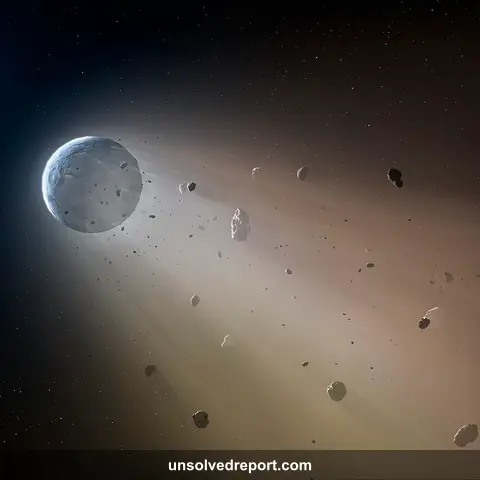
WD 1145+017: The Disintegrating Planet Nobody Has Ever Seen
WD 1145+017: a dead star shredding a planet in real time, yet no one has ever actually seen the thing being destroyed. Here's why that's still a mystery.
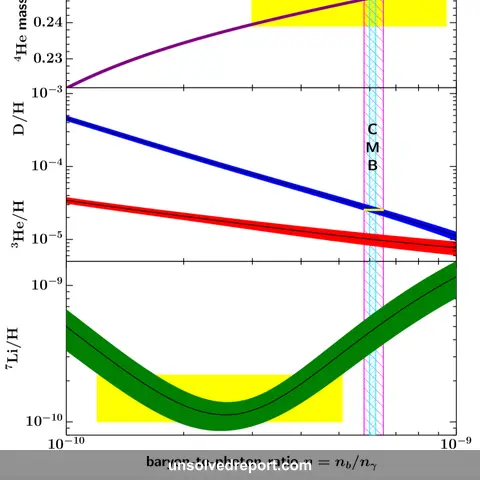
The Cosmological Lithium Problem: Why 2/3 of Big Bang Lithium Is Missing
Big Bang physics predicts triple the lithium the oldest stars actually have. A 2024 interstellar gas measurement just made the gap harder to explain away.
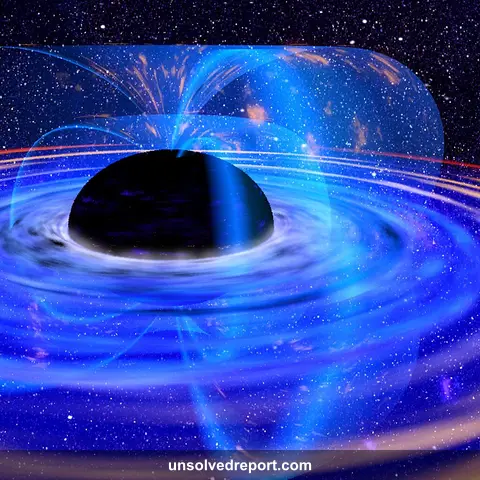
Neutron Star Maximum Mass: The Line Nobody Can Find
A neutron star dies and becomes a black hole somewhere between 2.2 and 2.9 solar masses. Astronomers already found one that shouldn't exist. Where's the real line?