Seven Pagodas of Mahabalipuram: 6 Temples the Sea Swallowed
Legend said the sea swallowed six temples at Mahabalipuram. In 2004 the tsunami pulled the water back — and proved something really was down there.
The sea ran away.
December 26, 2004. Minutes before the Indian Ocean tsunami slammed into the Coromandel Coast, the water at Mahabalipuram pulled back — hundreds of meters of it — baring the bottom of the ocean to the open sky. Fishermen stared. A few tourists stared with them. Out of the draining water rose a long, dead-straight line of huge rocks, like the spine of something that had been sleeping down there.
Then the waves came back. They came back hard. And when they finally let go for good, the beach was stripped — centuries of sand scoured clean — and granite carvings that no living human being had ever laid eyes on were sitting there in the daylight.
Here's the thing. For more than two hundred years, European visitors had jotted down the same local story: seven great temples once stood on this shore, and six of them had been eaten by the sea — a drowned-city legend with echoes of India's own Dwarka, another coastal city that legend insists the ocean took whole. The tsunami didn't prove that legend. But it grabbed the question by the collar and dragged it, literally, back into the light.
What we actually know
Start with the solid ground. Mahabalipuram — you'll also see it spelled Mamallapuram — sits about 60 kilometers south of Chennai in Tamil Nadu. Centuries ago it was a buzzing port and an artists' capital under the Pallava dynasty, hitting its stride during the reigns of Mahendravarman I (c. 600–630 CE) and Narasimhavarman I (c. 630–680 CE), according to the World History Encyclopedia.
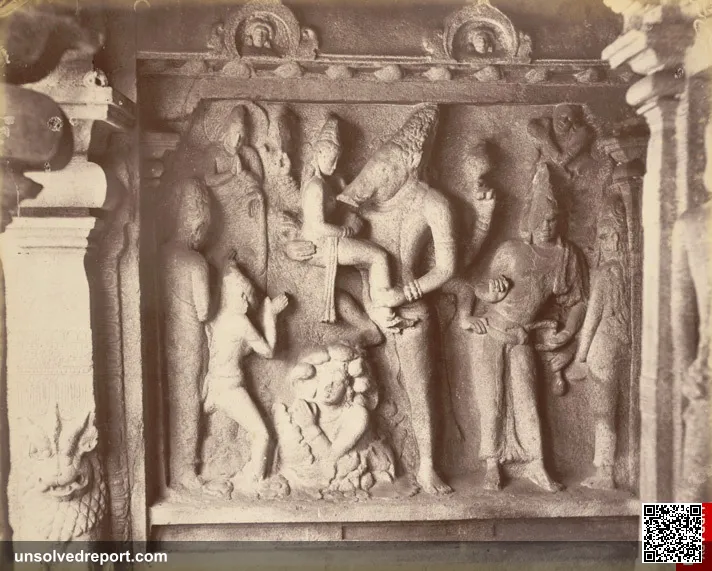
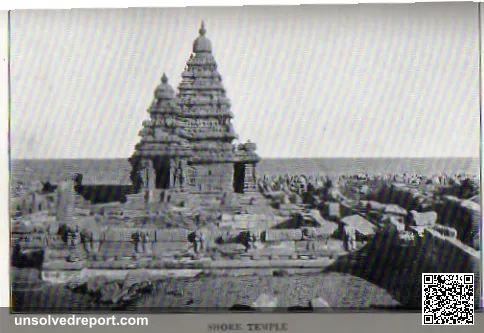
Walk the site today and the genius is everywhere. Temples carved to look like chariots, called rathas. Cave sanctuaries cut straight into the rock. A vast open-air wall of stone — the Descent of the Ganges — and the slim, salt-bitten Shore Temple right at the water's edge. All of it was "carved out of rock along the Coromandel coast in the 7th and 8th centuries," in the words of UNESCO, which named the Group of Monuments at Mahabalipuram a World Heritage Site in 1984. The Shore Temple was the work of Narasimhavarman II Rajasimha (c. 700–728 CE).
Now, that catchy name — the "Seven Pagodas." It isn't Tamil at all. It's European. The first detailed write-up came from John Goldingham, an English astronomer based in Madras, who showed up in 1798 and carefully recorded the art, the statues, the inscriptions. His essay later landed in Mark William Carr's 1869 book Descriptive and Historical Papers Relating to the Seven Pagodas on the Coromandel Coast, per the Wikipedia summary of the legend.
But the eeriest line is older. The architect William Chambers had come by in 1772 and again in 1776, and Carr quotes him passing on what the older locals swore they'd seen with their own eyes: the tops of several pagodas standing far out in the sea, "which being covered with copper, probably gilt, were particularly visible at sunrise as their shining surface used to reflect the sun's rays." Picture that for a second. Golden spires catching the dawn — out past the breakers, where no spire should be. The British Romantic poet Robert Southey took that image and burned it into the European imagination with his 1810 poem The Curse of Kehama.
And then 2004 happened. As the tsunami pulled out, it "scoured away sand deposits that had covered these sculptures for centuries," and out came an elaborately carved lion, a half-finished elephant, and a stallion rearing up on its hind legs, according to Al Jazeera's contemporaneous reporting. T. Satyamurthy, a senior archaeologist with the Archaeological Survey of India (ASI), said the water had ripped open structures that "appear to belong to a port city built in the seventh century," as reported by Down To Earth.
But here's the twist most people miss. The underwater story didn't start with the tsunami at all. Two years before the wave, in April 2002, a joint team from India's National Institute of Oceanography (NIO) and Britain's Scientific Exploration Society had already been diving the seabed off the Shore Temple — the same kind of painstaking underwater survey work that turned up disputed stone alignments at Lake Titicaca and off the coast of Yonaguni in Japan. They found running walls and scattered stone blocks down at roughly 4–7 meters, several hundred meters offshore — and judged them a match for the Pallava period (7th to early 9th century CE). After the disaster, in early 2005, the ASI teamed up with the Indian Navy and dragged sonar along the coast. They reported a wall about 6 feet high and 70 meters long, plus what they took to be the remains of two submerged temples and one cave temple, all within about 500 meters of shore, per the Wikipedia compilation. The careful voice of ASI's Dr. Sathiamoorthy comes through in World Archaeology: the structures "could be part of the small seaport city which existed here before the water engulfed them. They could be part of a temple or a building. We are investigating."
The part nobody has solved
So here's the honest mystery, with the romance scraped off.
We can say this much for certain: man-made stone structures really do lie drowned off Mahabalipuram. They're plausibly Pallava-era. And they point to a coastal complex bigger than everything still standing on dry land. That's not a legend. That's down there.
What we cannot say is whether the legend's exact math — seven temples, six drowned, one spared — is real history or a poem that grew over centuries until it sounded like a fact.
A few honest knots refuse to come undone. The submerged walls and blocks are badly eroded and caked in sediment, so figuring out what each building actually was — or how many once stood — is genuinely hard. The how and when of the sinking is argued over too: did one monstrous event drown the temples in a night, or did slow erosion and a shifting coastline nibble them away over generations? And that number, seven, might be a symbol rather than a headcount. As the Wikipedia synthesis puts it, with one eyebrow raised, the findings "do not necessarily correspond to the seven pagodas of legend" — even while they confirm "a large complex of temples was in Mahabalipuram." That gap, between a real drowned complex and the precise tale spun about it, is the part nobody has closed.
Three ways to read the drowned stones
Theory 1 — The temples are literally down there, just like the story says. This is the oldest read, kept alive by Chambers' 1772–76 testimony: six temples with gilded copper tops genuinely stood on the shore, the sea swallowed them, and only the Shore Temple was spared. Where it stands today: legend, partly backed up. Real submerged structures do exist — but nothing ties them to a count of seven or to a single drowning night.
Theory 2 — A bigger Pallava port-and-temple complex, lost the slow way. Plenty of archaeologists lean here: Mahabalipuram was once far larger, and its seaward edge was claimed bit by bit by erosion, creeping shorelines, and rising water over centuries — no single dramatic night required. Where it stands today: the scholarly favorite, and the one best supported by the NIO and ASI surveys.
Theory 3 — A medieval tsunami or storm surge did it. Some accounts float a destructive wave somewhere around the 10th–13th century. Where it stands today: speculation. It's plausible — the region clearly has the seismic muscle, and 2004 proved that beyond doubt — but there's no firm record from the time pinning the loss to any specific date.
What nobody argues about is the most cinematic fact of the whole story. A tsunami that took so much, for a handful of minutes, also gave something back — it tore the curtain of sand off carvings the Pallava sculptors had left half-finished, and reminded everyone watching that the sea keeps better secrets than it lets on.
And if the ocean was hiding this much, just a few hundred meters out — what else is it still holding onto?
Sources & further reading
- UNESCO World Heritage Centre — Group of Monuments at Mahabalipuram (whc.unesco.org/en/list/249/)
- World History Encyclopedia — Mahabalipuram (worldhistory.org/Mahabalipuram/)
- Wikipedia — Seven Pagodas of Mahabalipuram (en.wikipedia.org/wiki/Seven_Pagodas_of_Mahabalipuram)
- Al Jazeera — Tsunami waves reveal Indian relics, 11 Feb 2005 (aljazeera.com/news/2005/2/11/tsunami-waves-reveal-indian-relics)
- Down To Earth — Tsunami uncovers ancient sculptures in Mahabalipuram (downtoearth.org.in/coverage/tsunami-uncovers-ancient-sculptures-in-mahabalipuram-in-tamil-nadu-8006)
- World Archaeology — Tsunami Reveals Temple of Mahabalipuram (world-archaeology.com/world/asia/india/tsunami-reveals-temple-of-mahabalipuram/)
- Carr, M.W. (1869) Descriptive and Historical Papers Relating to the Seven Pagodas on the Coromandel Coast (referenced via above)
- National Institute of Oceanography (India) underwater investigations off Mahabalipuram, 2002 (NIO / Scientific Exploration Society survey)


Tunguska Event 1908: The Blast Nobody Can Explain
The Tunguska Event of 1908 hit Siberia with the force of 1,000 nuclear bombs, flattened 800 square miles of forest — and left zero crater. So what hit us?

D.B. Cooper: The $200,000 Skyjacking Nobody Can Solve
D.B. Cooper grabbed $200,000, jumped from a 727 into a night storm, and was never identified. What did the FBI actually prove — and what stayed fog forever?
Roanoke's Lost Colony: 115 Gone, One Carved Word
A governor sails home in 1590 to find his colony erased: no bodies, no graves, just CROATOAN carved in a post. So where did 115 people go?