Tunguska Event 1908: The Blast Nobody Can Explain
The Tunguska Event of 1908 hit Siberia with the force of 1,000 nuclear bombs, flattened 800 square miles of forest — and left zero crater. So what hit us?
June 30, 1908. A man named Semen Semenov is sitting on his porch at a lonely trading post in Siberia. Then, as he told it, "the sky split in two and fire appeared high and wide over the forest." The next instant, he's on the ground. His chair has thrown him. "At that moment I became so hot that I couldn't bear it," he later told investigators, "as if my shirt was on fire."
He was 40 miles away from it.
Forty miles north of that porch, something had just gone off in the sky with the force of a large nuclear weapon — and this was decades before nuclear weapons existed. It flattened roughly 800 square miles of forest. It tipped over millions of trees like matchsticks. It shook instruments clear across Europe. And then it vanished. No crater. No smoking metal wreck. No body. More than a hundred years later, scientists agree on what kind of thing visited the Tunguska River that morning — and they still argue about the rest. This is one of the best-documented disasters of the 20th century. Almost nobody saw it up close and lived to point at the spot.
What We Actually Know Happened
Start with the parts nobody disputes. At roughly 7:14 a.m. local time on June 30, 1908, a colossal explosion ripped through the air several miles above the basin of the Podkamennaya Tunguska River, in a stretch of central Siberia so empty you could fly over it for hours and see no one (Britannica). The place was so remote that the first scientists wouldn't stand on the site for almost twenty years.
Now the scale. This is where it stops sounding like a weather report and starts sounding like the end of the world. The energy released lands somewhere between roughly 10 and 15 megatons of TNT — about a thousand Hiroshimas (Britannica; Scientific American). NASA describes "a butterfly-shaped area of destruction of 830 square miles extending nine to 22 miles from the epicenter with millions of trees knocked over" (NASA). Picture that footprint from above: trees blown flat in a great fan, all of them pointing away from one spot in the middle, like grass combed by a giant hand. That pattern would turn out to be the whole case cracked open.
And it didn't stay a local affair. Seismographs across Eurasia twitched. Pressure waves rolled out so far that delicate barometers picked them up in England (Wikipedia, citing primary sources). For several nights afterward, people all over Europe looked up and saw skies that wouldn't go fully dark — a strange glow, blamed on dust flung high into the air, catching sunlight that should have been long gone.
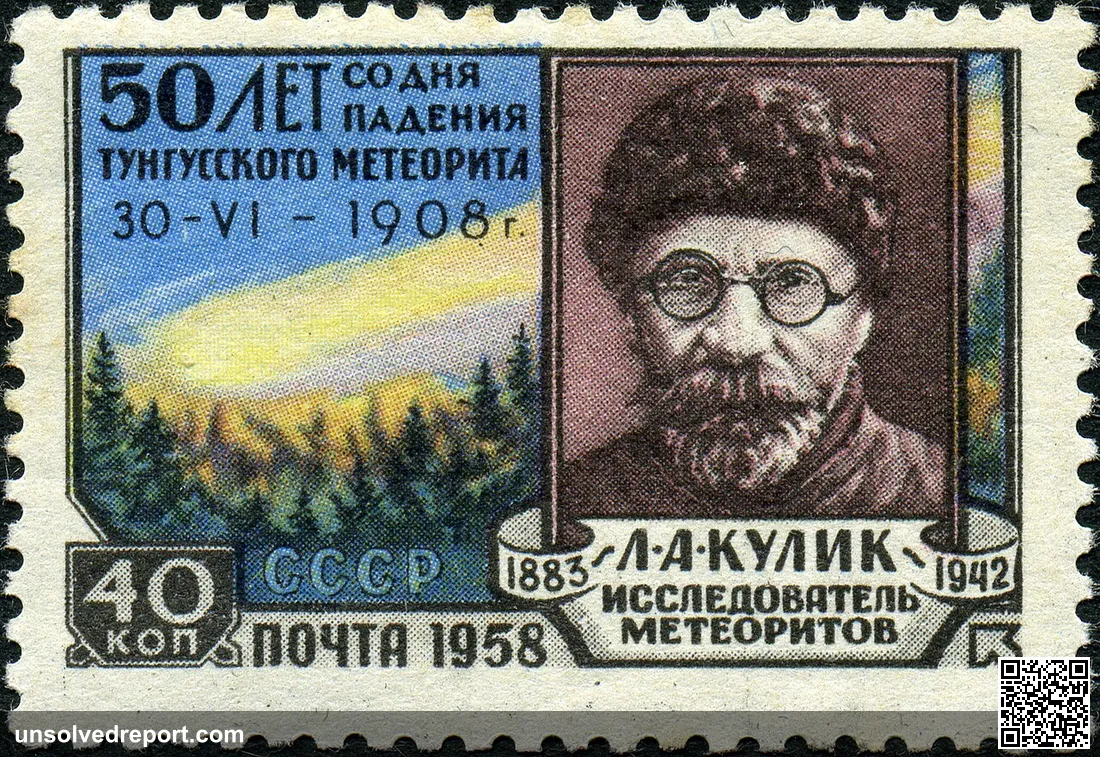
Then there's the man who finally went looking. When Soviet mineralogist Leonid Kulik mounted his expedition, the land told him a deeply weird story — the kind of silent, physics-defying scene investigators would face again decades later at the Dyatlov Pass. He tried to reach the area in 1921 and got turned back; "not until 1927 did Kulik succeed in reaching his goal" (NASA). Here's the strange part. At what should have been ground zero, the trees were still standing — upright, but stripped of every branch and scrap of bark, and scorched black. And there was no crater. None. He searched and searched and never found one big chunk of whatever did this. To this day, the only fragments anyone can plausibly pin to the event are microscopic, "each measuring less than a millimeter across" (Britannica).
So what flattens a forest the size of a city and leaves a hole the size of nothing? Science has a word for it: an airburst. The leading reading goes like this — a stony asteroid a few tens of meters wide (NASA puts it around 130 feet across) came screaming into the atmosphere at hypersonic speed, got crushed and cooked by the air until it shattered all at once, and detonated some 3 to 6 miles up (NASA; Scientific American). A blast in mid-air, not at the ground. That one fact does two jobs at once: it explains the missing crater, and it explains those eerie trees standing bare right under the explosion, blasted from straight above.
The Question That Won't Die
So if scientists basically agree a thing from space blew up in the sky — what's left to fight about?
A lot, honestly. The cleanest way to say it is the way Scientific American said it: "no one has yet found fragments of the object or any impact craters in the affected region" (Scientific American). Two big unknowns sit tangled together:
- What was it — rock or ice? A stony asteroid is the front-runner. But a small comet is still very much in the running — the same asteroid-or-comet ambiguity that puzzles astronomers watching active bodies like 6478 Gault blur the line between the two. Comets hit Earth far faster, so a smaller, icier traveler could land the same punch — and ice would vaporize almost completely, which would tidily explain why so pitifully little solid stuff survived (Royal Observatory Greenwich).
- How big, and how much energy? The numbers keep moving as the modeling sharpens. Some researchers argue the object was smaller than long believed, with the energy maybe as low as a few megatons rather than 10 to 20 (Scientific American).
Here's the catch. Nobody bagged solid evidence in 1908 — and by the time Kulik arrived, the site had soaked up nearly twenty years of weather and new growth. So these questions may never close. As the Royal Observatory Greenwich puts it, flat out, "we'll possibly never know for sure exactly what happened that night" (RMG).
Theories, Dead Ends, and One Stubborn Lake
From here we leave hard fact and step into ideas — proposals and arguments, clearly labeled as such, not settled truth.
The comet idea (an old, serious one)
Way back in 1930, astronomer Fred Whipple floated the notion that the thing was a small comet, not an asteroid. Backers point out that the date sits right near the Beta Taurid meteor shower — debris trailing along behind Comet Encke (RMG). It's a respectable minority view. The snag: a confirmed comet strike on Earth has never actually been documented (Scientific American).
Lake Cheko: a crater hiding in plain sight? (proposed, then shot at)
Between 2007 and 2009, a team from the University of Bologna dropped a bombshell: a small, funnel-shaped lake called Cheko, about five miles from the epicenter, might be an impact crater — punched out by a surviving fragment of the object. They pointed to the lake's shape, to the fact that it seemed missing from older maps, and to a buried acoustic "reflector" deep in the mud that might be a dense, meter-size lump of something (Scientific American; Gasperini et al., Terra Nova, 2009).
Tantalizing. And then later work hit back hard. Researchers reading the lake's sediments concluded Cheko is much older than 1908 — the layers of mud imply an age of at least several centuries — and noted that nearby lakes wear the same funnel shape, which points to plain old geology like thawing permafrost rather than a fallen rock (Krasnoyarsk Science Center). So where does that leave the Lake Cheko crater claim today? Disputed, and not widely accepted.
The wild ones
A giant blast with no body left behind — of course that vacuum pulled in fringe ideas, everything from exploding spacecraft to exotic physics. None of them has a shred of supporting evidence, and we name them only to set them down again. Because here's the twist that makes Tunguska so good: the boring explanation is the terrifying one. Rocks and ice from space cross Earth's path all the time. Every so often, one is big enough to flatten a forest the size of a major city.
Which is exactly why this still matters. NASA holds Tunguska up as a defining case study for its Planetary Defense Coordination Office (NASA) — a quiet reminder that the sky over an empty Siberian forest in 1908 could just as easily have been the sky over a city full of people. The real question was never whether it can happen again. It's the simpler, colder one nobody can yet answer: what, exactly, hit us last time? — the same flavor of question that still lingers over the Wow! signal, another burst from the sky nobody has ever fully explained.
Sources and Further Reading
- Britannica — "Tunguska event"
- NASA — "115 Years Ago: The Tunguska Asteroid Impact Event"
- Scientific American — "The Tunguska Mystery 100 Years Later"
- Royal Observatory Greenwich — "The Tunguska event explained"
- Gasperini et al., "Sediments from Lake Cheko… a possible impact crater," Terra Nova (2009)
- Krasnoyarsk Science Center — evidence refuting the Lake Cheko impact hypothesis

D.B. Cooper: The $200,000 Skyjacking Nobody Can Solve
D.B. Cooper grabbed $200,000, jumped from a 727 into a night storm, and was never identified. What did the FBI actually prove — and what stayed fog forever?
Roanoke's Lost Colony: 115 Gone, One Carved Word
A governor sails home in 1590 to find his colony erased: no bodies, no graves, just CROATOAN carved in a post. So where did 115 people go?
Eltanin Antenna: The 1964 'Alien Machine' That Was Alive
A 1964 Navy photo two miles deep showed what looked like a built antenna on the seafloor. It wasn't. Here's the 1971 identification — and what's been found since.