Methuselah Star: The Star Older Than the Universe It Lives In
The Methuselah star, HD 140283, was clocked at 14.5 billion years old — older than the 13.8-billion-year-old universe holding it. How can that be true?
There is a star out there that, for a few wild years, seemed to be older than everything. Older than the galaxy. Older than the planets. Older, somehow, than the universe it was sitting inside.
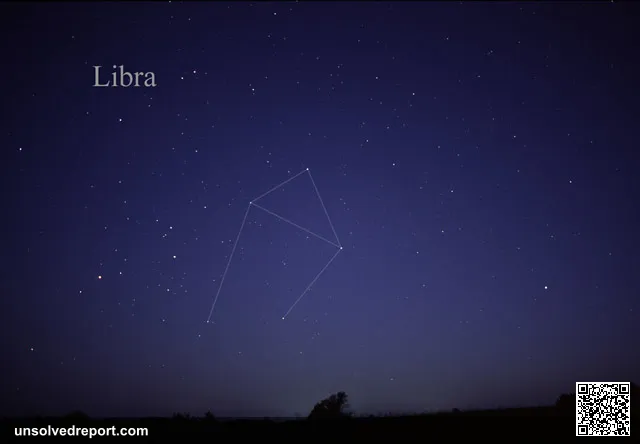
It hangs in the constellation Libra, faint and quick, sliding through our patch of the galaxy. Your eyes will never catch it. But astronomers gave it a name straight out of scripture: the Methuselah star, after the man in the Bible said to have lived 969 years. On the star charts it goes by HD 140283. And here is the part that hooked everyone: the headlines screamed that this little star had "broken" the Big Bang. The truth is stranger, quieter, and far more interesting than that.
What We Actually Know
Start with the cold, hard facts. HD 140283 is a metal-poor subgiant sitting about 190 to 200 light-years away, out in Libra, glowing at an apparent magnitude of roughly 7.2, which is just dim enough that you'd need binoculars to find it (Space.com; Star Facts). Astronomers have been watching it for over a century, and not because it's bright. It's because it moves. This star tears across the sky fast enough to cover the width of a full Moon in about 1,500 years, the kind of gallop that puts it in the same conversation as the galaxy's hypervelocity stars (Star Facts).
But the speed isn't even the weird part. The weird part is what it's made of. HD 140283 holds only about 1/250th of the iron our Sun carries, a chemical oddity that, in its own way, puts it in the company of stars like Przybylski's Star (Space.com). Think about what that means. Heavy elements like iron don't just exist. They get cooked inside stars and flung out across space when those stars die, seeding the next generation. So a star this starved of iron must have been born when the universe had barely started stocking its shelves. It is one of the first kids on the block.
Now for 2013, the year things got strange. A team led by Howard Bond, of Pennsylvania State University and the Space Telescope Science Institute, ran the numbers carefully and published them in the Astrophysical Journal Letters (ADS record). Using the Fine Guidance Sensors on the Hubble Space Telescope, they pored over observations taken between 2003 and 2011 to pin down the star's parallax, and with it, exactly how far away it sits and how brightly it truly burns (Space.com). "One of the uncertainties with the age of HD 140283 was the precise distance of the star," Bond said (Space.com). Then they fed that sharpened distance into stellar models that allowed for helium drifting through the star and an extra dose of oxygen relative to iron. Out came a number: 14.46 billion years, give or take roughly 0.3 to 0.8 billion. "Put all of those ingredients together, and you get an age of 14.5 billion years," Bond said (Space.com).
And there's the rub. The sharpest measurement we have of the universe's own age comes from the European Space Agency's Planck mission, which mapped the faint afterglow of the Big Bang and clocked the cosmos at about 13.8 billion years, usually written as 13.797 plus or minus 0.023 billion, the same Planck-era number at the center of the Hubble tension debate over how fast the universe is really expanding (ESA Planck). Line those two numbers up. A 14.5-billion-year-old star, inside a 13.8-billion-year-old universe. A child older than its own mother. On paper, it just can't be.
So What's Really Going On?
Here's the part the headlines got wrong. The universe is not younger than its stars. That was never the real mystery. The honest question is smaller, sneakier, and much harder to answer: just how precisely can we read the age off a single ancient star, when every method comes with its own fuzzy edges?
Because even Bond's eye-popping 14.5 never truly beat the universe once you played fair with the error bars. With a wobble of around 800 million years on either side, the star's age could dip as low as roughly 13.7 billion, which slips it comfortably back under the cosmic ceiling (Live Science / Space.com). The "older than the universe" drama came from grabbing the middle number and treating it like a fixed fact, when it was really the center of a range.
And then the story kept moving, which is the best bit. In 2021, Jianling Tang and Meridith Joyce published a fresh take in Research Notes of the AAS. They blended MESA stellar-evolution models with CHARA interferometry and Gaia parallax data, and landed on a much younger age: 12.01 plus or minus a razor-thin 0.05 billion years (IOPscience; arXiv). Comfortably inside the timeline. Crisis over, right?
Not so fast. In November 2025, a team writing in Astronomy & Astrophysics pulled off something new. For the first time, they caught HD 140283 quivering, detecting solar-like oscillations with NASA's TESS mission. It's a technique called asteroseismology, and it basically presses an ear to the star and listens to its insides ring (A&A; arXiv preprint). Their verdict: 14.2 plus or minus 0.4 billion years. Old. Very old. They call it consistent with the age of the universe to within one standard deviation, sitting about 0.8 sigma above the cosmic number.
So forget the tidy ending where newer measurements simply shrank the star down to size. Two of the most recent, most dedicated studies disagree with each other by about two billion years, one near 12, one near 14.2, and both teams insist their answer fits the universe just fine. The open question now is which set of assumptions, distances, and chemical recipes is the right one. Nobody has closed the book. This is live science, still being argued.
Three Ways to Read the Mystery
One: it was always just measurement fuzz (the mainstream call). Most astronomers say there was never a real fight here, only the brutal difficulty of dating a star. The answer leans hard on distance, on oxygen abundance, on how fast helium drifts inside the star, and on which stellar models you trust (Space.com). Nudge any of those inputs a little and the age swings by a billion years. Tighten the error bars, and the star quietly settles into a universe that's older than it. This is the reading the evidence backs best.
Two: it's a survivor from the universe's very first stars. This star is so iron-starved (a metallicity around -2.4 dex) that most experts read it as proof it was born early, maybe within a few hundred million years of the Big Bang, a timeline that echoes the same impossibly early galaxies JWST keeps turning up (Star Facts). Picture it as an eyewitness to cosmic dawn, not literally older than the dawn, but standing right there when the lights first came on. It's a well-grounded idea, though it leans on our models of how the early universe got salted with heavier elements.
Three: it's an immigrant from another galaxy. This is the one that gives you chills. That 2025 asteroseismic study, backed up by the star's chemistry and the way it orbits, makes the case that HD 140283 is a halo star most likely stolen from the Gaia-Enceladus dwarf galaxy when that galaxy crashed into the Milky Way 8 to 11 billion years ago (A&A). If they're right, Methuselah wasn't born here at all. It's a wanderer, older than much of our own galaxy's disk, which would explain both its ancient bones and the way it rips across our sky like it's just passing through.
What the Methuselah star never did was kill the Big Bang. What it did do, and is still doing, is push astronomers to sharpen one of the cruelest measurements in all of science: stamping an exact birthday on a single star that was already ancient back when the Sun was nothing but a thought. Somewhere out in Libra, it's still moving. And we still don't quite know how old it is.
Sources & Further Reading
- ESA, "Planck reveals an almost perfect Universe" — age of the universe, ~13.8 billion years
- Bond et al. (2013), Astrophysical Journal Letters, "HD 140283: A Star in the Solar Neighborhood that Formed Shortly after the Big Bang" (via NASA ADS)
- Tang & Joyce (2021), Research Notes of the AAS, "Revised Best Estimates for the Age and Mass of the Methuselah Star HD 140283" (IOPscience / arXiv:2105.11311)
- Astronomy & Astrophysics (2025), "Asteroseismic investigation of HD 140283: The Methuselah star" (arXiv:2510.11532)
- Space.com, "Strange 'Methuselah' Star Looks Older Than the Universe" and "Methuselah: The oldest star in the universe"
- Star Facts, "Methuselah Star (HD 140283)"

Coronal Heating Problem: The Sun Breaks Its Own Rules of Heat
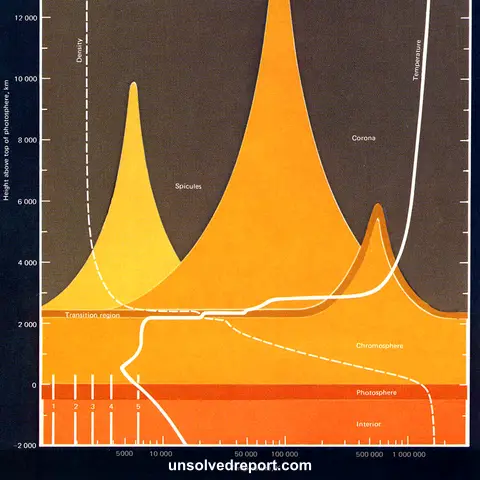
The Sun's surface is 10,000°F. Its corona hits 2 million. Walk away from a fire, get colder — unless it's the Sun. Scientists still can't fully explain why.
Galactic Center Gamma-Ray Excess: Dark Matter or 35,000 Dead Stars?
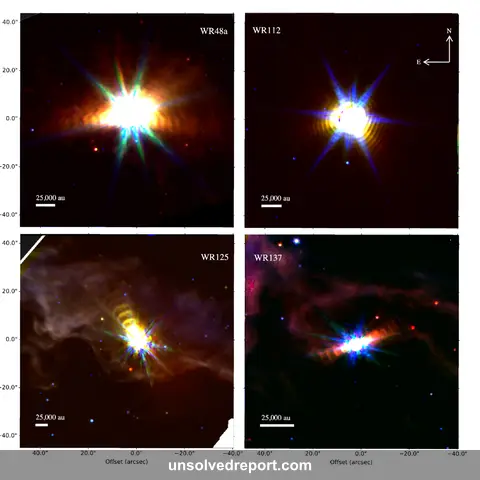
A real gamma-ray glow at the Milky Way's core has survived 15 years of scrutiny. Dark matter or dead stars? A 2026 AI analysis just reopened the case.
The Hubble Tension: Two Right Answers That Can't Both Be Right
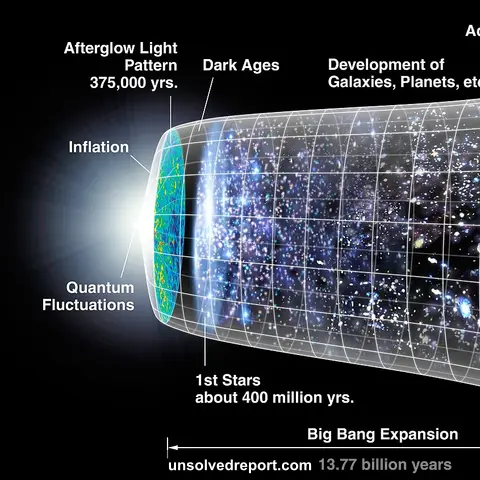
Two flawless measurements of cosmic expansion disagree by 9% at 5-sigma or more. The Hubble tension has no known fix. So what is the universe hiding?