Odd Radio Circles: Giant Rings in Space Nobody Can Explain
A ring of radio light wider than the Milky Way, glowing in nothing else, no visible light, no X-rays. Scientists found it. They still can't explain it.
Point an ordinary telescope at this patch of sky and you'd shrug. A faint smudge of a galaxy, one of billions. Nothing to write home about.
Now swap in a radio telescope.
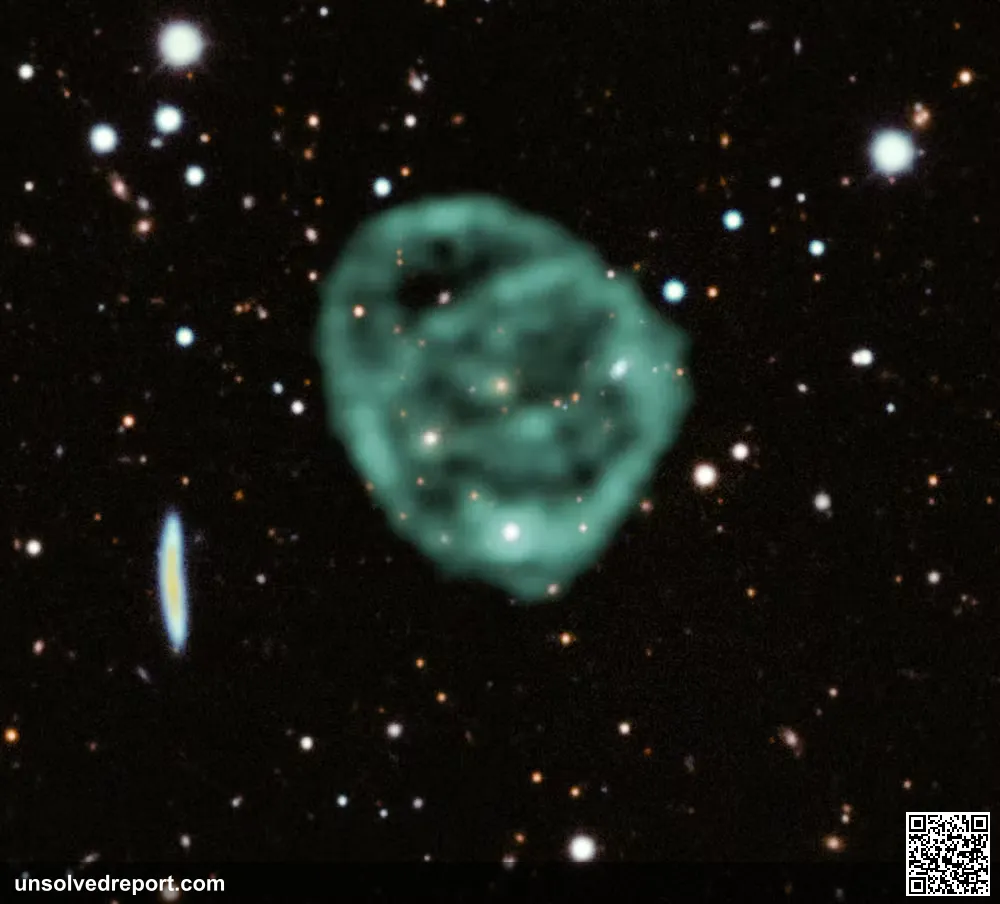
A ring snaps into view. A perfect circle of glow wrapped around that little galaxy, so wide it could swallow the entire Milky Way and still have room left over. And here's the part that raises the hair on your arms: it shines in radio waves and nothing else. No visible light. No X-rays. No infrared. Just a giant, silent halo that only the right kind of eye can see. Astronomers gave these things a name as plain as the objects are weird: odd radio circles, or ORCs. Here's what we actually know, what we honestly don't, and the ideas scientists are chasing right now.
What We Actually Know
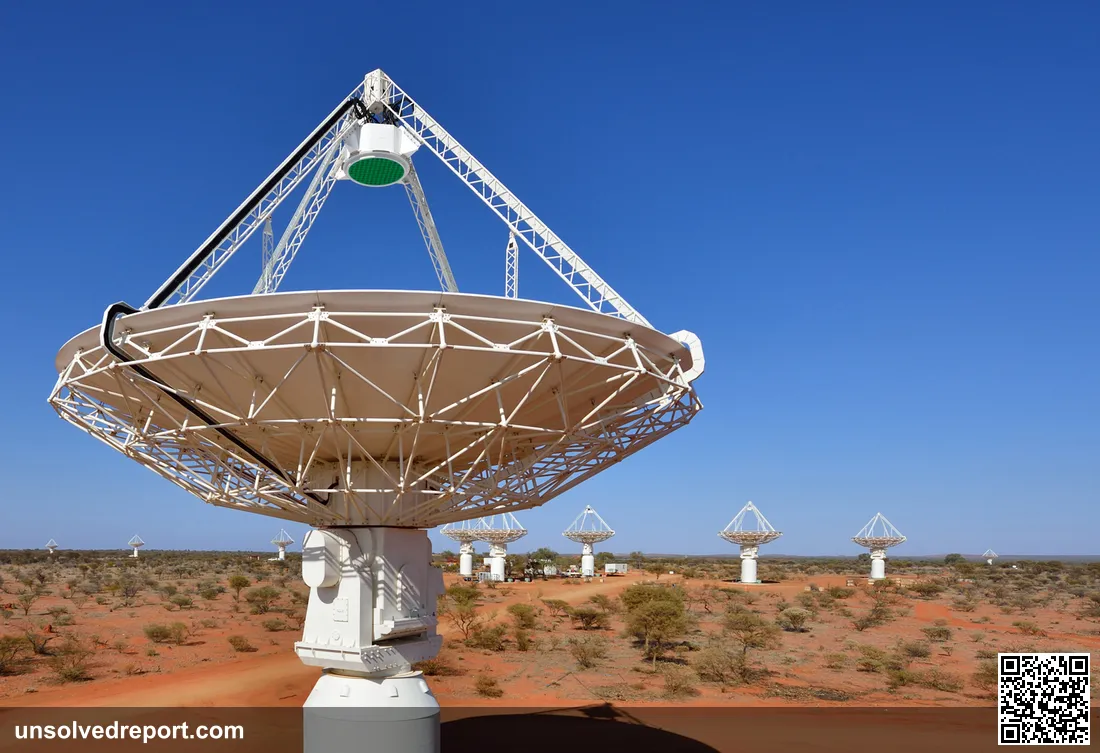
It started in 2019, hiding inside data from CSIRO's Australian Square Kilometre Array Pathfinder (ASKAP) telescope in Western Australia, gathered during the Evolutionary Map of the Universe (EMU) Pilot Survey. The find went official in 2021, written up in Publications of the Astronomical Society of Australia by a team led by Ray Norris, a professor at Western Sydney University and CSIRO (Norris et al. 2021, PASA). The paper laid out four circular radio objects, each about 60 arcseconds across. Three turned up in ASKAP. The fourth was pulled out of older data from India's Giant Metrewave Radio Telescope, the same kind of radio survey work that has turned up other short-lived puzzles like fast radio bursts (The Conversation).
Three things about ORCs make scientists lean in close.
First, they hide from almost everything. Look at the rings in optical, infrared, or X-ray light and you find no clear match. They only show up in radio. Second, most of them have an elliptical galaxy parked dead in the middle, right at the geometric center of the circle. That bullseye is no accident. It strongly suggests the galaxy and the ring are tied together, not just two unrelated things lined up by chance (Norris et al. 2021). Third, and this is the one that's hard to wrap your head around: they are gigantic. Those central galaxies sit roughly a billion light-years away, which means the rings around them stretch about a million light-years across. The visible disk of our entire Milky Way is only about 100,000 light-years wide. So picture it plainly: a single ORC is bigger than a galaxy.
The sharpest look at one of these came from South Africa's MeerKAT radio telescope. In a 2022 study in Monthly Notices of the Royal Astronomical Society, Norris and colleagues mapped the object called ORC1 in fine detail (Norris et al. 2022, MNRAS). They pinned the central host galaxy at a redshift of about z = 0.55, putting the ring's diameter near 500 kiloparsecs, well over a million light-years. The glow itself is synchrotron radiation, the telltale signature of high-energy electrons whipping along magnetic field lines. And here's the clue that really matters: the magnetic field runs tangentially around the ring, hugging the edge like a rubber band. That's exactly what you'd expect if a shock wave had swept up and squeezed the magnetic field as it blasted outward. The radio spectrum also showed "steepening," the fingerprint of an aging crowd of electrons, which hints that we're catching the late, fading breath of some violent event rather than something flaring to life right now.
Then 2024 brought a fresh angle. A team led by Alison Coil, professor of astronomy and astrophysics at the University of California, San Diego, turned to an object called ORC 4, the first ORC visible from the Northern Hemisphere (Keck Observatory). Using the Keck Cosmic Web Imager on Maunakea, they spotted something startling: a huge reservoir of hot, compressed, glowing gas wrapped around the central galaxy, far more than a normal galaxy should be hauling around. Their findings landed in Nature (Coil et al. 2024, Nature, DOI 10.1038/s41586-023-06752-8).
The Question Nobody Can Close
So strip it down. What makes a flawless radio ring, a million light-years wide, that shines in no other kind of light at all?
That's the real mystery, and scientists say so out loud. As of the latest peer-reviewed work, no single model has been nailed down for certain. Worse, only a handful of confirmed ORCs exist, and you can't build a sure theory on a fistful of examples.
The puzzle keeps splitting into more pieces the harder you stare. Why are they invisible at every wavelength except radio? Why so cleanly round, and so jaw-droppingly huge? What kind of event inside a galaxy could shove a shock wave out to a million light-years and leave behind a shell this smooth and symmetric? And the sneakiest question of all: are all ORCs even the same kind of thing? Or has the "ORC" label quietly swept up several unrelated phenomena that just happen to look like circles on a radio map? Astronomers are upfront about it. The sample is tiny, and a few objects make a thin floor to stand a big theory on.
The Leading Ideas
What comes next is informed scientific speculation. These are working ideas under active study, not closed cases. Treat them as the best current guesses, not verdicts.
The galactic-wind shell (the front-runner). The idea with the most momentum is that an ORC is a fossil, the leftover scar of a colossal outflow blasted out by its central galaxy. In the 2024 Nature study, Coil's team matched their Keck observations of ORC 4 against computer simulations. The story goes like this: a burst of furious star formation drives a galactic wind that howls outward for roughly 200 million years at speeds up to about 2,000 kilometers per second. When the wind finally dies down, a forward shock keeps tearing outward, scooping gas into an expanding shell that lights up in radio, while a reverse shock sends cooler gas tumbling back toward the galaxy (ScienceDaily). Coil pointed to two must-haves: "you need a high-mass outflow rate, and the surrounding gas just outside the galaxy has to be low density, otherwise the shock stalls" (Keck Observatory). And remember the tangential magnetic field and the aging electrons MeerKAT found in ORC1? They slot neatly into an expanding-shock story.
A collision of supermassive black holes. Norris and colleagues have floated another candidate: a cataclysm in the host galaxy, like two supermassive black holes merging, could fire off a single spherical shock wave, leaving behind a shell we see edge-brightened into a ring (Norris et al. 2022, MNRAS). It's a contender, not a confirmed culprit.
Radio-galaxy "phoenixes" and other long shots. Some researchers have asked whether ORCs might be revived relics, the ghosts of old radio-galaxy jets that switched off ages ago and somehow got re-lit, among other scenarios floating through the literature. These ideas are getting tested against fresh observations as more candidate ORCs surface in ongoing surveys.
Pull back and there's a thread running through every serious theory: a shock wave expanding into thin gas, seen as a ring because a hollow sphere always glows brightest around its rim, the same trick a soap bubble plays on your eye, and the same optical sleight of hand that makes Hoag's Object look like a perfect ring of stars. Which engine inflates that bubble, a starburst wind, a black-hole merger, or something nobody's named yet, is the exact question the next wave of radio surveys was built to crack. And that's the quiet thrill of an ORC. It isn't spooky. It isn't supernatural. It's just a brand-new kind of object the universe was hiding in plain sight, waiting until we finally built radio eyes sharp enough to catch it staring back.
Sources & further reading
- Norris et al., "Unexpected circular radio objects at high Galactic latitude," PASA, 2021: https://www.cambridge.org/core/journals/publications-of-the-astronomical-society-of-australia/article/unexpected-circular-radio-objects-at-high-galactic-latitude/4346B9FAADAA764CB6B122FBBF5B1E56
- Norris et al., "MeerKAT uncovers the physics of an odd radio circle," MNRAS, 2022: https://academic.oup.com/mnras/article/513/1/1300/6553851
- Coil et al., "Ionized gas extends over 40 kpc in an odd radio circle host galaxy," Nature, 2024: https://www.nature.com/articles/s41586-023-06752-8
- W. M. Keck Observatory, "Space Oddity: Uncovering the Origin of the Universe's Rare Radio Circles": https://keckobservatory.org/radio-circles-kcwi/
- ScienceDaily, "Space oddity: Uncovering the origin of the universe's rare radio circles," 2024: https://www.sciencedaily.com/releases/2024/01/240108125729.htm
- Ray Norris, "'Odd radio circles' that baffled astronomers are likely explosions from distant galaxies," The Conversation: https://theconversation.com/odd-radio-circles-that-baffled-astronomers-are-likely-explosions-from-distant-galaxies-178290
Voyager Interstellar Magnetic Field Anomaly: 40 Degrees Wrong
Voyager's interstellar magnetic field anomaly: two probes, two crossings, six years apart — same impossible reading. Why won't the compass swing back?
Przybylski's Star: The Sky's Most Impossible Light
Przybylski's Star glows with plutonium and promethium, elements that decay in years, not eons. Sixty years on, nobody can explain why they're still there.
Impossibly Early Galaxy Problem: JWST Found What Shouldn't Exist
JWST just found galaxies too big, too bright, and too early to exist under our own laws of physics. Is cosmology broken — or is something stranger going on?