Patiala Necklace Mystery: 2,930 Diamonds, Almost None Found
Cartier built the Patiala Necklace with 2,930 diamonds in 1928. By 1948 it vanished from a locked treasury — so where did nearly 3,000 stones go?
Two thousand nine hundred and thirty diamonds. One necklace. And then — nothing. In 1928, Cartier handed over a piece of jewelry so over-the-top it almost sounds made up: a waterfall of stones hung around the world's seventh-largest diamond. Twenty years later it was gone. No trial. No confession. No recovered loot. Just an empty shelf in a royal treasury and a single 1946 photo of the last man ever caught wearing it. Cartier has since rebuilt one famous piece of it — but the great river of original stones? It never came back. Here's exactly what the record says, and where it goes dark.
How It Was Built
Picture a man arriving in Paris with trunks. Not suitcases — trunks, packed with loose gemstones. That was Bhupinder Singh, the Maharaja of Patiala, in 1925, and he placed an order so big it became the largest single commission Cartier had ever taken to that point (Wikipedia: Patiala Necklace; The Cartiers, Hans Nadelhoffer family glossary). Three years of work later, in 1928, Cartier delivered the finished thing.
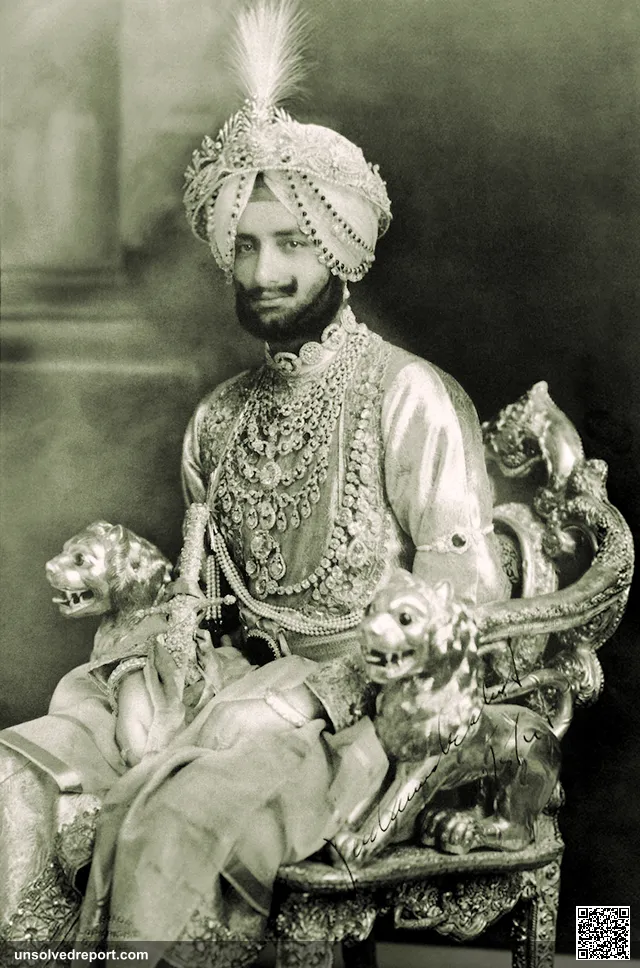
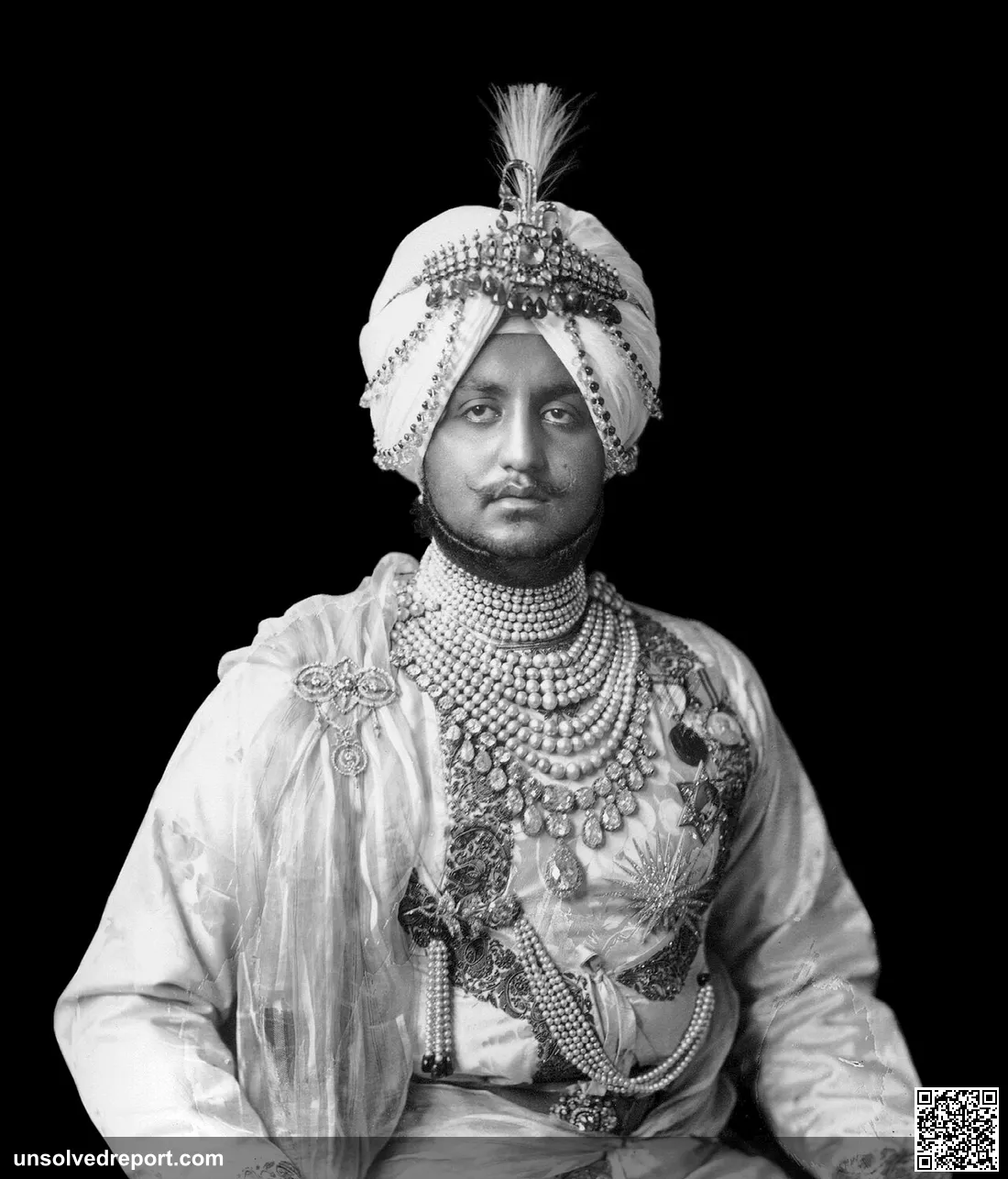
And the finished thing was almost absurd. 2,930 diamonds — about 962 carats of them — spilling across five chains and a ceremonial collar (Wikipedia). At the very center blazed the De Beers diamond, dug out of South African ground in 1888 and shown off at the 1889 Paris Universal Exposition. It started as a 428-carat rough lump and was cut down to 234.65 carats — enough to rank, at the time, as the seventh-largest diamond on the planet (Wikipedia; A Diamond Is Forever). And it didn't sit there alone. Around it clustered seven more big diamonds, each somewhere between roughly 18 and 73 carats, with Burmese rubies thrown in for good measure (Wikipedia).
This wasn't just jewelry. It was a wall of light that said: this is what our dynasty is. The Maharaja wore it. So did his son after him. The last photo we can be sure of comes from 1946 — Yadavindra Singh, Bhupinder Singh's successor, draped in all those stones (Wikipedia; Discovery UK).
And then the camera stops. Around 1948, the necklace simply isn't in the royal treasury of Patiala anymore (Wikipedia). The timing is no accident. India had just won independence, the princely states were being folded into the new Union of India, and the maharajas watched their old worlds — and their old fortunes — get rearranged overnight (Discovery UK), the same upheaval that still keeps Vault B beneath a Kerala temple sealed shut. Here's the strange part: nobody ever filed a theft in a way that named a culprit. No one was ever put on trial for losing it (Discovery UK).
The trail goes cold for decades. Then it twitches twice. In 1982, the De Beers diamond surfaced — alone — at a Sotheby's auction in Geneva, linked to the Patiala royal family, with bidding said to climb to around $3.16 million (Wikipedia; Discovery UK). Then it slipped back into the shadows, owner undisclosed, and stayed there.
The second twitch came in 1998, and it's the eerie one. A Cartier man named Eric Nussbaum reportedly walked into a second-hand jewelry shop in London — and there, sitting in the case, was a piece of the necklace. Not the glory of it. The bones of it: the stripped-down skeleton, picked clean (Wikipedia; Discovery UK). Cartier bought the gutted frame and spent about four years rebuilding it to look like the original. But the real stones were gone — so the restorers filled the empty settings with cubic zirconia and synthetic diamonds, and dropped a replica of the De Beers diamond into the spot where the real one used to burn (Wikipedia) — a stand-in echoing the way the Florentine Diamond has only ever survived as a legend and a paste copy.
So Where Did the Diamonds Go?
Let's say it plainly, because the plain version is the unsettling one: sometime between roughly 1946 and 1948, a necklace holding nearly three thousand diamonds left a guarded treasury — and most of those stones have never been publicly accounted for since.
That 1998 "recovery" sounds triumphant until you look closely. Cartier got back the framework and almost nothing else. The big pendant diamonds, the ones in that 18-to-73-carat range, and the Burmese rubies? Not in the fragment Cartier bought. They've never turned up in any documented sale (Wikipedia; Discovery UK). The De Beers diamond is its own lonely thread: one appearance in 1982, then silence, then an unnamed owner somewhere out there. And the thousands of smaller stones? No paper trail at all. They just dissolved.
So the real question was never "where's the necklace?" — Cartier's rebuilt version is sitting right there, documented. The question that keeps you up is sharper: what happened to the original gems? Who took the piece apart? And where on Earth did all those stones scatter to? On the public record, there's no answer. The honest truth is that the breakup was never fully investigated, never settled in a court, never reconstructed stone by stone. It just… happened, in the dark.
The Theories
What follows is speculation — best guesses, not facts. None of it has been confirmed by a court, an inventory, or anyone owning up to it. With that flag firmly planted, here are the three leading ideas.
Theory 1 — A quiet sell-off. The most popular explanation is also the least dramatic: someone deliberately took the necklace apart and sold it off for cash. The logic holds together. Independence and Patiala's merger into India squeezed former ruling families hard, and a pile of anonymous loose diamonds is far easier to sell quietly than one world-famous, instantly recognizable necklace (Discovery UK) — much the way royal treasure scattered quietly after empires fell apart around the six Faberge eggs that vanished with the Romanovs. That lonely De Beers diamond showing up at Sotheby's in 1982, tied to the Patiala family, gets read by some as a quiet hint pointing this way. The catch: it's plausible and money-makes-sense logical, but unproven. It leans on context, not on any actual order to sell.
Theory 2 — An inside job. A rival idea says someone with treasury access stole the necklace, smuggled it out of the country, and broke it up so the stones could be sold with no awkward history attached (Discovery UK). It fits the way the smaller stones vanished completely. But there's a loud silence working against it: no named suspect, no charge, no trial — which is a very strange thing to find after a theft this enormous.
Theory 3 — A slow fade. The gentlest reading mixes the first two: maybe the piece came apart over years, through a drizzle of private sales, gifts, and resettings, so there was never one single "event" anyone could write down. Under this version the necklace didn't vanish in a night — it melted, slowly, into the world's gem trade. This actually fits the scattered comebacks — one big stone in 1982, a stripped frame in 1998 — better than a single cinematic heist. The downside is built right in: a slow fade leaves almost nothing behind to prove it ever happened.
Here's what we can hold onto for sure, and it's worth holding tight: a real necklace of 2,930 diamonds existed. We can see it in photos right up to 1946. By around 1948 it was gone. And only fragments have ever come back into the light — not unlike how the Peacock Throne disappeared from India in 1747 without a single confirmed piece ever resurfacing. Everything past that — the how, the who, the where — is still a genuinely sourced blank.
Which leaves one quiet, prickly thought to carry with you. Somewhere out there, in vaults and ring settings and collections that have no idea what they're holding, those stones may still be glittering — scattered, renamed, unrecognizable — waiting on a record that may never be written.
Sources & Further Reading
- Patiala Necklace — Wikipedia
- What Happened to the Patiala Necklace and Was it Ever Found? — Discovery UK
- Patiala Diamond Necklace: Cartier's Lost Legend — A Diamond Is Forever
- Patiala Necklace glossary — The Cartiers (Nadelhoffer/Cartier family research)

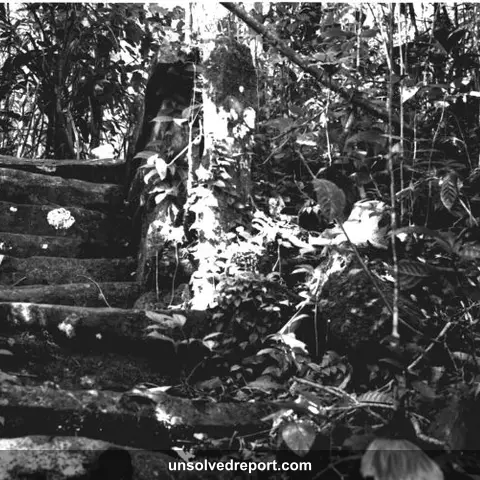
Gunung Padang Dating Controversy: The Pyramid Claim That Got Retracted
27,000 years old, or 2,000? A retracted paper, a buried hill in West Java, and a number that split archaeology in two. Here's what the evidence actually shows.
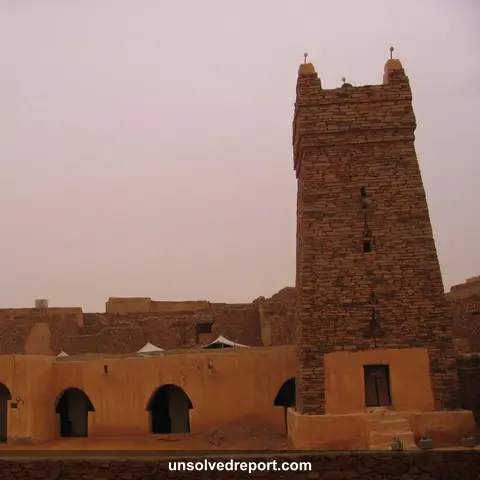
Oualata, Mauritania: The Ksour Mystery No One Can Date
Oualata's painted walls are repainted by hand every year, erasing the evidence — so how old is this Mauritania ksour really? Even UNESCO won't say.

Hinterkaifeck: The Killer Who Stayed for Dinner
Six people slaughtered on a Bavarian farm in 1922 — then someone fed the cows, lit the stove, and stayed for days. Who, and why, still has no answer.