Plane of Satellite Galaxies Problem: A Puzzle No One Can Crack
Plane of satellite galaxies problem: tiny galaxies orbit the Milky Way and Andromeda in flat, spinning discs cosmology says shouldn't exist. Why?
Astronomers expected a mess. When they mapped the dozens of tiny dwarf galaxies that follow the Milky Way around, the textbook said those little companions should be scattered everywhere — a jumbled, roughly round swarm, like gnats around a porch light. That is not what they found. A startling number of the brightest ones were lined up in a single thin sheet, gliding the same way, like cars looping a racetrack. Then the same eerie neatness showed up around our giant neighbor Andromeda. Then around a third galaxy entirely. Decades later, scientists are still arguing about what it means. Welcome to the "plane of satellite galaxies" problem — one of the most stubbornly fascinating puzzles in all of astrophysics.
What we actually see out there
The weirdness starts in our own backyard.
In 2012, Marcel Pawlowski, Pavel Kroupa, and their colleagues took a hard look at everything orbiting the Milky Way — its satellite galaxies, its globular star clusters, even its streams of torn-apart stars. The pattern they found was so striking they gave it a name: the "Vast Polar Structure," or VPOS. Think of a colossal, flattened disc about 250 kiloparsecs across but only 20 to 30 kiloparsecs thick — a cosmic pancake, standing almost straight up compared to the flat spiral of the Milky Way (Pawlowski et al. 2012, Monthly Notices of the Royal Astronomical Society). And here's the part that raises the hair on the back of your neck: when they measured which way the brightest satellites were moving, most of them were circling inside that thin sheet in the same direction. The whole structure seems to turn together. That is not what a random snapshot looks like.
Andromeda told an even sharper version of the same ghost story. In a 2013 paper in Nature, Rodrigo Ibata and his team described "a vast, thin plane of corotating dwarf galaxies" wrapped around the Andromeda galaxy (M31). Of 27 satellites with solid distance measurements, about 15 dropped neatly into a plane more than 400 kiloparsecs wide — yet barely 14 kiloparsecs thick. Picture a dinner plate the width of a stadium but no thicker than the rim. Then came the kicker: 13 of those 15 in-plane galaxies were all spinning the same way around Andromeda (Ibata et al. 2013, Nature; Conn et al. 2013). A random cloud should never march in step like that.
Two galaxies, you might say — maybe a coincidence. But then the universe did it a third time, far beyond our own neighborhood. In 2018, Oliver Müller, Pawlowski, Helmut Jerjen, and Federico Lelli reported in Science that around the giant elliptical galaxy Centaurus A, 14 of 16 satellites with velocity data were following one coherent, rotating pattern, lined up with their flattened arrangement in space. How rare is that, according to standard cosmological simulations? Fewer than about 0.5% of comparable systems behave this way (Müller et al. 2018, Science). Half of one percent.
And the latest twist is the strangest yet. In April 2025, Kosuke Jamie Kanehisa and colleagues reported in Nature Astronomy that Andromeda is lopsided in a way that almost defies belief: all but one of its 37 known satellites sit on the single hemisphere facing the Milky Way — crammed into an arc of roughly 107 degrees. In their comparison simulations, fewer than 0.3% of Andromeda-like galaxies showed asymmetry that extreme, and not a single one matched the whole picture (Kanehisa et al. 2025, Nature Astronomy; summarized by Phys.org). It's as if the satellites were all huddled on one side of the room, staring at us.
Why this keeps astronomers up at night
Here's the heart of it.
Our best theory of how the universe is built is called the "Lambda Cold Dark Matter" model — ΛCDM for short — and it is a triumph. It explains the great cosmic web of galaxies, the faint afterglow of the Big Bang, the way matter clumps across billions of light-years. It works beautifully on the biggest scales we can measure.
In that picture, dwarf galaxies should rain down onto a big galaxy from every direction, over billions of years, like snow falling from all sides at once. The result should be a fat, roughly spherical swarm. Thin, spinning discs of satellites? Those are supposed to be rare.
Yet there they are — in at least three nearby systems, including the only two big galaxies whose satellites we can study in fine detail: our own Milky Way and Andromeda. So the question is simple to say and genuinely unsolved: are these tidy planes a real, repeating feature of the cosmos that exposes a crack in our model of how galaxies form — or are they, at least in part, lucky alignments and tricks of perspective that look more dramatic than they really are? As of 2026, nobody has won this argument.
The rival explanations
What follows are the competing ideas. Some are mainstream and hotly debated. All of them are proposals, not settled fact — read them that way.
Idea 1: The planes are real, and our cosmology needs fixing. This is the camp of Pawlowski, Kroupa, and their collaborators. Their case: the planes are too thin, too organized in their spin, and now — with Andromeda — too lopsided to brush off as chance. And the fact that the same trick keeps appearing around different host galaxies, they argue, points to something the standard model is flat-out missing (Kanehisa et al. 2025). One bold possibility from this camp: maybe many of these satellites aren't ancient clumps of dark matter at all. Maybe they're "tidal dwarf galaxies" — knots of gas and stars flung out during a violent collision between two galaxies long ago. Debris from one big crash would naturally fly off sharing a common plane and a common direction of spin, which would explain the whole eerie geometry in one stroke (Pawlowski et al. discussion). The catch — and it's a real one — is that tidal dwarfs are expected to carry almost no dark matter, while the Milky Way's satellites look like they're stuffed with it.
Idea 2: The planes are real, but fleeting — and ΛCDM is fine after all. In 2023, Till Sawala and colleagues fired back in Nature Astronomy. Sharper measurements from the Gaia spacecraft, they argue, change everything. To them, the Milky Way's "plane" is partly an illusion — a product of its lopsided spread of satellites plus a temporary lineup of its two most distant members, Leo I and Leo II. In this reading, the plane isn't a long-lived, stately spinning disc at all. It's a passing arrangement that forms, drifts apart, and re-forms — and short-lived planes exactly like it pop up often enough in modern simulations to fit comfortably inside the standard model (Sawala et al. 2023, Nature Astronomy). This directly attacks the "rotationally stabilized disc" idea, and it's very much a live punch in an ongoing fight.
Idea 3: The devil is in the simulations and the data. A cooler-headed position says the whole answer may come down to fine print: how exactly you define a plane, how you account for the satellites you simply haven't spotted yet, and how faithfully simulations capture the shove of massive companions. For example, some studies suggest the recently arrived Large Magellanic Cloud may be temporarily nudging the orbits of other satellites, faking the look of one coherent plane (Garavito-Camargo et al. 2021). Fresh statistical tools have also been proposed to test "planeness" more rigorously (Sawala et al. 2024 preprint — not yet peer-reviewed at the time of writing).
So where does that leave us? Nowhere tidy — and that's the point. The facts themselves aren't in dispute. These flattened, partly spinning, lopsided arrangements of galaxies are genuinely out there, hanging in the dark. What they're whispering about dark matter and the birth of galaxies is exactly the kind of unsolved question that keeps astronomers staring — at the night sky, and at their simulations — hunting for the one piece that finally clicks into place.
Sources & further reading
- Pawlowski, Pflamm-Altenburg & Kroupa (2012), "The VPOS: a vast polar structure of satellite galaxies," MNRAS — link
- Ibata et al. (2013), "A vast, thin plane of corotating dwarf galaxies orbiting the Andromeda galaxy," Nature — link
- Conn et al. (2013), distribution of M31 satellites and ΛCDM, MNRAS — link
- Müller, Pawlowski, Jerjen & Lelli (2018), "A whirling plane of satellite galaxies around Centaurus A," Science — link
- Sawala et al. (2023), "The Milky Way's plane of satellites is consistent with ΛCDM," Nature Astronomy — link
- Kanehisa et al. (2025), "Andromeda's asymmetric satellite system as a challenge to cold dark matter cosmology," Nature Astronomy — arXiv link; plain-language summary at Phys.org
- Garavito-Camargo et al. (2021), orbital-pole clustering induced by the LMC, ApJ — link

Repeating Fast Radio Bursts: Some Run on a 16-Day Clock
Most fast radio bursts flash once and vanish. A rare few — repeating fast radio bursts — come back on a schedule. Why? Nobody can fully explain it yet.
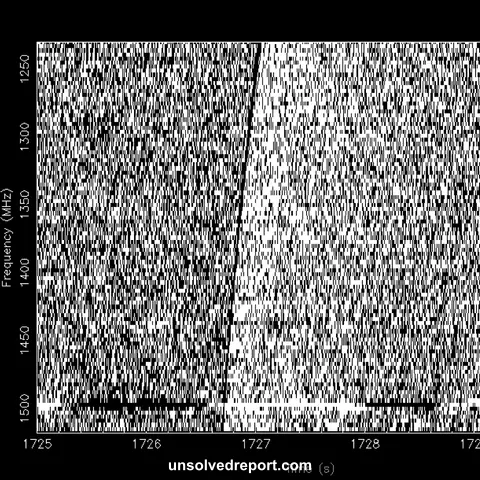
Fast Radio Bursts: The Flash With 3 Days of the Sun's Power
A fast radio burst crams 3 days of the Sun's energy into one millisecond, then vanishes. We've caught thousands. So what in the universe is firing them?
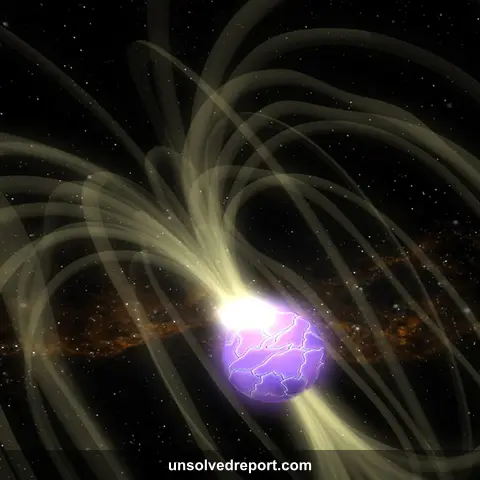
SGR 0501+4516: The Roaming Magnetar With No Birthplace
Hubble tracked SGR 0501+4516 for a decade and its birthplace vanished — no supernova shell, no star cluster, nothing. So where was it actually born?