SGR 0501+4516: The Roaming Magnetar With No Birthplace
Hubble tracked SGR 0501+4516 for a decade and its birthplace vanished — no supernova shell, no star cluster, nothing. So where was it actually born?
A dead star the size of a city is gliding through the dark edge of the Milky Way, and it has nowhere to point back to. It is one of the most magnetic things anyone has ever found. For years, astronomers thought they knew exactly where it came from. Then, in 2025, ten quiet years of Hubble measurements pulled the rug out. The star is called SGR 0501+4516 — and right now it's the best clue we have that some magnetars may not be born the way every textbook swears they are.
What We Actually Know
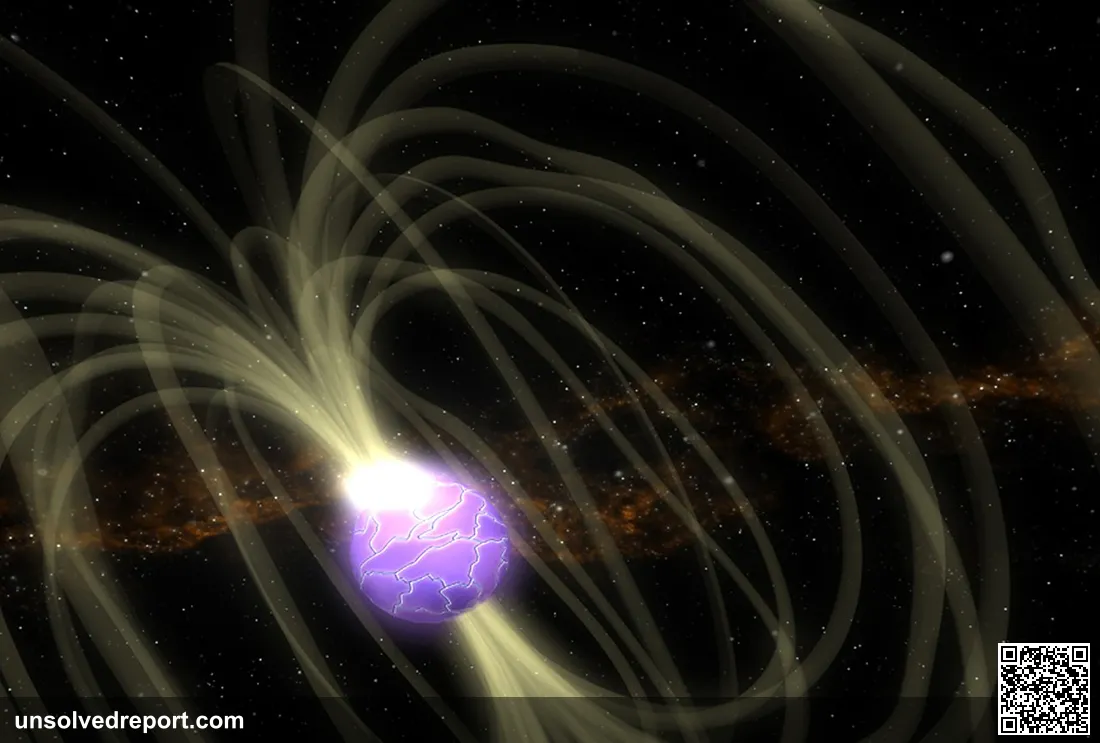
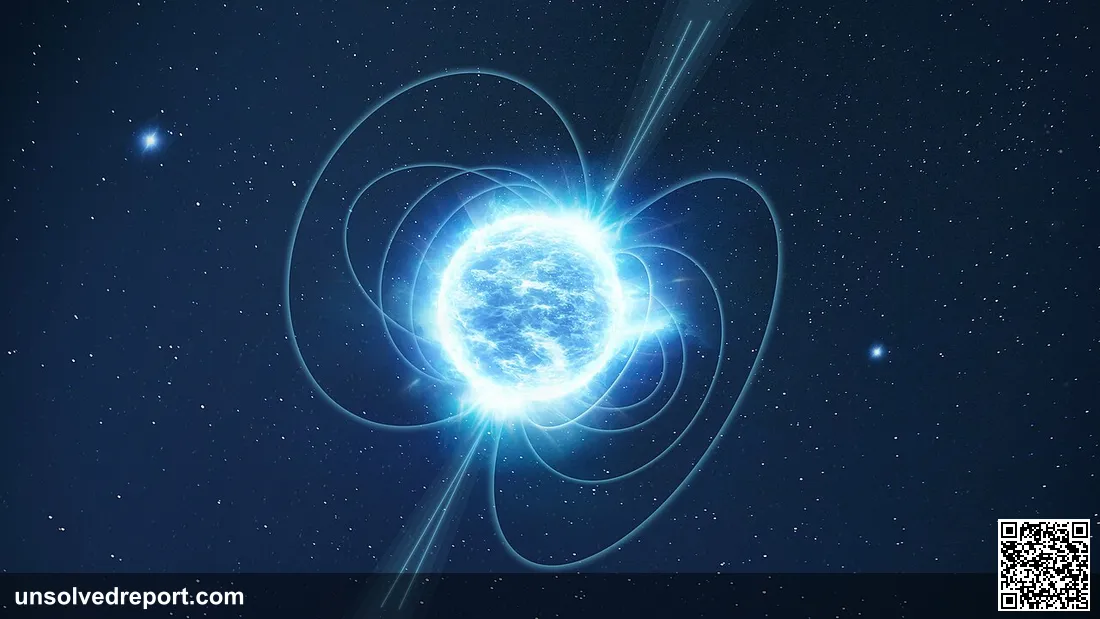
Start with the star itself. A magnetar is a kind of neutron star — the crushed, impossibly dense core left over when a giant star dies. But one thing makes a magnetar a monster: its magnetic field. Around 10^15 gauss. That's a thousand trillion times stronger than Earth's, and hundreds of times fiercer than a normal radio pulsar's, which makes magnetars the most magnetic objects we know of anywhere (Museum of Science). Get one wrong and the field would scramble the atoms in your body from halfway across a solar system. And they're rare — only about 30 are known in the entire galaxy (ESA).
This one announced itself with a scream. On August 22, 2008, NASA's Swift observatory caught short, savage bursts of gamma rays blasting out from near the flat plane of the Milky Way (Chrimes et al. 2025, Astronomy & Astrophysics). On the sky, the source sat about 80 arcminutes from a ragged supernova leftover called HB9 — picture the width of your pinky held out at arm's length (ESA). That nearness felt like a clue. Magnetars are supposed to be born in supernovae, so a magnetar lounging right next to a supernova's blown-out shell looked like a neat little origin story. Case closed, surely.
To actually test it, an international team led by Ashley Chrimes of the European Space Agency did something patient. They aimed the Hubble Space Telescope at the magnetar three different times — 2010, 2012, and 2020 — stretching a ten-year ruler across the sky, then pinned every image against Gaia's catalog of reference stars (ESA). What they were chasing is called proper motion: how fast the object slides across the heavens, and in which direction.
The answer came back sharp. The magnetar drifts at 5.4 ± 0.6 milliarcseconds per year — a gentle pace of about 51 ± 14 kilometers per second across the sky, assuming it sits roughly 2 kiloparsecs away (Chrimes et al. 2025). Its spin-down "characteristic" age lands somewhere around 10,000 to 20,000 years. Young, in star terms. Young enough that its birthplace should still be visible.
Here's the part that breaks everything. The team rewound the magnetar's motion, playing the film backward to see where it had come from. The trail did not lead to HB9 — not in speed, not in direction. The paper says it flat out: "a physical association between SGR 0501+4516 and HB9 is therefore ruled out by both the magnitude and direction of the proper motion" (Chrimes et al. 2025). And it gets stranger. Following that backward path across the magnetar's whole likely lifetime, they found nothing waiting at the other end — no other supernova remnant, no cluster of massive stars, no nursery of any kind anywhere along the line (ESA). The team also locked down a faint near-infrared counterpart with oddly non-stellar colors, which is what pinned the object's exact position for the whole motion study.
So the magnetar has an alibi for every crime scene we can find. None of them fit.
The Real Question Nobody Can Answer
Strip it down and the mystery is brutally simple. If SGR 0501+4516 wasn't born at HB9, and there's no supernova wreckage or star-forming cradle anywhere it could have come from — then where, and how, did it get made?
The standard answer is supposed to be airtight. Neutron stars, magnetars included, are made when the core of a massive star collapses and the star detonates as a supernova (Museum of Science). That blast throws out a glowing shell of debris that hangs around, visible, for tens of thousands of years. A magnetar this young should have a shell to call home. This one simply doesn't. And that's the whole point — it's not a smudge in the data or a measurement that slipped. It's a clean, careful, well-checked fact that the usual story can't swallow. ESA goes so far as to call SGR 0501+4516 "the likeliest candidate in our galaxy for a magnetar that was not born in a supernova."
Worth being honest about which parts are solid. The proper motion, and the fact that HB9 is ruled out — those are firm, peer-reviewed measurements. What it all means — whether this points to some weird, non-supernova birth — is the part still hanging wide open. The researchers themselves don't claim an answer. They lay out a lineup of suspects.
The Suspects
These are the explanations the team and the wider field are kicking around. Each one is believable. None is proven.
Suspect 1 — A white dwarf that quietly fell in (the leading guess, still speculation). What if the thing that became this magnetar was never a giant star at all? Picture instead a white dwarf — the crystallized cinder of a dead Sun-like star — orbiting a partner in a binary. If that white dwarf keeps siphoning gas off its companion, it can tip past a critical mass and, rather than blowing up, just fold inward and collapse into a neutron star (ESA). The key detail: this route doesn't have to leave behind a bright supernova shell. No shell, no birthplace to find. The Chrimes paper names SGR 0501+4516 "the best Galactic candidate for a magnetar formed through a mechanism other than massive star core-collapse" (Chrimes et al. 2025).
Suspect 2 — Two dead stars that crashed together (speculation). Now imagine two compact corpses — neutron stars, or white dwarfs — spiraling closer and closer until they merge. Under the right conditions, that collision could fuse into a single magnetized neutron star, and again, possibly without the obvious supernova fingerprint everyone was hunting for (ESA). It's a tempting idea, because it offers a way to forge a magnetar deep inside an old, settled crowd of stars, nowhere near any recent fireworks.
Suspect 3 — It's older or sneakier than it looks (speculation). The calmer reading: maybe some magnetars are just way older than their estimated ages let on. Or maybe their birth supernova was such a runt — flinging out so little material — that the shell faded out of sight ages ago (Sci.News summary of the study). If so, you don't need any new physics. You just need to admit that magnetar ages and faint, vanished shells are slipperier than we'd like.
And here's a thread that makes the whole thing tingle. Fast radio bursts — those millisecond flares of radio energy that flash across the cosmos — sometimes erupt from old populations of stars where no supernova has gone off in ages. If magnetars really can be built by white dwarfs collapsing or dead stars merging, in exactly those quiet old neighborhoods, that might just explain where some of those orphaned bursts are coming from (ESA). A possibility. Not a verdict.
For now, SGR 0501+4516 keeps drifting — roughly 51 kilometers every single second — carrying its secret with it. We've clocked its speed. We've traced its path. We've crossed off the cradle everyone assumed was its own. The one thing we still can't do is say where it truly came from. And that honest, gaping blank in the map? That's exactly the kind of question worth staying up to watch.
Sources and Further Reading
- Chrimes, A. A., et al. (2025). "The infrared counterpart and proper motion of magnetar SGR 0501+4516." Astronomy & Astrophysics, 696, A127. aanda.org
- European Space Agency. "Hubble investigates a magnetar's birthplace." esa.int
- Museum of Science. "Sheer Magnetism: What's a Magnetar?" mos.org
- Sci.News. "Runaway Magnetar is Traversing Milky Way from Unknown Place of Origin." sci.news
- Phys.org. "Hubble tracks a roaming magnetar of unknown origin." phys.org
JuMBOs: 40 Pairs of Rogue Planets Science Can't Explain
JWST found 40 pairs of Jupiter-mass objects drifting through Orion with no star, no clear origin, and no explanation. So what are the JuMBOs really?
WD 1145+017: The Disintegrating Planet Nobody Has Ever Seen
WD 1145+017: a dead star shredding a planet in real time, yet no one has ever actually seen the thing being destroyed. Here's why that's still a mystery.
The Cosmological Lithium Problem: Why 2/3 of Big Bang Lithium Is Missing
Big Bang physics predicts triple the lithium the oldest stars actually have. A 2024 interstellar gas measurement just made the gap harder to explain away.