Repeating Fast Radio Bursts: Some Run on a 16-Day Clock
Most fast radio bursts flash once and vanish. A rare few — repeating fast radio bursts — come back on a schedule. Why? Nobody can fully explain it yet.
A spark of radio energy flares somewhere in deep space. It lasts a few thousandths of a second — and in that blink it dumps out as much power as the Sun pours into space over days. Then it's gone. Most of these flashes appear exactly once and never come back.
But a stubborn few do something far stranger. They return. Some flicker back at random. A handful keep a schedule, pulsing on a rhythm you could almost mark on a calendar. So here's the question that keeps astronomers up at night: why do some of these signals come back, while others fall silent forever? Nobody can answer it yet. And that's what makes it one of the liveliest mysteries in all of modern astrophysics.
What We Actually Know
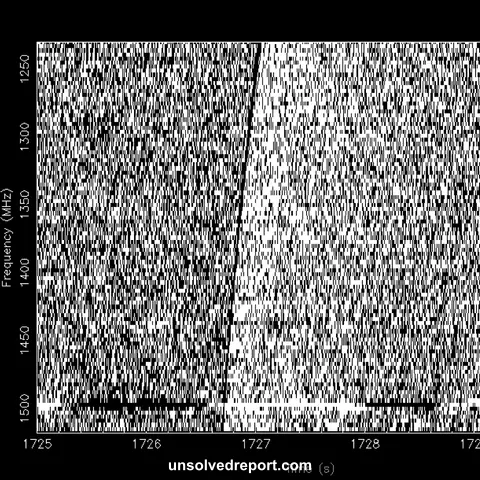
Fast radio bursts — FRBs — are millisecond-long flashes of radio waves. The first one wasn't spotted live; it was dug out of old archived data in 2007. For years, they seemed to be strictly one-and-done events. Flash, then nothing.
Then 2016 cracked it open. Astronomers confirmed that a source on their list, FRB 121102, was flashing again and again from the very same speck of sky. It was the first repeater to ever have its home address found: a small, busy, star-forming dwarf galaxy about 3 billion light-years away (IOPscience, ApJL Focus on FRB 121102). And when this thing gets going, it really gets going — at its wildest, FRB 121102 has fired off 122 bursts in a single hour.
Now here's the clue that changed everything, and it came from our own backyard. On April 28, 2020, radio dishes caught a monster burst — a megajansky flare named FRB 20200428 — blasting out of SGR 1935+2154. That's a magnetar: a neutron star with a magnetic field so absurdly strong it almost breaks the imagination, sitting right inside our Milky Way, roughly 30,000 light-years off. It was the first FRB-like burst ever pinned to one specific object. And it didn't come alone — an X-ray flare went off at the very same instant (Bochenek et al., Nature, via Caltech). The takeaway was huge: magnetars can, at the very least, fire signals at FRB strength.
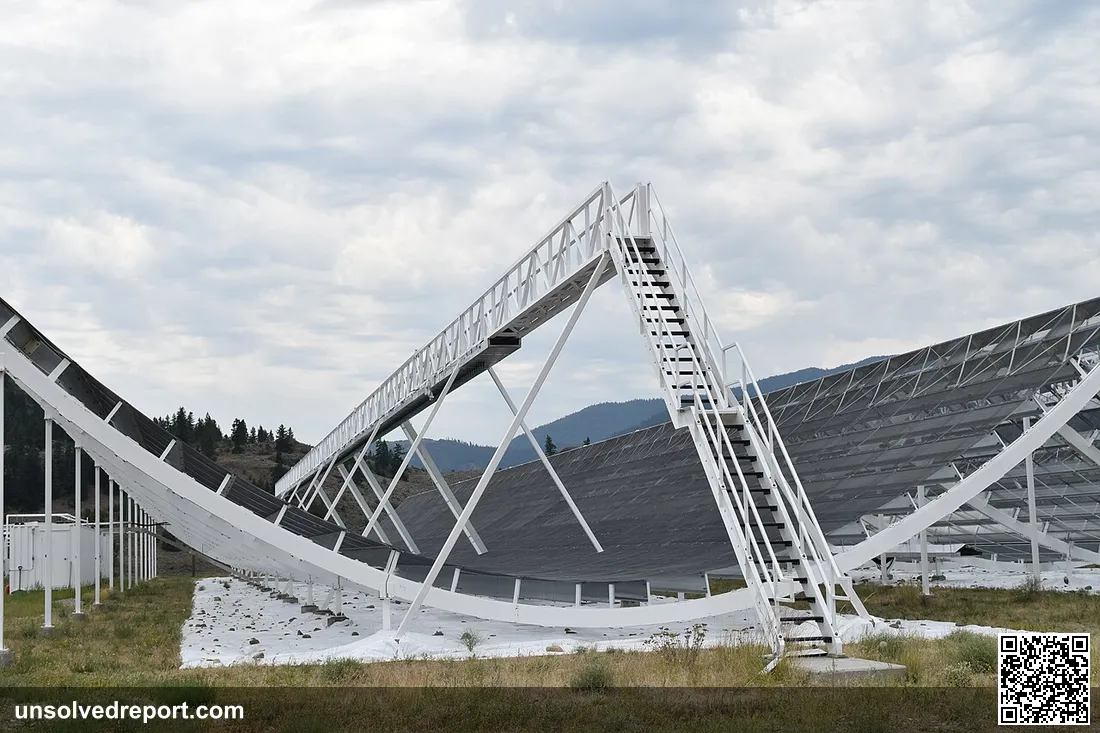
Then the repeaters showed off another trick. Some of them keep time. In 2020, the CHIME/FRB Collaboration found that FRB 180916.J0158+65 runs on a cycle of about 16.35 days. It bursts during a roughly four-to-five-day window, falls quiet for about twelve days, then wakes up and does it all over again. Half its bursts land inside a window just 0.6 days wide. The source lives in a star-forming patch on the edge of a spiral galaxy about 500 million light-years away (CHIME/FRB Collaboration, Nature, 2020). A clock, ticking across half a billion light-years.
And the numbers have exploded. The First CHIME/FRB Catalog, in 2021, logged 536 bursts — 62 of them from 18 repeating sources — and found that only about 2.6% of all sources were ever caught repeating (CHIME/FRB Catalog 1, ApJS). The Second CHIME/FRB Catalog blew that wide open: 4,539 bursts from 3,641 separate sources, including 981 bursts from 83 known repeaters (CHIME/FRB Catalog 2, ApJS). And these flashes reach almost unthinkably far. FRB 20220610A, tracked down by Australia's ASKAP and the European Southern Observatory's Very Large Telescope, came from a galaxy system at a redshift of about 1.0 — its light has been traveling for roughly 8 billion years just to reach us (Ryder et al., Science, 2023).
The Part Nobody Can Explain
Here's where the mystery bites. Astronomers genuinely do not know whether repeaters and non-repeaters are two completely different kinds of object — or the same kind of thing acting two different ways. And nobody can say why the repeaters come back at all.
The shapes of the bursts only make it weirder. Look closely and CHIME finds it over and over: repeater bursts tend to be narrower in frequency but stretched out longer in time than the one-off flashes. The difference is so reliable that machine-learning programs can sort the two crowds apart with high accuracy (CHIME/FRB Catalog 2 morphology study, arXiv 2601.16048). Sounds like two separate species, right? Except the same research finds something that points the other way — certain traits, like the width of the sub-bursts once you account for their duration, hint that both kinds might share a single engine after all (Curtin et al., ApJ, 2025). So which is it? The data refuses to pick a side.
And there's a trap nobody can fully escape. A source filed today as a "non-repeater" might just be a repeater that hasn't been caught flashing twice yet. Since only about 2 to 3% of sources are ever seen to repeat, the so-called silent majority could be crawling with hidden repeaters — ones the telescopes simply haven't watched long enough. In fact, some models argue that a single underlying population of repeaters, just with wildly different activity levels, is enough to reproduce everything CHIME sees (James et al., zDM modeling, arXiv 2306.17403). One engine, or two? The question is still wide open.
The Best Guesses So Far
Everything below is informed speculation — not settled fact. Researchers are stress-testing these ideas right now, and none of them is confirmed.
The magnetar idea — the current favorite. That SGR 1935+2154 detection put young, fiercely magnetic neutron stars out in front. Picture a magnetar's crust cracking under the strain, and its monstrous magnetic field suddenly snapping into a new shape — that kind of violence could plausibly launch radio bursts again and again. And FRB 121102's young, star-forming home fits the young-magnetar story neatly, because magnetars are born when massive stars die (ApJL Focus on FRB 121102). It's the strongest framework anyone's got. It just can't explain every behavior on its own yet.
A partner star, and the strange clock. So what sets that 16-day rhythm of FRB 180916 ticking? The leading guesses: a magnetar swinging around a companion star in orbit, or the neutron star slowly wobbling like a dying top, or a stellar wind switching the signal on and off. One study of the repeater FRB 20201124A made the case that its surroundings fit best with a magnetar paired up with a hot, fast-spinning Be star — read off from shifts in the burst's magnetic fingerprint, a thing called Faraday rotation (Nature Communications, 2022). There's a related twist, too: magnetars locked in a binary might stay "aligned" — keeping their spin and magnetic axes lined up by feeding on material from a partner — so they keep firing, while lonely magnetars drift out of line and go dark (phys.org coverage, 2026).
A warning about clues that look too clean. Science catches its own mistakes, and FRB research just lived through a perfect example. In 2022, CHIME reported FRB 20191221A pulsing with a crisp 216.8-millisecond internal beat — practically a smoking gun for a spinning neutron star (CHIME/FRB Collaboration, Nature, 2022). Then a later look reidentified that "signal" as something far less exotic: pulses from a known Milky Way pulsar, PSR J0248+6021, not a deep-space FRB at all (arXiv 2606.07087, 2026). The neutron-star connection still rests on solid ground — but it's a sharp reminder to hold any single tidy "answer" loosely.
So here's the honest scorecard. Magnetars can make FRB-like bursts. Repeaters and non-repeaters really do look measurably different. And yet no one can tell you, with certainty, why some signals come back — or whether the silent ones are truly silent, or just quietly waiting. That gap, the space between what we can measure and what we can explain, is exactly where the mystery lives. Somewhere out there, right now, something is deciding whether to flash again. We just can't see it coming.
Sources & further reading
- CHIME/FRB Collaboration, "Periodic activity from a fast radio burst source," Nature (2020): https://www.nature.com/articles/s41586-020-2398-2
- Bochenek et al., "A fast radio burst associated with a Galactic magnetar" (SGR 1935+2154 / FRB 20200428), Nature (2020), Caltech archive: https://authors.library.caltech.edu/records/v84d4-vcs34
- "Focus on the Repeating Fast Radio Burst FRB 121102," The Astrophysical Journal Letters (IOPscience): https://iopscience.iop.org/journal/2041-8205/page/Focus_on_FRB_121102
- The First CHIME/FRB Catalog, ApJS (2021): https://iopscience.iop.org/article/10.3847/1538-4365/ac33ab
- The Second CHIME/FRB Catalog, ApJS (2025): https://iopscience.iop.org/article/10.3847/1538-4365/ae3828
- Ryder et al., "A luminous fast radio burst that probes the Universe at redshift 1" (FRB 20220610A), Science (2023): https://www.science.org/doi/10.1126/science.adf2678
- CHIME/FRB Collaboration, "Sub-second periodicity in a fast radio burst" (FRB 20191221A), Nature (2022): https://www.nature.com/articles/s41586-022-04841-8
- "CHIME/FRB misclassification of a Galactic pulsar as a periodic fast radio burst," arXiv (2026): https://arxiv.org/abs/2606.07087
- "Unveiling the Spectral Morphological Division of FRBs with CHIME/FRB Catalog 2," arXiv (2026): https://arxiv.org/abs/2601.16048
- "Repeating fast radio burst 20201124A originates from a magnetar/Be star binary," Nature Communications (2022): https://www.nature.com/articles/s41467-022-31923-y
- James et al., "A single population of repeating FRBs can explain CHIME data," arXiv (2023): https://arxiv.org/pdf/2306.17403
- "Repeating fast radio burst shows diverse activity and hints at magnetar origin," phys.org (2026): https://phys.org/news/2026-01-fast-radio-diverse-hints-magnetar.html
Fast Radio Bursts: The Flash With 3 Days of the Sun's Power
A fast radio burst crams 3 days of the Sun's energy into one millisecond, then vanishes. We've caught thousands. So what in the universe is firing them?
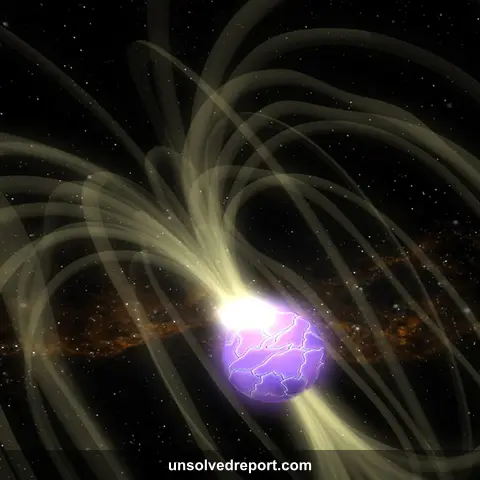
SGR 0501+4516: The Roaming Magnetar With No Birthplace
Hubble tracked SGR 0501+4516 for a decade and its birthplace vanished — no supernova shell, no star cluster, nothing. So where was it actually born?
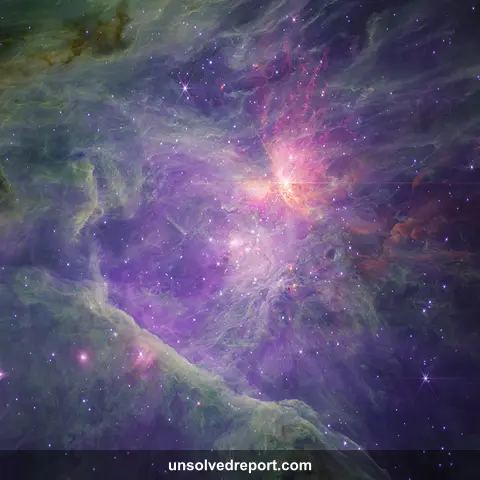
JuMBOs: 40 Pairs of Rogue Planets Science Can't Explain
JWST found 40 pairs of Jupiter-mass objects drifting through Orion with no star, no clear origin, and no explanation. So what are the JuMBOs really?