The Great Attractor: The Pull You Can't See or Stop
Something is dragging the Milky Way at 600 km/s toward a spot hidden behind our own galaxy. Astronomers call it the Great Attractor. What is it, really?
Right now, as you read this, you are being dragged across the universe. You can't feel it. You never agreed to it. But the Sun is going with you, and so is the whole Milky Way, and a few hundred thousand galaxies besides — all of us hurtling toward one spot in the sky at about 1.3 million miles per hour. Here's the eerie part: whatever is doing the dragging hides behind a curtain we cannot see through. Astronomers gave it a name worthy of the strangeness. They call it the Great Attractor.
Don't reach for the doomsday button. This isn't science fiction, and nothing is coming to get you. It's one of the most carefully measured puzzles in all of cosmology — and when you ask what's actually out there, the honest answer is still, in part, we're working on it.
The facts we can stand on
Back in the late 1970s and 1980s, astronomers were clocking the motions of galaxies when they hit something that simply shouldn't have been there. Strip away the smooth, even expansion of the universe, and our entire cosmic neighborhood still had an extra drift — a shared lean, all in one direction, as if everything nearby were quietly sliding down the same hill.
In 1986, a team of seven astronomers — nicknamed the "Seven Samurai" — pinned it down. David Burstein, Roger Davies, Alan Dressler, Sandra Faber, Donald Lynden-Bell, Roberto Terlevich, and Gary Wegner took distance estimates for around 400 elliptical galaxies and found them all streaming toward one shared gravitational focus, a whole vast region pouring toward a single point (Wikipedia, "Great Attractor"). That point got the name: the Great Attractor.
Here's what the measurements really say.
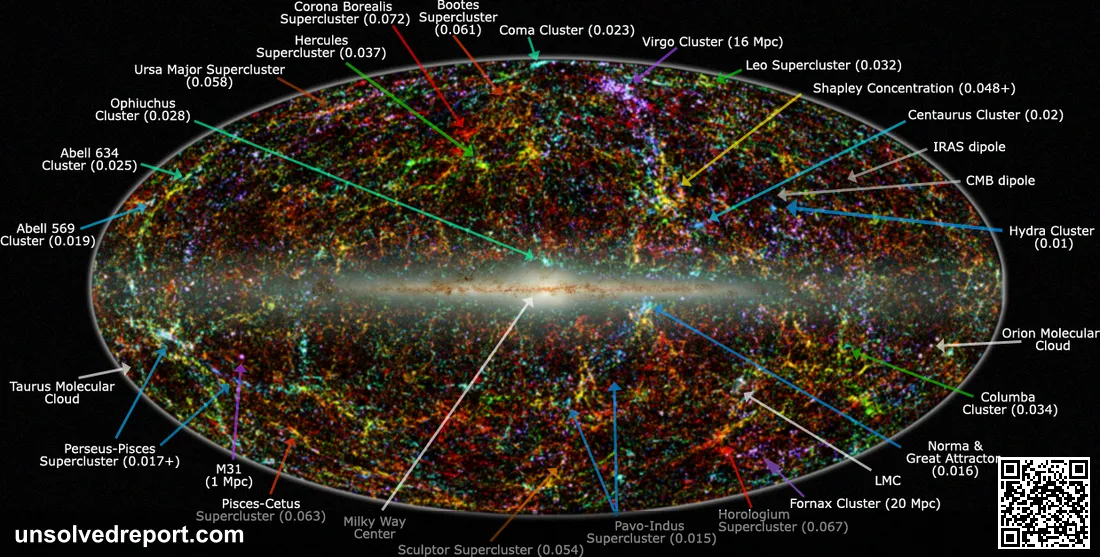
- We are moving, and fast. The Milky Way and its companions — the Local Group — clock about 600 kilometers per second against the cosmic microwave background, the faint afterglow of the Big Bang that gives us a fixed yardstick to measure motion. Aim that drift, and it points toward the southern constellations of Norma and Triangulum Australe (BBC Sky at Night Magazine). Sharper modern numbers push the Local Group's speed to roughly 620 kilometers per second (Wikipedia, "Dipole repeller").
- It's surprisingly close. By cosmic standards, anyway. The Great Attractor sits somewhere between 150 and 250 million light-years away (Wikipedia, "Great Attractor").
- And it's hiding behind us. The pull points straight into the Zone of Avoidance — the stripe of sky smothered by the dust, gas, and glare of our own Milky Way's disk. The BBC says it plainly: this is "that part of space where we can't see anything because it's blocked by the light of the Milky Way" (BBC Sky at Night Magazine).
- X-rays slipped past the curtain. Visible light gets swallowed by all that dust. X-rays don't — they punch through. And when astronomers looked in X-rays, the region lit up around the Norma Cluster (catalogued as Abell 3627), a massive, dust-shrouded swarm of galaxies about 220 million light-years away (Wikipedia, "Norma Cluster").
Then, in 2014, a team led by R. Brent Tully zoomed all the way out. By tracking the velocities of thousands of galaxies, they drew the borders of our home supercluster — the Laniakea Supercluster — defining it as the entire "basin of attraction" flowing toward the Great Attractor (Tully et al., Nature, 2014, summarized by National Geographic). Laniākea is Hawaiian for "immense heaven." It holds an estimated 100,000 galaxies and runs about 400 million light-years across. And here's the twist that reframes everything: in this picture, the Great Attractor isn't an object at all. It's a place — the low point of a gravitational valley, with our entire supercluster pooled at the bottom.
The question nobody can close
Tidy so far. Now the part that has outlived the Seven Samurai themselves: everything we can see still doesn't explain how hard we're being yanked.
When the Great Attractor was first proposed, early estimates pointed to a heap of mass on the order of 10^16 solar masses — ten thousand trillion Suns (Wikipedia, "Great Attractor"). So astronomers went and counted the galaxies actually visible out there. The total came up short. A 2005 analysis went further, pegging the Great Attractor's local mass at roughly one-tenth of that original figure (Wikipedia, "Great Attractor"). The Norma Cluster is genuinely enormous — but on its own, it just doesn't seem heavy enough to whip an entire supercluster along at 600 kilometers per second.
Think of it this way: the gas pedal is mashed to the floor, but pop the hood and the engine looks too small for the job. Something else is adding to the pull, and astronomers have spent decades fighting over what — and over how much of our motion comes from the Great Attractor versus things lurking far beyond it. As R. Brent Tully put it in 2022, "the nature of that source has been obscure" for more than 30 years (University of Hawaiʻi News). The Zone of Avoidance keeps a slice of the answer permanently dimmed — which is exactly why this is still an open case, not a solved one.
The leading suspects
What follows are the leading scientific interpretations. Where the evidence is still being weighed, it's flagged as such.
Suspect one: it's really the Shapley Supercluster behind the curtain (well supported). Look straight past the Great Attractor — about three times farther out — and you hit the Shapley Supercluster, the densest known pileup of galaxy clusters anywhere in the nearby universe. A lot of researchers now think much of our motion is the Great Attractor and the far-off Shapley pulling in the same direction at once, so the two simply stack (Scientific American). One estimate hands about 44% of the Local Group's CMB-frame motion to the Great Attractor region and about 30% to Shapley, with the rest scattered across other distant clumps. Those percentages are still argued over — treat them as best guesses, not gospel.
Suspect two: we're being pushed as much as pulled (a striking newer idea). In 2017, a team led by Yehuda Hoffman floated the Dipole Repeller: a vast, near-empty stretch of space — a supervoid — sitting on the opposite side of the sky (Nature Astronomy, 2017, via Sky & Telescope). Empty space can't literally shove anything. But a region starved of matter pulls back less than the crowded regions hemming it in, so we drift away from the void. Picture a tug-of-war: Shapley and the Great Attractor hauling from one side, the under-stuffed void effectively "repelling" from the other. On this model, our velocity splits about evenly between the two.
Suspect three: it's a mix — and Laniakea may not be the last word. A 2022 study that rebuilt the orbits of 10,000 galaxies handed astronomers "the first good look at this previously enigmatic region" (University of Hawaiʻi News). Some researchers now suspect Laniakea itself is just a wrinkle inside an even bigger basin of attraction — and that our supercluster isn't gravitationally bound at all, and will one day come apart. This rethink is still in motion, and not everyone is sold.
And what it is not. Despite that ominous name, the Great Attractor is not going to "eat" the Milky Way. The universe's expansion is speeding up, and on the largest scales that expansion is expected to win — towing distant superclusters apart faster than gravity can ever reel them back (Space.com). We are being pulled. We will almost certainly never arrive.
And maybe that's the most wonderful thing about it. This isn't a mystery wrapped in cosmic conspiracy. It's hidden by dust — the plain old dust of our own galaxy, the same stuff that lets us exist at all, parked between us and the answer like a smudge on a window. We're detectives, reading the motion of the heavens to fingerprint a culprit we've never clearly seen. The pull is real. The case is still open — just one entry in the growing list of cosmic mysteries even the best telescopes can't crack. And somewhere behind that smudge, the universe is keeping its next secret warm.
Sources and Further Reading
- Wikipedia: Great Attractor
- Wikipedia: Laniakea Supercluster
- Wikipedia: Norma Cluster
- Wikipedia: Dipole Repeller
- BBC Sky at Night Magazine: What is the Great Attractor?
- National Geographic: New Map Locates Milky Way in Neighborhood of 100,000 Galaxies (Laniakea)
- University of Hawaiʻi: Astronomers trace galaxy flows across 700 million light years (2022)
- Sky & Telescope: Cosmic Void "Pushes" Milky Way (Dipole Repeller)
- Scientific American: How Astronomers Found Our Cosmic Address
- Space.com: Will the Great Attractor Destroy Us?
Great Pyramid's Big Void: A 100-Foot Room No One Has Entered
ScanPyramids detected a 100-foot void hidden inside the Great Pyramid in 2017 — and no human has ever seen inside it. So what's really in there?
Plane of Satellite Galaxies Problem: A Puzzle No One Can Crack
Plane of satellite galaxies problem: tiny galaxies orbit the Milky Way and Andromeda in flat, spinning discs cosmology says shouldn't exist. Why?
Repeating Fast Radio Bursts: Some Run on a 16-Day Clock
Most fast radio bursts flash once and vanish. A rare few — repeating fast radio bursts — come back on a schedule. Why? Nobody can fully explain it yet.