Saddle Ridge Hoard: $10M in Buried Gold Nobody Can Explain
The Saddle Ridge Hoard: $10M in gold coins dug up under a California tree in 2013. We know everything about it — except who buried it, and why.
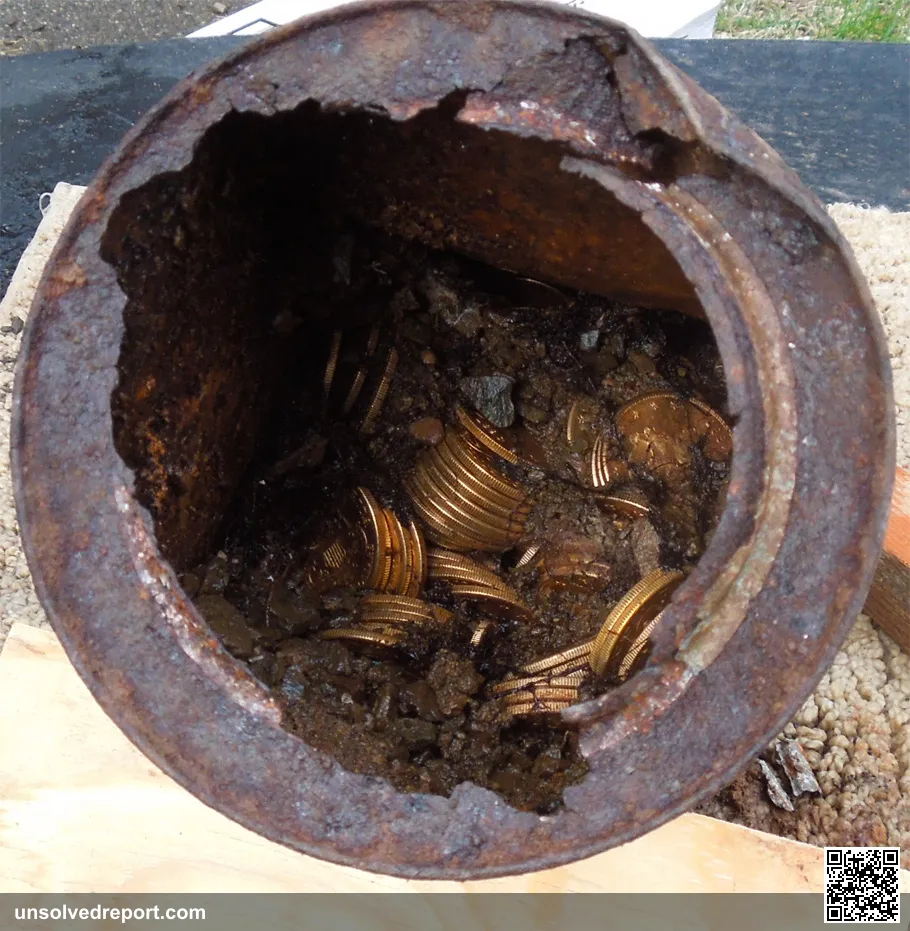
February 2013. A couple is walking their dog across their own land in California's Gold Country when one of them spots a rusted can poking out of the dirt under an old tree. They pry it loose. It's heavy — too heavy for an empty tin. And there, catching the light at the rim, is the edge of a gold coin.
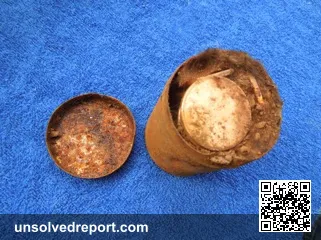
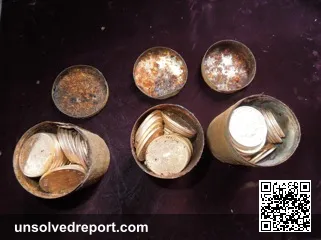
They keep digging. Eight corroded cans come out of that hillside, and inside them: 1,427 nineteenth-century gold pieces. It is the largest buried gold-coin treasure ever recovered in the United States — the kind of jackpot treasure hunters still chase at sites like the reputed Dutch Schultz stash in the Catskills. More than a decade later, the coins have been graded, sold, and scattered to collectors all over the world. And yet the one question that matters is still sitting exactly where it started. Nobody knows who buried them. Nobody knows why.
What We Actually Know
Let's be clear about one thing up front: this is not a hoax. The find is real, well-documented, and authenticated. The coins surfaced in February 2013 on private property in Northern California, dug up by a couple the numismatic firm Kagin's would only call by the pseudonyms "John and Mary" — fake names, chosen to guard their privacy and their safety, according to the Smithsonian's National Museum of American History (americanhistory.si.edu).
Now the numbers. The hoard held 1,427 coins — $20 double eagles, $10 eagles, and $5 half eagles — adding up to a face value of $27,980. They were minted between 1847 and 1894, most of them at the San Francisco Mint, per the Smithsonian and Coin World (coinworld.com). All of it had been packed into eight metal cans and lowered into the ground. The finders gave the treasure a name — "Saddle Ridge" — after a striking rock formation on their property.
Here's the part that stuns the coin world. Many of these pieces came out of the dirt in jaw-dropping condition. The Professional Coin Grading Service (PCGS) authenticated the hoard and found that more than a dozen of the coins were either the finest known examples of their type, or tied for it (pcgs.com). The crown jewel was a single 1866-S "No Motto" double eagle — a $20 coin struck before the words "In God We Trust" were ever stamped onto the design — graded PCGS MS62, the finest known of its variety (pcgs.com). Kagin's put the total market value at more than $10 million.
The burial was a secret. The sale was anything but. Starting May 29, 2014, Kagin's offered the coins in an unusual deal with Amazon.com — a splashy, high-profile online numismatic sale. And buyers pounced. The History Blog reported that hundreds of coins sold within hours, with one batch of 225 coins hitting $2.4 million by midnight (thehistoryblog.com). The finders said they'd keep a few coins for sentimental reasons, pay off debts, and give to local charities, the Smithsonian noted.
Then came the part nobody dreams about when they picture finding treasure: the tax bill. Because the coins counted as "treasure trove," the IRS treats them as taxable income in the year the finders took undisputed possession — whether or not they sold a single coin — a rule that goes back to a 1969 federal court ruling (time.com). Reporting at the time figured the couple might owe roughly half the value once you stacked up federal and state taxes. Still, the gold was on their own land, and it was plainly old enough that any original owner had been dead for generations. No rival claimant ever stepped forward. The hoard was legally, fully theirs.
The Question That Won't Go Away
So here's the riddle that has never been cracked: who took 1,427 gold coins, gathered over nearly half a century, sealed them in cans, and buried them on a lonely hillside — and then never came back for them, the same vanishing act pulled off by whoever hid the fortune behind the Beale Ciphers?
The dates are the eeriest clue of all. This wasn't a single fat stack of fresh currency. It was a collection, built up across decades — 1847 all the way to 1894. That slow accumulation points to someone — or maybe a chain of someones — feeding a cache year after year, not a thief dumping the take from one big score. And whoever it was clearly meant to return. You don't bury gold under a marked tree and a named rock unless you're planning to dig it up again. But they didn't. No note. No map. No descendant who has ever come forward with the story. The land's ownership history coughs up no obvious answer either.
It's worth drawing a clean line between mystery and myth here. The burial itself is documented fact. The identity and the motive of the person who buried it are simply unknown — and no reputable authority has ever filled that blank with a confirmed name.
So Who Did It? The Theories
Theory 1 — The 1901 Mint heist (investigated, then rejected). The story that spread fastest said the coins were loot from Walter Dimmick, a San Francisco Mint clerk convicted of swiping about $30,000 in gold in 1901. Tidy. Dramatic. And wrong. Investigators went looking and shut it down. U.S. Mint deputy director Adam Stump said there was nothing linking the hoard to any theft at any Mint facility, and researchers Richard Kelly and Nancy Oliver showed exactly why the timeline collapses: Dimmick stole from a working cashier's vault that would have held only coins dated 1900 or 1901, and he grabbed double eagles only — while the Saddle Ridge coins span 1847–1894 and come in several denominations (coinworld.com). Treat this one as dead.
Theory 2 — Outlaw loot (folklore, no evidence). The romantic version pins the gold on legends like Jesse James or the stagecoach bandit Black Bart, both of whom were active in or around the era. It's a great campfire story. It's also just a story — there's no evidence tying either man to the hoard. File it under legend.
Theory 3 — A nervous saver who didn't trust banks (plausible, unproven). Plenty of coin experts think the dullest explanation is the likeliest one: a nineteenth-century person — maybe a miner chasing a claim as elusive as the Lost Dutchman Mine, a merchant, a rancher — who quietly squirreled away gold over decades and buried it for safekeeping in an age of bank failures and money panics, then died or was somehow stopped from ever getting it back. That long, drawn-out spread of dates fits this picture far better than any robbery. But it's an interpretation, not a proven fact.
The honest truth? The Saddle Ridge Hoard is solved as an object and unsolved as a story — unlike the Gardner Museum heist, where even the objects themselves are still missing. We know precisely what was found, what it was worth, and where it all went. What we don't know is whose hands first dropped those cans into the California soil — and unless some long-lost letter or land record surfaces, we may never find out. For now, the hillside is still holding on to its one last secret.
Sources & Further Reading
- Smithsonian National Museum of American History — "Discovering the Saddle Ridge Hoard": americanhistory.si.edu
- PCGS — "PCGS Certifies $10+ Million Gold Coins Treasure for Kagin's Inc.": pcgs.com
- PCGS CoinFacts — 1866-S $20 No Motto (Saddle Ridge Hoard): pcgs.com
- Coin World — "Saddle Ridge gold hoard found in California": coinworld.com
- Coin World — "Mint, researchers dispel Saddle Ridge rumor": coinworld.com
- The History Blog — "Half of Saddle Ridge Hoard coins sold in 72 hours": thehistoryblog.com
- Time — "Couple Finds Gold Coins: When Finders-Keepers Is Legally Sound": time.com
- National Geographic — "Who Buried the $10 Million in Coins Found By a California Couple — and Why?": nationalgeographic.com
- CNN — "Could century-old theft explain mystery of gold coins?": cnn.com
Pereshchepina Treasure: 800 Objects, One Unproven Royal Grave
75kg of gold and silver, 800+ objects, one boy's stubbed toe in 1912 — is the Pereshchepina Treasure really Khan Kubrat's grave? The evidence still splits historians.

São João Shipwreck 1552: The Treasure No One Has Ever Found
One of the richest ships to ever sail from India broke apart on a wild African coast in 1552. Her treasure vanished. Nobody has ever found it — why?
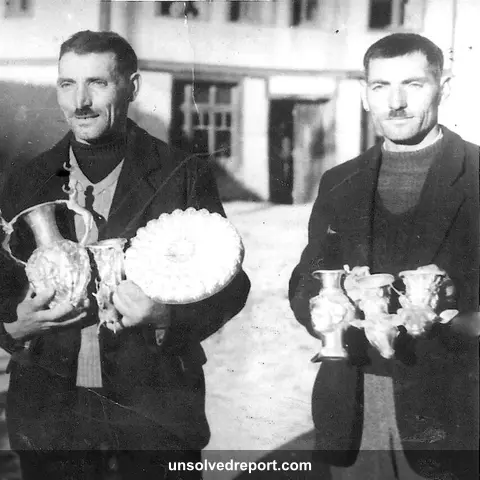
Panagyurishte Treasure: Solid Gold Mistaken for Whistles
Three brothers digging clay in 1949 Bulgaria pulled nine solid-gold vessels from the ground and reportedly tried to blow into them like whistles. Who buried them, and why did they never come back for the gold?