Great Pyramid's Big Void: A 100-Foot Room No One Has Entered
ScanPyramids detected a 100-foot void hidden inside the Great Pyramid in 2017 — and no human has ever seen inside it. So what's really in there?
For more than four thousand years, the Great Pyramid kept its secrets in plain sight. The map seemed finished. A Grand Gallery. A King's Chamber. A Queen's Chamber. The corridors stitching them together. Every textbook drew the same picture, and nobody expected the picture to change.
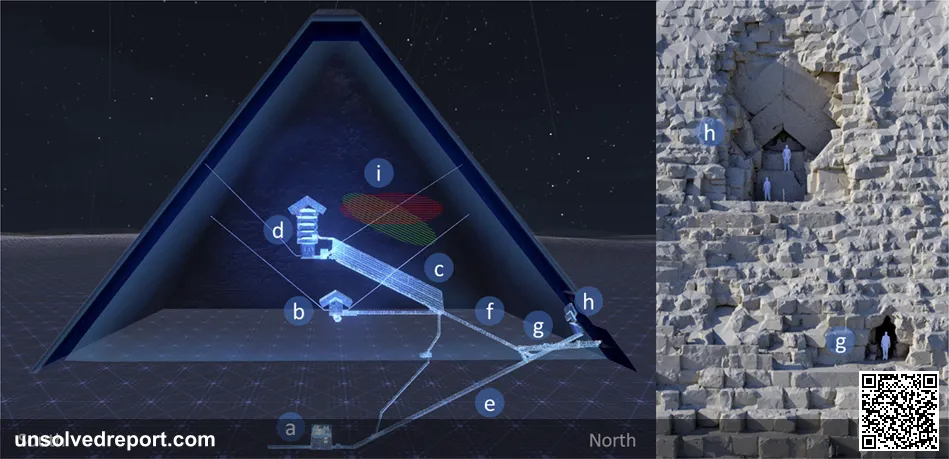
Then, in 2017, a team of physicists did something no tomb robber, no archaeologist, no curious king had ever tried. They aimed invisible particles from outer space straight through the mountain of stone. And the particles came back with a story. High above the soaring Grand Gallery, sealed inside solid limestone, was a space at least 100 feet long that no human is known to have set foot in. The scientists gave it a flat, almost shy name: the "Big Void."
Nearly a decade later, here's where we stand. We know it's there. We still have no idea what it's for.
What we actually know
The discovery grew out of ScanPyramids, a scientific mission that launched on October 25, 2015, under the authority of Egypt's Ministry of Antiquities. The Faculty of Engineering of Cairo University and the French HIP Institute (Heritage, Innovation and Preservation) designed and ran it together, with one rule baked in from the start: probe the largest Old Kingdom pyramids without "drilling the slightest opening" (ScanPyramids launch announcement; Wikipedia: ScanPyramids). No tunnels. No damage. Just looking — through stone.
So how do you see inside a wall the height of a 40-story building? You let the sky do it for you.
The trick is called muon radiography. Muons are charged particles born when cosmic rays from space slam into the upper atmosphere. They rain down on us constantly, day and night, and the strange part is they pass right through stone — but dense rock soaks up more of them than empty air does. Put detectors inside and around the pyramid, count how many muons arrive from each direction over months, and the hollow spots light up: more muons get through where there's nothing to stop them (Science News). The pyramid, in effect, took its own X-ray.
Now here's what makes this finding so hard to wave away. Three separate teams, using three completely different detector technologies, found the exact same anomaly in the exact same place. Nagoya University laid nuclear emulsion films in the Queen's Chamber. Japan's KEK organization set scintillator hodoscopes in the same room. And France's CEA (Alternative Energies and Atomic Energy Commission) parked gas detectors outside the pyramid altogether (arXiv preprint of the Nature paper, 1711.01576). Three methods. One answer. A large cavity, hovering above the Grand Gallery.
The results landed in the peer-reviewed journal Nature on November 2, 2017, and the language was careful, almost understated. The team reported "a large void (with a cross section similar to the Grand Gallery and a length of 30 m minimum)" sitting above the Grand Gallery, and called it "the first major inner structure found in the Great Pyramid of Khufu since the 19th century" (Nature, Morishima et al. 2017, via ADS; arXiv abstract). Thirty meters is roughly 98 to 100 feet. To picture it, look at the Grand Gallery just below: about 47 meters long and 8.6 meters tall. The Big Void is a space on that same grand scale.
But notice what the scientists did not do. They didn't claim to know what it was. The published abstract says flatly that there is "currently no information about the role of this void," and presents the work as a showcase for how particle physics can crack open archaeology — not as the discovery of a tomb, a treasure, or a hidden king (arXiv abstract).
One more thing, because people mix this up constantly. The Big Void is not the same as a second, smaller ScanPyramids find. In March 2023, the team confirmed a "North Face Corridor" — a passage roughly 9 meters long and about 2 by 2 meters, tucked behind the distinctive chevron blocks on the pyramid's north face. They threaded a 6-millimeter endoscope through a gap in the masonry to look, and CEA physicist Sébastien Procureur said the first images "seem to show there is nothing" inside (Live Science). Different space. Different story. Keep them separate.
The question nobody can answer yet
Here's the part that still hasn't been cracked. The North Face Corridor has been seen — there's a camera, there are pictures. The Big Void has not. As far as the published record goes, no endoscope, no drone, no human has ever entered the Big Void, joining the ranks of history's untouched enigmas like the sealed tomb where rivers of mercury still flow. Everything we know about it, we know from the way muons slip through it (Wikipedia: ScanPyramids). We have detected a room without ever seeing it.
Which leaves even the simplest questions wide open — the Big Void now sits among 15 ancient mysteries archaeologists still can't explain. Mehdi Tayoubi, president of the HIP Institute and a co-author of the study, laid out the mystery without flinching: "We don't know for the moment if it's horizontal or inclined, [or] if it is made from one structure or several successive structures" (National Geographic). Read that again. The Big Void might be one long chamber — or a string of smaller spaces that the muons smear together into a single blur. Its tilt, its true shape, and above all its purpose are genuinely unknown. The void is real. Its meaning is not.
So what is it? The leading theories
What follows are educated guesses from Egyptologists and the research team. None has been confirmed, and the people who found it are the first to say: slow down.
Theory 1: It's a leftover from building, not a hidden room. This is the favorite among archaeologists. Cambridge Egyptologist Kate Spence told National Geographic the space might relate to an internal ramp used during construction to haul the massive granite roof blocks into place. Egyptologist Salima Ikram pointed out that sitting directly above the Grand Gallery, it may have helped build that gallery in the first place (National Geographic). In this view, the Big Void isn't a secret at all — it's a fingerprint of how the pyramid was engineered.
Theory 2: It's there to take the strain. A close cousin of that idea: voids above big galleries may have helped spread the crushing weight of all that overlying stone — much like the known relieving chambers stacked above the King's Chamber. It's a reasonable guess. It's still just a guess, waiting on someone to actually look inside.
Theory 3: It's a real, undiscovered chamber. This is the one that sets imaginations on fire — a sealed burial space, a hidden room of religious meaning, the same kind of hope that has driven the 20-year search for Cleopatra's tomb at Taposiris Magna. Be clear-eyed here: there is no evidence for any of it. The 2023 corridor investigation turned up nothing supporting hidden burial chambers tied to Khufu's tomb, and the Big Void's purpose has never been shown. Thrilling? Yes. Proven? Not even close.
And tellingly, the experts closest to the work are the most cautious of all. Ikram gave maybe the most honest line in the whole saga: "I don't think it's ever too early to speculate, but you might be widely wrong" (National Geographic).
That tension is exactly what makes the Big Void so addictive. We have rigorous, peer-reviewed, independently replicated proof that a 100-foot space sits deep inside the most studied building in the ancient world — and we still cannot say, with confidence, why it's there. Skeptics doubted the team's interpretations at first, but the value was hard to argue with; after the North Face Corridor was inspected, even longtime critic Zahi Hawass admitted ScanPyramids had made a "major discovery" (Wikipedia: ScanPyramids).
So the void waits, exactly as it has for over four thousand years — much like the cliff tomb that hid 50 pharaohs waited in silence before its secret finally surfaced — except now we know it's there, holding its breath in the dark. The last chapter, the one where someone finally looks inside, hasn't been written yet. What do you think is waiting in it?
Sources & Further Reading
- Morishima, K., Tayoubi, M., et al. "Discovery of a big void in Khufu's Pyramid by observation of cosmic-ray muons." Nature, November 2, 2017. Abstract via NASA ADS | Open-access preprint, arXiv:1711.01576
- National Geographic, "Mysterious Void Discovered in Egypt's Great Pyramid." Link
- Live Science, "Cosmic rays reveal 'hidden' 30-foot-long corridor in Egypt's Great Pyramid." Link
- Science News, "Muons unveiled new details about a void in Egypt's Great Pyramid." Link
- ScanPyramids project launch announcement (October 2015). PR Newswire
- Wikipedia, "ScanPyramids" (overview and North Face Corridor details). Link
Plane of Satellite Galaxies Problem: A Puzzle No One Can Crack
Plane of satellite galaxies problem: tiny galaxies orbit the Milky Way and Andromeda in flat, spinning discs cosmology says shouldn't exist. Why?
Repeating Fast Radio Bursts: Some Run on a 16-Day Clock
Most fast radio bursts flash once and vanish. A rare few — repeating fast radio bursts — come back on a schedule. Why? Nobody can fully explain it yet.
Fast Radio Bursts: The Flash With 3 Days of the Sun's Power
A fast radio burst crams 3 days of the Sun's energy into one millisecond, then vanishes. We've caught thousands. So what in the universe is firing them?