Costa Rica's Stone Spheres: The Balls the Bulldozers Almost Erased
Costa Rica's stone spheres: carved without metal tools, unearthed on a banana plantation, then dynamited by treasure hunters. What were they really for?
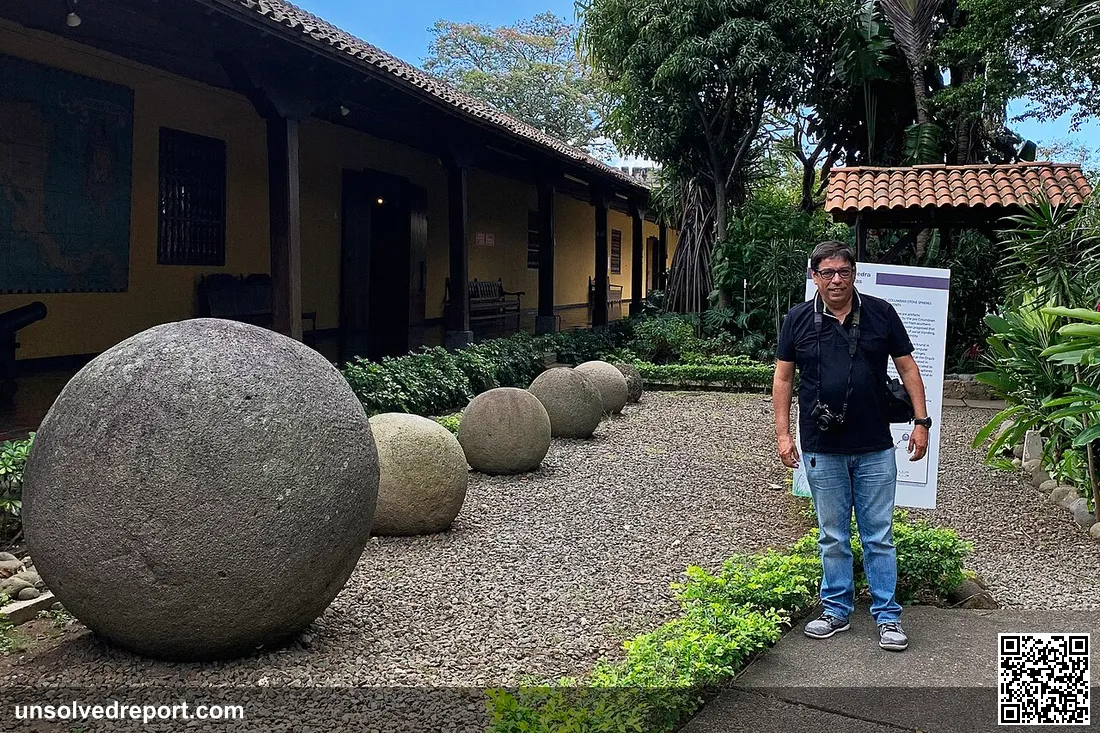
The 1930s. Southern Costa Rica. Crews from the United Fruit Company are hacking back dense jungle in the Diquis Delta to plant bananas - and the forest starts handing them something it has no business hiding. Stone balls. Some no bigger than an orange. Others taller than a grown man and heavy as a truck. Round - startlingly, almost impossibly round - and they are everywhere.
Here's where the story turns dark. The workers got an idea: balls this perfect must be hollow, and hollow things hide gold. So they drilled into them. Packed them with dynamite. Blew them open to check. Others were just shoved aside by bulldozers, or rolled off to decorate someone's lawn or a government plaza. By the time anyone studied them seriously, many of the finest spheres on Earth had already been cracked, carted off, or scattered in pieces.
The survivors are now among the most celebrated archaeological objects in the Americas: the stone spheres of Costa Rica, also called the Diquis spheres. They are genuinely remarkable. They are also - and this part the internet hates to admit - far better understood than the legends let on.
What We Actually Know
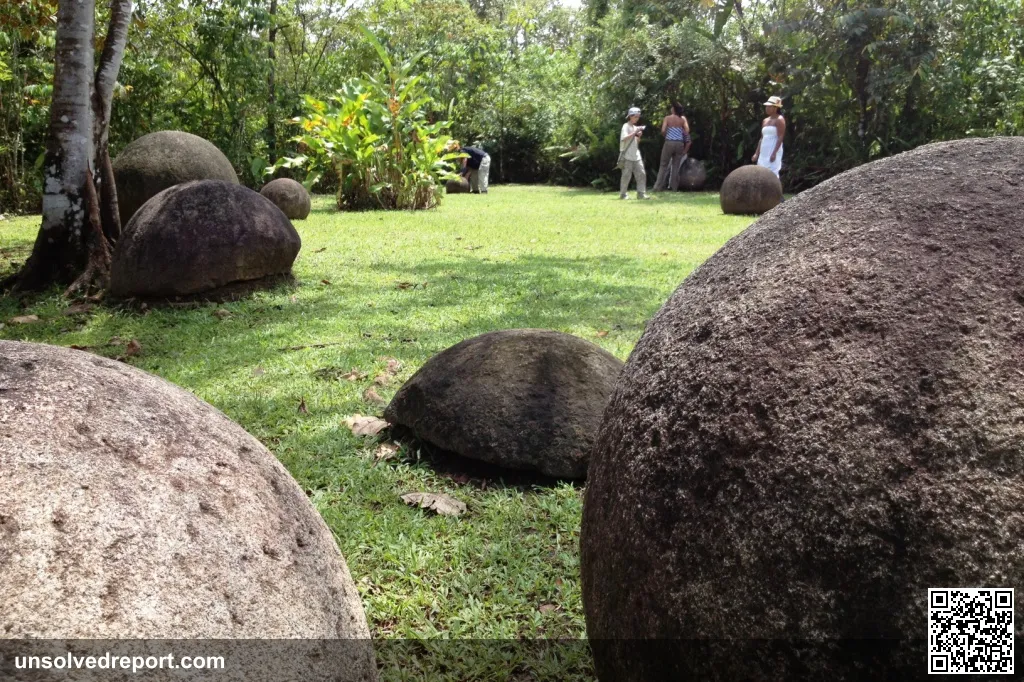
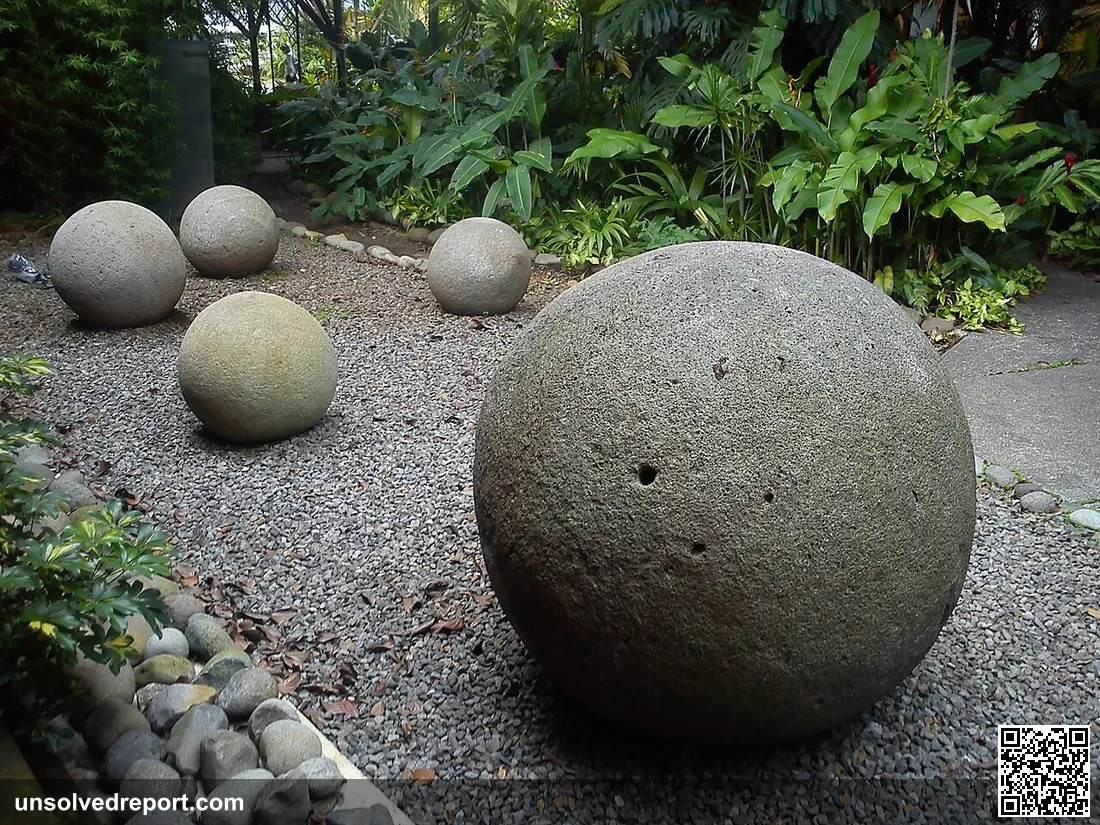
Start with the numbers, because they're wild on their own. Over 300 documented spheres, packed into the Diquis Delta of southern Costa Rica and out on the offshore Isla del Cano. They run from a few centimeters across all the way up to giants measured at roughly 2.6 meters in diameter and weighing on the order of 15 tons, according to Wikipedia's catalog of the sites. Fifteen tons. A single ball.
Most are carved from gabbro - a coarse, grainy igneous rock, a cousin of basalt. And it didn't come from where the spheres ended up. The rock was sourced from the foothills of the Talamanca range and hauled, sometimes for many kilometers, down to the flat deltaic lowlands where it was finished and arranged. A smaller number were made from limestone or sandstone.
Now the part that kills every "ancient mystery" headline: archaeologists know roughly how they were made. No metal. No magic. The makers had no metal tools at all. Instead, as summarized by the Metropolitan Museum of Art, they wrestled raw boulders into shape with a slow, stubborn three-step routine:
- Controlled fracture and pecking - battering the rock with harder hammerstones, knocking it down toward a rough ball,
- Grinding and abrasion - patiently wearing away the high spots,
- Polishing with sand and water - rubbing the surface to its final glassy smoothness.
The results can be astonishingly regular - some spheres miss being a true ball by only a tiny percentage. Impressive? Absolutely. Beyond human hands? Not even close. That's exactly what skilled artisans can pull off working by eye, by hand, over a very long time. The roundness is a triumph of craft and patience - not a calling card from somewhere else.
Sit with what that craft really cost. Gabbro is hard, dense, unforgiving. Turning a rough boulder into a smooth ball meant landing an enormous number of careful blows - each one carrying the same quiet terror: one bad strike could split the whole stone and erase months of work in a heartbeat. The maker had to judge the curve by eye alone, rotating the boulder, checking it, shaving down the bumps, creeping toward a perfect round. Then came the polishing - weeks more of slow grinding with sand and water. One big sphere was a massive collective bet of time and skill. Which tells you something on its own: these things mattered, enormously, to the people who made them.
The transport is just as loud a clue. The gabbro sits in the Talamanca foothills - but the finished spheres turned up kilometers away, out on the flat delta. So picture the job: quarry or pick out boulders up in the highlands, then move multi-ton stones across rivers and lowland terrain - almost certainly by human muscle, ropes, levers, maybe wooden rollers or sledges. You don't do that by accident. That kind of operation needs leaders, planning, and a lot of organized hands - exactly the chiefdom structure archaeology has found in the region all on its own.
Who Made Them - and When
The spheres belong to the Diquis culture and the chiefdom societies that came before it, the indigenous people of the region. Pinning down a date is the tricky part, because stone can't be radiocarbon-dated - the rock keeps no clock. So archaeologists date the spheres by their neighbors instead: the pottery, charcoal, and buildings found around them.
Read that way, most of the sphere-making lands in the stretch from roughly 500 to 1500 CE - what archaeologists call the Aguas Buenas and Chiriqui periods - with the great majority of survivors made after about 1000 CE. The site that anchors all of this is Finca 6, where spheres still rest close to where they were originally placed.
And that detail matters more than almost anything else here. So many spheres were dragged off before anyone studied them that finding one in situ - right where it was left - is precious. At Finca 6 and nearby sites, the spheres appear set out in lines and clusters near the homes of elites. That's why most researchers read them as markers of status, power, and social order - monumental statements made by chiefly societies - rather than tools, calendars, or maps. What exactly they meant, though? Still honestly unknown.
In June 2014, UNESCO made it official, inscribing the Precolumbian Chiefdom Settlements with Stone Spheres of the Diquis on the World Heritage List - bundling four sites together: Finca 6, Batambal, El Silencio, and Grijalba-2. The first cultural World Heritage site in all of Costa Rica, per the UNESCO listing. That same year, the country took the spheres to heart, stamping them onto currency and folding them into the national imagination.
The research backstory is worth knowing, because it explains why our knowledge is both real and maddeningly incomplete. Serious study kicked off with archaeologists Samuel Lothrop and Doris Stone in the 1940s, working partly from the very spheres United Fruit's clearing had exposed. Their fieldwork - summarized in references like the Smithsonian-affiliated literature - locked down the basics: the spheres were indigenous, pre-Columbian, made by local hands. Later waves of Costa Rican and international archaeologists, digging at Finca 6 and the other delta sites, filled in the timeline and the social picture. But because so much was wrecked before science showed up, every undisturbed sphere is a small rescue of information that was nearly lost forever.
The Questions That Are Actually Open
Here's the honest part. What's still unresolved isn't whether humans made the spheres - they plainly did. It's the finer points:
- What did they mean, and what were they for? Pure status symbols? Astronomical or directional markers? Ceremonial objects? Some mix of all three? The neat lines hint at something, but they don't settle it.
- The exact timeline. With nothing on the stone itself to date, the chronology leans on the stuff buried alongside it - leaving wiggle room about when sphere-making began and when it peaked.
- The lost context. This is the heartbreaker. So many spheres were relocated in the 20th century that a huge amount of the spatial information - the where and next to what that could have answered the other questions - was destroyed before anyone wrote it down. We're piecing together a puzzle whose pieces were literally scattered by bulldozers.
Those are the questions a careful archaeologist will actually argue about. Modest. Specific. And a very long way from cosmic.
The Fringe Theories - Named Out Loud
The spheres have been dragged into a mountain of pseudo-archaeology, and it deserves to be called out plainly. They've been pinned on the lost continent of Atlantis. On extraterrestrial visitors. On the lazy idea that no "primitive" society could ever have hit such precision. Anthropologist John Hoopes of the University of Kansas - one of the world's leading specialists on the spheres - has spent years swatting down exactly these myths, pointing out in interviews and in writing for outlets like History that there's no credible evidence for any of it.
The whole pseudoscience pyramid balances on one cracked brick: the belief that near-perfect roundness must be beyond ancient hands. It isn't. Stoneworkers all over the world figured out, independently, how to shape hard rock with patience and abrasives, and the Diquis spheres sit comfortably inside human ability. And that "supernaturally perfect" claim? It tends to crumble the moment you pull out a measuring tape. They're very round - but they're handmade, with exactly the small imperfections handmade things carry.
It's also worth facing the source of the modern hype head-on. A lot of it traces back to fringe writers like Erich von Daniken, whose "ancient astronaut" books treated every impressive non-European monument as proof of alien meddling. That framing isn't just wrong - it carries an ugly idea underneath it: that the indigenous peoples of the Americas couldn't have built sophisticated things on their own. Hoopes and other archaeologists have said it flat out - that's not only unscientific, it's quietly insulting to the descendants of the people who actually made the spheres. Run the same logic at a European monument like Stonehenge and nobody would tolerate it for a second. Which is exactly why specialists treat it as a bias to be named, not a hypothesis to be tested.
There's a cousin myth too: that the spheres are arranged to encode astronomical alignments or some lost map. The honest answer is that we mostly can't even test this - because the great majority of spheres were shoved out of place before anyone recorded where they sat. The handful still standing at Finca 6 do show deliberate lines and clusters - but nothing anyone has proven to be an astronomical instrument. Strip away the lost context, and sweeping geometric claims are just guesswork wearing the costume of discovery.
Why the Spheres Still Grip Us
Clear away the Atlantis and the aliens, and what's left is better than any fantasy. A society that quarried hard igneous rock up in the mountains, moved multi-ton boulders down into the lowlands, ground them into monumental spheres by hand, and then set them in deliberate arrangements to broadcast authority across the land. That's real engineering. Real organization. Real art. The achievement of indigenous Costa Ricans - work that was nearly erased twice: once by dynamite and bulldozers, and again by myths that refused to give them the credit. Telling the true story hands it back.
And that's the eerie thing about it. The deepest mystery here was never how the balls were made. It's how close we came to never knowing - and how many other quiet wonders are still out there, waiting under someone's plantation, one careless blast away from being lost.
Sources & further reading
- Stone spheres of Costa Rica - Wikipedia - https://en.wikipedia.org/wiki/Stone_spheres_of_Costa_Rica
- A Stone Sphere from Costa Rica - The Metropolitan Museum of Art - https://www.metmuseum.org/perspectives/stone-sphere-costa-rica
- What Are the Mysterious Stone Spheres of Costa Rica? - HISTORY - https://www.history.com/articles/stone-spheres-costa-rica
- Precolumbian Chiefdom Settlements with Stone Spheres of the Diquis - UNESCO World Heritage - https://whc.unesco.org/en/list/1453/
- Mysterious stone spheres in Costa Rica investigated - ScienceDaily - https://www.sciencedaily.com/releases/2010/03/100322143217.htm
Shigir Idol Mystery: The 12,500-Year-Old Face No One Can Read
The Shigir Idol mystery: gold miners pulled this 12,500-year-old wooden god from a Russian bog. It's covered in faces nobody can read. What is it hiding?
Newgrange: The Tomb That Catches the Sun Once a Year
Older than the pyramids, this Irish mound swallows one winter sunrise a year and aims it straight at the dead. Nobody left a note explaining how, or why.

Longyou Caves: China's 2,000-Year-Old Caverns Nobody Can Explain
In 1992, farmers pumped out a 'bottomless' pond and found a hand-carved underworld with zero written record. Who built it, and why does nobody know?