Western Deffufa: The 4,000-Year Giant That's Almost Solid Inside
The Western Deffufa is a 65-ft mud-brick giant in Sudan that's almost solid inside. So what happened in there? Even archaeologists disagree.
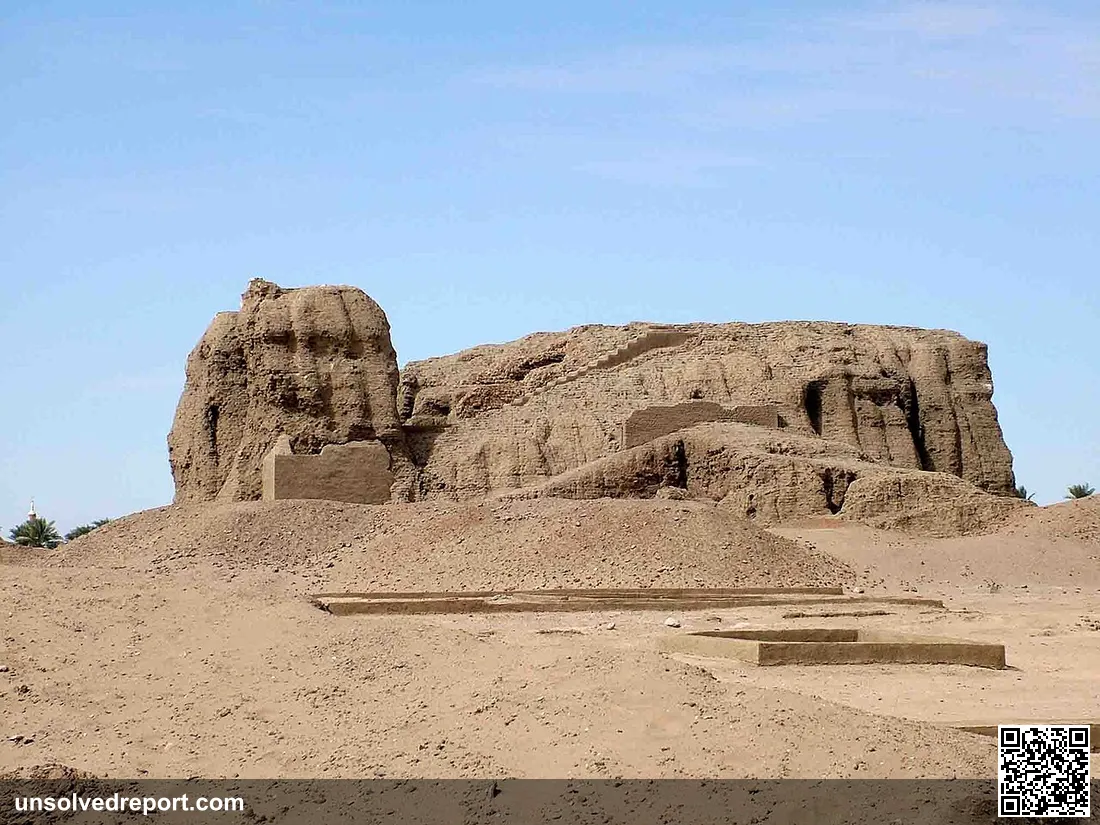
Stand on the flat Nubian floodplain of northern Sudan and one thing breaks the horizon: a hulking brown mass the size of a small office building, shouldering up out of the dirt like a hill someone started and never finished. But it isn't a hill. Nothing about it is natural. People raised it, brick by sun-dried brick, about four thousand years ago — and they were one of the oldest city-building civilizations Africa has ever known. It's still standing. It's one of the biggest mud-brick structures left on the whole continent. And here's the part that keeps gnawing at the experts who've spent fifty years digging around it: the building is mostly not hollow. So what on earth did people actually do inside a giant that has almost no inside?
What We Actually Know
The Western Deffufa rises from the ruins of Kerma, an ancient city on the east bank of the Nile in Upper Nubia. Kerma wasn't some village — it was a capital. The seat of the Kingdom of Kerma, a Nubian power that thrived roughly between 2500 and 1500 BC, and one that scholars routinely call the earliest urban center in Africa outside Egypt (Archaeology Magazine; EBSCO Research Starters). It started life on what was then an island in the Nile, then swelled into a major trade hub, the meeting point where the African interior shook hands with Egypt.
Now picture the monument itself: pure sun-dried mudbrick, top to bottom. The exact size shifts a little depending on how you count the erosion, but the base runs around 50 by 25 meters (call it 52 by 27 meters, or roughly 179 by 89 feet), and what's left of its eroded height reaches about 18 to 19 meters, with older estimates pushing closer to 20 meters (somewhere around 60 to 65 feet) (Wikipedia; EBSCO). The walls are the wild part. They've been reported at up to roughly nine meters thick (EBSCO) — nine meters of solid brick. That sheer bulk is a big reason this thing has shrugged off four thousand years of wind and the rare desert downpour and is still here to confuse us.
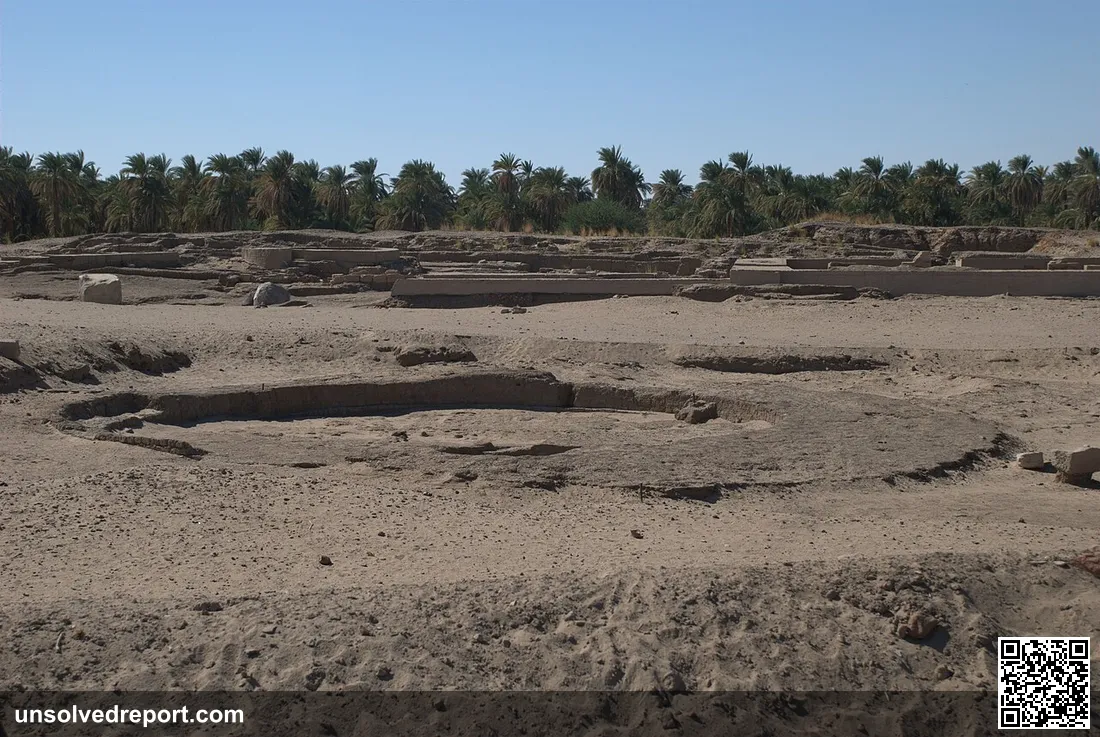
The name itself is a little slippery. "Deffufa" comes either from a Nubian word for a mudbrick building or from the Arabic daffa, meaning "mass" or "pile" (Wikipedia) — which, honestly, "pile" is a fair description. And there isn't just one. There are two of these structures at Kerma. The Western Deffufa stands inside the old town. Its sibling, the Eastern Deffufa, sits about two kilometers away (roughly 1.2 miles), out in the city's enormous cemetery, and most experts read it as a funerary chapel tied to royal burials (Atlas Obscura; Ancient Origins).
Almost everything we understand about this place traces back to one man. Swiss archaeologist Charles Bonnet of the University of Geneva started excavating Kerma in 1976 — fifty years after American Egyptologist George Reisner first put a spade in the ground here back in the 1910s (Archaeology Magazine). And Bonnet's biggest discovery wasn't a wall or a room. It was an idea. His decades of patient digging proved that Kerma "was not merely an Egyptian colony, but had been built and ruled by Nubians" (Archaeology Magazine). Reisner, a century earlier, had squinted at the site through Egyptian eyes and seen an outpost. Bonnet flipped the whole story — revealing a sophisticated African civilization that stood entirely on its own (Archaeology Magazine).
Bonnet showed something else, too: the Western Deffufa was never one building. It grew. It began as a modest little chapel during Kerma's early days (around 2400–2000 BC), then got swallowed up and expanded into the monster we see now during the Classic period, after roughly 1750 BC (Wikipedia; Archaeology Magazine). Inside, excavators mapped an interior staircase climbing to a rooftop platform, a scatter of small chambers and the passageways linking them, and spaces buried underground. Fragments hint that the interior once glittered — faience tiles, inlays, gold leaf — and the diggers found traces of religious activity throughout (Atlas Obscura; Ancient Origins). Add it all up and the leading read is this: the Western Deffufa was the main temple, the beating spiritual heart of the city.
So Here's the Strange Part
For a building this colossal, there's almost nowhere to stand inside it.
That's the puzzle. The Western Deffufa is, to a startling degree, a near-solid block of brick. Threading through all that mass is only a small handful of rooms, a few passages, and that one stairway. A temple you can walk through — sure, that makes sense. But a gigantic brick plug with a staircase running to the roof? That's a much harder thing to explain.
So the honest, unanswered question is simply how this building worked. Was the real worship happening up top, on the rooftop platform, with the entire mountain of brick below it serving mostly as one enormous raised floor? Was the solid core a deliberate statement — permanence, power, "we are not going anywhere" — or just the only sensible way to stack mudbrick that high without it collapsing? And how do the tiny inner chambers, the underground spaces, and the rooftop all fit together into one ceremony? Excavation has given us the architecture, the bones of the place. But what people actually did in here — the movement, the chanting, the order of the rituals — is mostly guessed at, not recorded. And the deepest layers are the foggiest of all. As researchers flatly put it, "little is known" about the shape of that first, original structure buried beneath all the later expansions (Wikipedia).
The Theories — and What Holds Up
It was the great temple (the mainstream view). The front-runner, built on Bonnet's excavations, says the Western Deffufa was Kerma's chief temple. One widely cited reconstruction paints a vivid picture: sun-worshipping cults gathering up on the rooftop platform, while rituals tied to the underworld played out below, in associated lower or nearby windowless chapels (Archaeology Magazine). The rooftop stairs, the glint of decoration, the building's commanding spot smack in the city center — it all points to something sacred. This is the strongest interpretation we've got. Just keep in mind the specific rituals are educated reconstruction, not a recorded script.
Or it was a watchtower over the trade road (the minority take). Not everyone buys "temple." Archaeologist Graham Connah has been cited describing the deffufa instead as a "watchtower associated with the Nile trade" — leaning toward something defensive and commercial rather than holy (EBSCO). It's very much a minority opinion, and it isn't where the consensus lands today. But the fact that a serious scholar could look at this same pile of brick and see a fortress tells you just how strange and open-to-reading the building really is.
Or maybe the mass was the whole point (the symbolic read). Here's a third angle that flips the question on its head. Instead of treating the solid core as a problem to solve, what if the solidity was the message? In this view, all that brick — the sheer impossible volume of it — was the statement: a permanent, unmissable declaration of the kingdom's authority and the sacred center of its city, the same way later civilizations used raw scale to broadcast power. Worth saying plainly: this one is an interpretation, a way of framing the evidence, not a proven fact.
What nobody argues about is the achievement. Long before the famous empires that would later sprawl across this region, a Nubian civilization on a Nile island took labor, mud, and belief and welded them into a monument that still looms over the plain today. The Western Deffufa stands as a quiet correction to a lot of old assumptions — proof that some of humankind's oldest cities and grandest buildings rose right here in Africa, south of Egypt. And the wildest thing? We're still learning to read what its builders left for us. The bricks have kept their secret for four thousand years. They're in no hurry to give it up.
Sources & further reading
- Western Deffufa — Wikipedia: https://en.wikipedia.org/wiki/Western_Deffufa
- A Nubian Kingdom Rises — Archaeology Magazine, Sept/Oct 2020: https://archaeology.org/issues/september-october-2020/features/sudan-kerma-nubian-kingdom/
- Kerma — EBSCO Research Starters (Anthropology): https://www.ebsco.com/research-starters/anthropology/kerma
- Western Deffufa of Kerma — Atlas Obscura: https://www.atlasobscura.com/places/western-deffufa-kerma
- The Forgotten Kingdom of Kerma and Its Incredible Deffufas — Ancient Origins: https://www.ancient-origins.net/ancient-places-africa/kerma-sudan-006597
- Kerma Kingdom Rules Nubia — EBSCO Research Starters: https://www.ebsco.com/research-starters/anthropology/kerma-kingdom-rules-nubia

Deep Sea Mysteries: 10 Real Sounds and Sights No One Can Explain
A roar heard 3,000 miles away. A whale no one answers. A light that swallows the horizon whole. Ten real deep sea mysteries — so why can't anyone close the file?
Yonaguni Monument: The Underwater 'Pyramid' Japan Won't Call Real
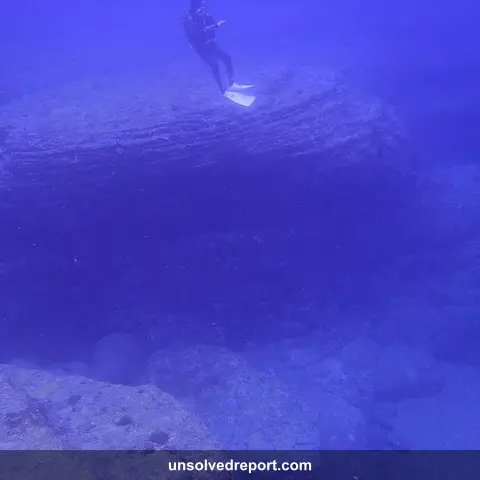
26 meters down off Japan sits a 'staircase' officials won't call a ruin. Is Yonaguni Monument a lost city, or does the rock hide a simpler answer?
Lycurgus Cup Mystery: The Roman Glass That Bleeds Red
A 1,600-year-old Roman cup turns jade green to blood red depending on where the light hits it. Scientists found the nanotech inside — but not who built it, or why.