Battle of Los Angeles: 1,400 Shells Fired at an Empty Sky
1,400 shells, five deaths, two cabinet secretaries with opposite answers, and no enemy ever found. What was the U.S. Army actually shooting at?
It's 3 a.m. on February 25, 1942. Los Angeles is pitch black — every light killed by a wartime blackout. Then the sky tears open. Searchlights stab upward, lock onto something, and thirteen hundred feet of nothing suddenly fills with fire. For more than an hour, anti-aircraft guns hammer the dark, raining hot shrapnel back down on the rooftops of a city of two million people.
By sunrise, more than 1,400 shells had been fired into the night.
No enemy plane was ever found. No bomb ever fell. So what, exactly, did an entire army open fire on? Here is what the official reports, a retouched photograph, and eight decades of follow-up investigation actually establish — and where the record still runs dry.
> ### The 60-Second Brief
> - Feb 23, 1942 — Japanese submarine I-17 shells the Ellwood Oil Field near Santa Barbara two nights before the "battle."
> - 3:16 a.m., Feb 25, 1942 — The 37th Coast Artillery Brigade opens fire on an unidentified radar contact reported ~120 miles off the coast.
> - Over 1,400 shells fired before the all-clear sounds at 7:21 a.m. — nearly four hours later.
> - 0 enemy aircraft, ships, or bomb craters were ever found; the only damage was from the city's own shrapnel.
> - 5 deaths, all indirect: 3 in blackout car crashes, 2 from stress-induced heart attacks.
> - 1983 — The U.S. Office of Air Force History officially attributes the panic to a stray weather balloon.
The Documented Facts
Let's start with what nobody disputes — the parts written down in official reports.
The mood was already raw. Just two nights earlier, on February 23, a Japanese submarine — the I-17 — surfaced near Santa Barbara and shelled the Ellwood Oil Field. The damage was tiny, but the message was huge: the war could touch the mainland (History.com). The West Coast went jittery.
Then, at about 2 a.m. on February 25, U.S. Army radar picked up "an unidentified object or objects about 120 miles off the coast of Los Angeles" (Los Angeles Almanac). Air raid sirens screamed. A total blackout slammed across the city. Searchlights swept the sky.
At 3:16 a.m., the shooting started. The 37th Coast Artillery Brigade fired over 1,400 shells before the "all clear" finally sounded at 7:21 a.m. (Wikipedia). Eyewitnesses — soldiers and civilians alike — swore they saw everything: enemy aircraft, falling bombs, even Japanese paratroopers drifting down. One person insisted a Japanese plane had crashed in Hollywood (Los Angeles Almanac).
Here's the strange part. When the sun came up: nothing. No Japanese ships off the coast. No downed enemy aircraft. No bomb craters. The only real damage came from the city's own guns — anti-aircraft shrapnel rained down, shattering windows and ripping through buildings (History.com).
And five people died. Not from any attack — three in car crashes during the blackout chaos, and two from heart attacks brought on by the stress (Wikipedia).
The official story splintered almost immediately. Secretary of the Navy Frank Knox stood up at a press conference and called the whole thing a "false alarm," blaming "war nerves." But Secretary of War Henry Stimson contradicted him, claiming as many as 15 enemy aircraft had flown over the city — a position he later quietly dropped (Los Angeles Almanac).
Two cabinet secretaries. Same event. Two completely different answers. That contradiction is the seed of everything that came after.
The Genuine Open Question
Here's the question that has never been fully closed: what were those guns actually shooting at for almost an hour?
The leading official answer came decades later. In 1983, the U.S. Office of Air Force History concluded the panic was triggered by meteorological balloons released for wind measurement — their lights and silvery color mistaken for aircraft in the dark — with the chaos worsened by stray flares and the shell bursts themselves (Wikipedia). A 1949 study had already fingered a weather balloon launched around 1 a.m. as the thing that "started all the shooting."
That explains the start. It struggles to explain the whole hour. A lost balloon drifts and pops. It doesn't hold the attention of dozens of searchlight crews and gun batteries across an entire city for sixty straight minutes while trained soldiers report a slow-moving object that doesn't fall when hit.
So the honest answer is: the trigger was probably a balloon and raw nerves. But the full picture of what those thousands of men believed they were tracking — that remains genuinely murky.
Theories and Interpretations
Once you accept the question is open, the theories rush in. Here's where we draw a hard line between documented fact and speculation.
The mass-hysteria theory (most supported). This is the mainstream read, and the evidence leans hard toward it. Frayed nerves after the Ellwood shelling, a real radar blip, one trigger-happy gun crew — and panic cascades. Once shells start bursting in the sky, those flashes become the "enemy" everyone else fires at. It's a feedback loop of fear. Plausible, well-grounded, but still a reconstruction, not a recording.
The lost-plane or recon theory (speculative). Some suggest a stray light aircraft or commercial plane wandered into the zone. There's no confirmed evidence for this, and Japan's own records, examined after the war, showed no carriers or planes near Los Angeles that night. Treat this as unverified.
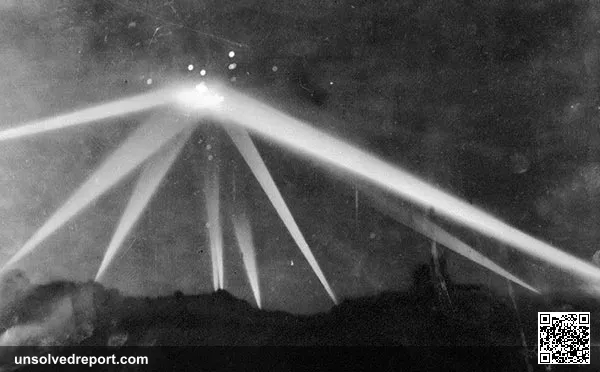
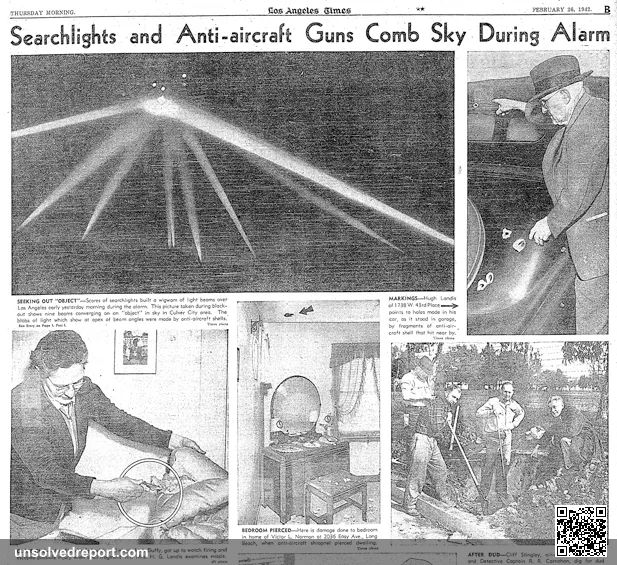
The UFO / extraterrestrial theory (unproven). This is the famous one — and it needs the clearest warning label. The whole alien angle hangs on a single photograph the Los Angeles Times ran on February 26, 1942, showing searchlight beams converging on what looks like a glowing disc. UFO enthusiasts call it proof of an alien craft.
But the Times itself has confirmed the image was heavily retouched before publication — a routine 1940s darkroom practice to boost contrast for newsprint (History.com). The original negative shows only faint, blurry lights. Just as telling: the "alien" interpretation didn't even exist until after 1947, when Roswell and Kenneth Arnold launched the modern UFO craze, and writers went hunting through old mysteries to reframe them (Military.com). In 1942, nobody said "alien." They said "Japanese." The extraterrestrial spin is a modern, unproven overlay on a wartime event.
Battle of Los Angeles: Facts at a Glance
Everything below is drawn from the official reports and sourced accounts cited in this article — no estimates added.
| Detail | What the record shows |
|---|---|
| Date of the "raid" | Night of Feb 24–25, 1942 (firing in the early hours of Feb 25) |
| Trigger context | Japanese sub I-17 shelled Ellwood Oil Field near Santa Barbara two nights earlier, Feb 23, 1942 (Wikipedia); (History.com) |
| Radar contact | ~2 a.m. — "an unidentified object or objects about 120 miles off the coast" (Los Angeles Almanac) |
| Firing began | 3:16 a.m., 37th Coast Artillery Brigade (Wikipedia) |
| "All clear" | 7:21 a.m. (Wikipedia) |
| Shells fired | Over 1,400 (Wikipedia) |
| Enemy aircraft found | None — no ships, no downed planes, no bomb craters (History.com) |
| Deaths | 5, all indirect — 3 in blackout car crashes, 2 from heart attacks (Wikipedia) |
| Navy's verdict (Knox) | "False alarm," blamed on "war nerves" (Los Angeles Almanac) |
| War Dept.'s verdict (Stimson) | As many as 15 enemy aircraft — later quietly dropped (Los Angeles Almanac) |
| Official 1983 finding | Meteorological balloons mistaken for aircraft, worsened by flares and shell bursts (Wikipedia) |
Timeline of That Night
A sourced, hour-by-hour reconstruction of the sequence — each entry tied to a citation already used above.
- Feb 23, 1942 — Japanese submarine I-17 surfaces near Santa Barbara and shells the Ellwood Oil Field; damage is minor but the coast is rattled (Wikipedia); (History.com).
- ~1 a.m., Feb 25, 1942 — A meteorological balloon is sent aloft; a 1949 study later names this as the object that "started all the shooting" (Wikipedia).
- ~2 a.m., Feb 25 — Army radar picks up an unidentified object "about 120 miles off the coast"; air raid sirens sound and a total blackout is ordered (Los Angeles Almanac).
- 3:16 a.m., Feb 25 — The 37th Coast Artillery Brigade opens fire; over the next hours it expends more than 1,400 shells (Wikipedia).
- During the barrage — Soldiers and civilians report enemy aircraft, falling bombs, and even paratroopers; one claims a Japanese plane crashed in Hollywood (Los Angeles Almanac).
- 7:21 a.m., Feb 25 — The "all clear" finally sounds. Daylight reveals no enemy — only shrapnel damage from the city's own guns (Wikipedia); (History.com).
- Feb 26, 1942 — The Los Angeles Times runs the now-famous searchlight photo, later shown to have been heavily retouched before publication — a routine contrast-boosting practice of the era (Wikipedia).
- Days after — Knox calls it a false alarm; Stimson counters with a claim of up to 15 aircraft, a position he soon abandons (Los Angeles Almanac).
- 1949 — A study fingers the 1 a.m. weather balloon as the initial trigger (Wikipedia).
- 1983 — The U.S. Office of Air Force History concludes meteorological balloons — their lights and silvery color mistaken for aircraft — set off the panic (Wikipedia).
What the 2026 Pentagon UFO File Release Actually Says
In May 2026, the Department of Defense's All-domain Anomaly Resolution Office (AARO) released a second batch of more than 200 declassified UAP-related records — incident reports, military pilot encounter logs, NASA imagery, FBI records, and State Department cables (Mappr). The Battle of Los Angeles appears in follow-on coverage of that release only as the earliest entry on a chronological list of widely cited UAP cases — it is not the subject of any new document in the release itself. AARO's own statement accompanying the files says the public records "do not contain proof of extraterrestrial origin for any case." In other words: this is a thematically related 2026 development, not new evidence about the night of February 25, 1942 specifically, and no primary document from the release addresses this case directly.
Frequently Asked Questions
Was the Battle of Los Angeles an actual attack?
No confirmed attack occurred. Despite more than 1,400 anti-aircraft shells fired over nearly four hours, no Japanese aircraft, ships, or bombs were ever found — only shrapnel damage from the city's own guns (History.com).
Did anyone die during the Battle of Los Angeles?
Yes — five people, but none from enemy action. Three died in car accidents during the mandatory blackout, and two suffered fatal heart attacks brought on by the panic (Wikipedia).
What triggered the shooting?
A radar contact reported roughly 120 miles off the coast around 2 a.m. set off air raid sirens and a blackout; a meteorological balloon released around 1 a.m. is the leading candidate for what actually appeared on radar and in searchlights (Los Angeles Almanac; Wikipedia).
Is the famous searchlight photo real?
The photo itself is real, but the Los Angeles Times has confirmed it was heavily retouched before publication — a standard 1940s darkroom technique to boost contrast for newsprint — meaning the sharp "disc" shape does not match the original negative's faint, blurry lights (History.com).
What is the official U.S. government explanation?
The U.S. Office of Air Force History concluded in 1983 that stray weather balloons, mistaken for aircraft in the dark, triggered the panic, which was then amplified by flares and the anti-aircraft bursts themselves (Wikipedia).
Does the 2026 Pentagon UFO file release explain what happened?
No. The May 2026 AARO release lists the Battle of Los Angeles only as the earliest entry in a historical timeline of UAP cases; it contains no new primary document specific to the 1942 incident, and AARO states the released files contain no proof of extraterrestrial origin for any case (Mappr).
A retouched photo. Two cabinet secretaries who couldn't agree. An hour of gunfire at empty sky. The Battle of Los Angeles teaches a quiet, uncomfortable lesson: sometimes the most convincing "evidence" is the part someone touched up in the dark — and once you know that, you start to wonder how many other famous photos were waiting in the same developing tray.
Sources & Further Reading
- Battle of Los Angeles — Wikipedia
- World War II's Bizarre 'Battle of Los Angeles' — HISTORY
- The Mysterious Battle of Los Angeles, 1942 — Los Angeles Almanac
- The WWII Mystery Behind the 1942 Battle of Los Angeles — Military.com
- Mapped: US UFO Sightings by State and the 15 Most Famous UAP Cases — After the Pentagon's May 2026 File Release — Mappr
Belgian UFO Wave: The Silent Triangle 2,000 People Reported
Thousands watched a silent triangle glide over Belgium in 1989-90. F-16 radar locked onto it 3 times. The famous photo was a hoax — so what chased those jets?
Betty and Barney Hill: 65 Years On, Still 2 Hours Nobody Can Explain
2 hours missing, a torn dress still in a UNH archive, a star map to Zeta Reticuli later disowned by its own author. What the 1961 Hill case actually proves.
Cash-Landrum Incident 1980: The UFO That Left Real Burns
A Texas grandmother, her friend, and a 7-year-old boy said a fiery UFO surrounded by 23 helicopters made them sick. Decades later, no one has explained why.