Lake Vostok: 2 Miles Under Ice, a DNA Result No One Can Explain
Sealed under 2 miles of Antarctic ice for millions of years, Lake Vostok gave up a DNA sample scientists still can't classify. What's really down there?
There is a lake the size of Lake Ontario that no human eye has ever seen. It sits in pitch darkness, under crushing pressure, beneath the coldest and most brutal place on the whole planet. And it may have been sealed off from the sky for longer than our species has even existed.
Its name is Lake Vostok. Getting to it took scientists almost thirty years of patient, freezing work. And the biggest question — does anything live down there? — is still wide open. Thirty years after the world first heard about this hidden sea, here's what we truly know, what we still don't, and exactly where the honest line falls between the two.
What We Actually Know
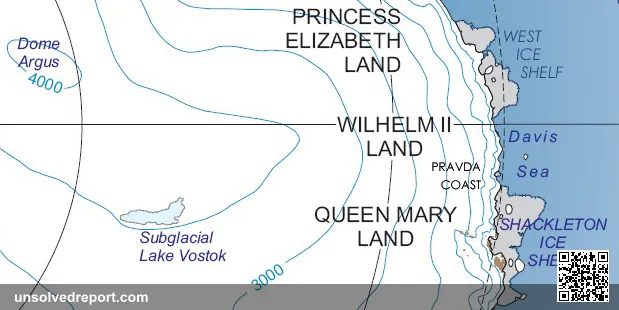
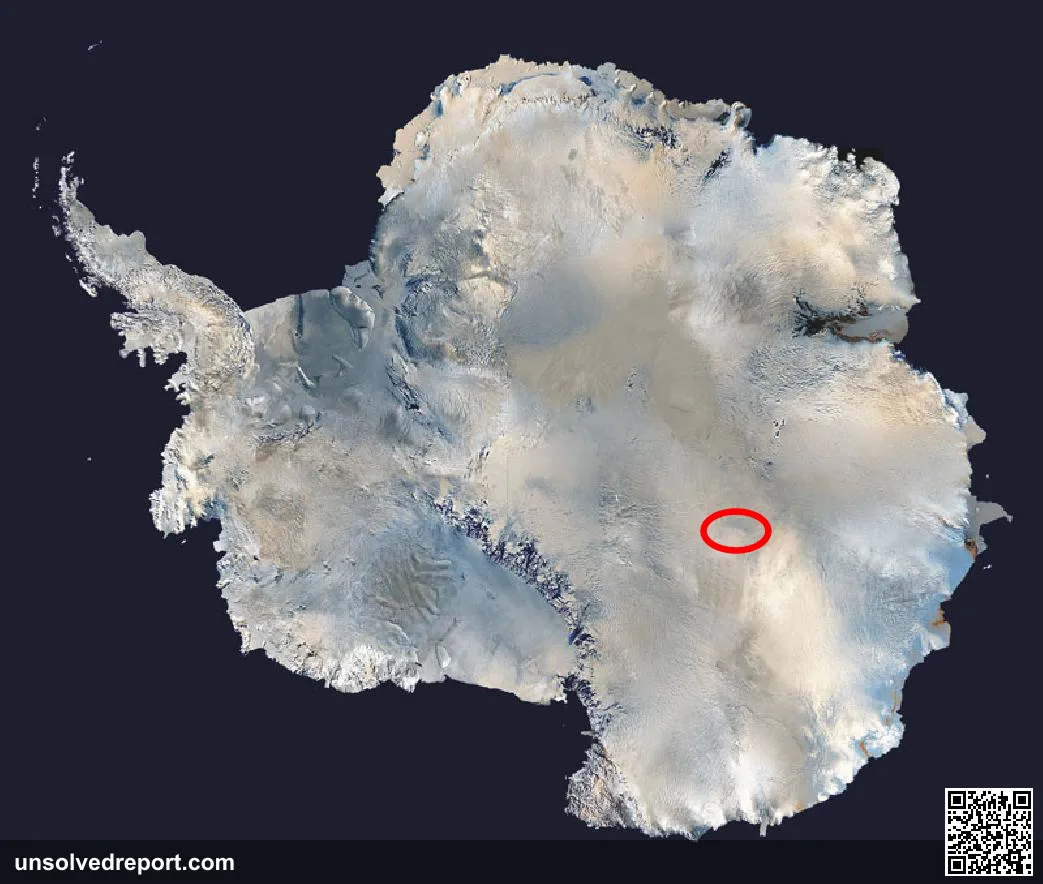
Start with where it hides. Lake Vostok lies deep under the central East Antarctic Ice Sheet, directly below Russia's Vostok Station. It's the giant of the family — Antarctica has hundreds of known lakes buried under its ice, and this is the biggest of them all. Picture a body of water roughly 250 kilometers long and 50 kilometers wide, spreading across about 12,500 square kilometers. That's a match for North America's Lake Ontario, and it ranks as the 16th-largest lake on Earth (Britannica). On average it's around 432 meters deep, plunging to roughly 800 meters in its southern basin, and it holds an estimated 5,400 cubic kilometers of water (Britannica).
Now for the part that stops you cold. Sitting on top of this lake is more than 3,700 meters of glacial ice — over two miles of it (Rogers et al., PLOS ONE / PMC). At the main drill site, the ice laid down from snow runs about 3,538 meters thick. And here's the strange twist: the lake stays liquid not despite all that ice, but partly because of it. The sheer weight bears down with pressures around 350 atmospheres, and that crushing force lowers the temperature at which water freezes. So the lake sits at roughly minus 3 degrees Celsius — colder than ordinary freezing, yet still liquid that far down (Siegert et al., Nature, 2001). All of it in permanent, total black.
There's more weirdness in the water itself. Scientists believe it's stuffed with dissolved oxygen — by some estimates around 50 times what you'd find in an ordinary surface lake. Why? Because gases locked inside the overlying ice get set free as the bottom of the glacier slowly melts down into the lake (Siegert et al., Nature, 2001).
Finding the lake was a slow detective story spread across decades and countries. Back in the 1960s, Russian geographer Andrey Kapitsa bounced seismic soundings off the ground near Vostok Station and was first to suggest water might be hiding down there. In the 1970s, British researchers ran radio-echo surveys and picked up oddly flat, mirror-like reflections — exactly what you'd expect from a smooth water surface. Years later, teams stacked that seismic data together with airborne ice-penetrating radar and satellite altimetry, and in 1996 they confirmed it: one single, enormous lake. The finding landed in Nature around June 20, 1996 (Cambridge / Journal of Glaciology).
Then came the moment of contact. On February 5, 2012, after years of drilling, a Russian team finally punched through the last of the ice and touched the lake's surface. The lake is under so much pressure that water came rushing up the borehole and froze — leaving a plug of "accretion ice" that researchers later cut into and studied (Science/AAAS).
The Question Everyone Wants Answered
So here's the real mystery, the one that keeps scientists up at night: is anything alive in Lake Vostok — and if so, what?
The clues are tantalizing, but nobody can call it proven. A peer-reviewed study of the meltwater from that accretion ice, led by Scott Rogers, Yury Shtarkman, and colleagues at Bowling Green State University, turned up 3,507 unique gene sequences — about 94% from bacteria and 6% from eukaryotes, with a couple from archaea (Rogers et al., PMC). And the sequences read like a guest list from wildly different worlds — including deep-sea hydrothermal vents. The team flagged more than 150 sequences from multicellular organisms, most of them fungi, plus dozens that matched heat-loving microbes. Separately, Russian scientist Sergey Bulat reported a bacterial type he labeled w123-10 with less than 86% genetic similarity to any species we know — different enough that he simply called it "unclassified" (Nature News, 2013).
Wait, though. Before you picture an alien zoo under the ice, here's the catch — and it's a big one: contamination. To keep the borehole from collapsing, the Russian drilling used a kerosene-based fluid. That fluid, plus human contact and lab handling, dragged surface microbes along for the ride. Critics pointed out the obvious worry: what looks like exotic deep-lake life could just be hitchhikers from the drill (Science/AAAS). And this wasn't just outside sniping — the doubt erupted inside the Russian program itself. Vladimir Korolyov of the genetics laboratory told Interfax the specimens they examined "belonged to contaminants" from the borehole kerosene, human bodies, or the lab (Nature News, 2013). And remember, accretion ice isn't the lake — it's refrozen lake water blended with whatever the borehole brought down with it.
So here's the honest scorecard. On one side: intriguing genetic signals that fit a living ecosystem. On the other: a perfectly credible explanation that some or all of those signals are just contamination. Telling the two apart will take cleaner sampling than anyone has managed so far. For now, the question stays open.
Theories, From Careful to Wild
Everything below reaches past what the evidence can currently confirm — so treat it accordingly.
A self-contained ecosystem (a scientific hypothesis). Plenty of researchers think it's believable that Vostok is home to chemolithoautotrophs — microbes that pull their energy straight from rock and minerals instead of sunlight, sitting at the bottom of a food web fed by dissolved oxygen and maybe geothermal heat (NASA Astrobiology). If it's real, that life would have spent unimaginable stretches of time adapting to high pressure, deep cold, endless dark, and total isolation. Reasonable to expect — but not yet confirmed.
An evolutionary time capsule (speculation). The lake may have been sealed for millions of years — you'll often see around 15 million cited, with some geological arguments stretching far longer — which has led a few people to wonder whether whatever lives there branched off and evolved on a path all its own, separate from surface life (Live Science). That lonely "unclassified" w123-10 result feeds the dream. But one oddball sequence is a long way from proving an isolated bloodline. This one is guesswork, not fact.
A rehearsal for other worlds (an analogy). Lake Vostok keeps getting called the best stand-in we have for the buried oceans of Jupiter's moon Europa and Saturn's Enceladus — both of which cradle liquid water under shells of ice (NASA Astrobiology). So the trick of probing Vostok cleanly, without seeding it with our own germs, is really a dress rehearsal. Learn to do it here, and one day we might sample an alien ocean without poisoning it first — the same kind of question that sits behind the Drake equation and the broader Fermi paradox: if life can start in the dark, how many other sealed worlds might already have it?
For now, Lake Vostok keeps its secret. And honestly, the bare facts are jaw-dropping enough on their own: a hidden sea, locked in darkness and pressure, waiting in the dark for who knows how long. Whether something is also living in it is a question we've reached out and touched — but haven't answered. That gap, stated plainly, is the entire pull of the thing. The next sealed world we crack open might just answer it for us.
Sources & further reading
- Britannica — Lake Vostok: https://www.britannica.com/place/Lake-Vostok
- Siegert et al., Nature (2001), Physical, chemical and biological processes in Lake Vostok: https://www.nature.com/articles/414603a
- Rogers, Shtarkman et al. (accretion ice metagenomics), PMC: https://pmc.ncbi.nlm.nih.gov/articles/PMC3700977/
- Royal Society — Microbiology of the subglacial Lake Vostok (2016): https://royalsocietypublishing.org/doi/10.1098/rsta.2014.0292
- Nature News (2013) — Russian scientist defends Lake Vostok life claims: https://www.nature.com/articles/nature.2013.12578
- Science/AAAS — Russian Team Retrieves First Sample From Lake Vostok: https://www.science.org/content/article/russian-team-retrieves-first-sample-lake-vostok
- Science/AAAS — What's Really Going on in Lake Vostok?: https://www.science.org/content/article/what-s-really-going-lake-vostok
- NASA Astrobiology — Life in the Extreme: Surviving Beneath a Glacier: https://astrobiology.nasa.gov/news/life-in-the-extreme-surviving-beneath-a-glacier-part-ii/
- Cambridge / Journal of Glaciology — Airborne radar survey above Vostok region: https://www.cambridge.org/core/journals/journal-of-glaciology/article/airborne-radar-survey-above-vostok-region-eastcentral-antarctica-ice-thickness-and-lake-vostok-geometry/85AA9954BA9836B328BDC7E73B92EAF9
- Live Science — Lake Vostok: the 15-million-year-old lake: https://www.livescience.com/planet-earth/antarctica/lake-vostok-the-15-million-year-old-lake-buried-miles-beneath-antarcticas-ice
The Lost Ninth Legion: How 5,000 Men Vanished
Five thousand Roman soldiers marched into the 2nd century and never marched out. No battle. No bodies. No record. Here's what the stones actually say.
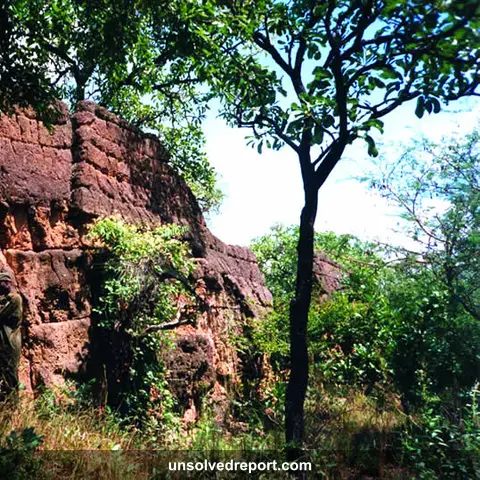
Sungbo's Eredo: The 100-Mile Wall Hidden in a Forest
Sungbo's Eredo: a 100-mile wall hidden in Nigeria's rainforest for centuries, taller than a six-story building. Who built it — and for what vanished queen?
Hessdalen Lights: The Valley Nobody Can Fully Explain
The Hessdalen lights blaze over a Norwegian valley on schedule since the 1980s. Scientists brought radar to catch it — what they found still baffles them.